County Longford Ireland · Co. Longford · Abbeylara Save · Share
POSTED FROM
ABBEYLARA
CO. LONGFORD · IE

Abbeylara
Mainistir Leathrátha, Co. Longford

The Ireland's Hidden Heartlands
STOP 07 / 07
Mainistir Leathrátha · Co. Longford

A crossroads village in north Longford built around a ruined Cistercian abbey, with a much older earthwork running through the fields and a modern tragedy that the country has not forgotten.

Abbeylara is a small crossroads village in the north-east corner of Co. Longford, three kilometres east of Granard on the R396, with the Cavan border close on one side and Westmeath on the other. It is filed under Offaly in some lists, which is simply wrong - this is Longford, in the lake-and-drumlin country the tourism people now call Ireland's Hidden Heartlands. A church, a school, a handball alley, a pub, a few rows of houses, and a great deal of farmland and water around it.

The village exists because of the abbey. Cistercian monks held the monastery here for over three hundred years, and the parish, the place name, and the dedication of the modern church all still point back to it. The ruins are the first thing you pass on the way in. Beyond that, this is angling and quiet-roads territory - Lough Kinale and Lough Derragh to the north, the River Inny, and the kind of back lanes where the traffic is tractors and the odd post van.

Two things give Abbeylara more weight than its size suggests. One is deep history: the Black Pig's Dyke earthwork crosses the parish, and a crannóg in Lough Kinale gave up one of the great pieces of early Irish metalwork. The other is recent and painful - the 2000 Garda siege in which John Carthy was shot dead, an event that led to a national tribunal and is still argued over. Come for the abbey and the loughs; know that the village carries that second story too.
Population
Small village, a few hundred people (no separate census-town figure published)
Pubs
1and counting
Founded
Cistercian abbey founded 1205 (Risteárd de Tiúit)
Coords
53.7647° N, 7.4461° W
01 / 07

At a glance.

Three things every local will eventually mention. Read these and you've already understood more than most day-trippers do.

02 / 07

The pubs.

None of these are themed Irish pubs, because they don't need to be. A few that earn the trip:

Crawford's

The local
Village bar, on the R396

The village pub, on the R396 in the heart of Abbeylara. A community local of the old kind - a quiet pint most of the week, live music and a crowd on its nights. In a village this size it is the social centre as much as a bar. Do not expect a gastropub; expect a proper country pub.

03 / 07

Stories & lore.

The reason to come back. The things every local will eventually tell you about, usually after the second pint.

Founded 1205, dissolved 1540

The Cistercian abbey

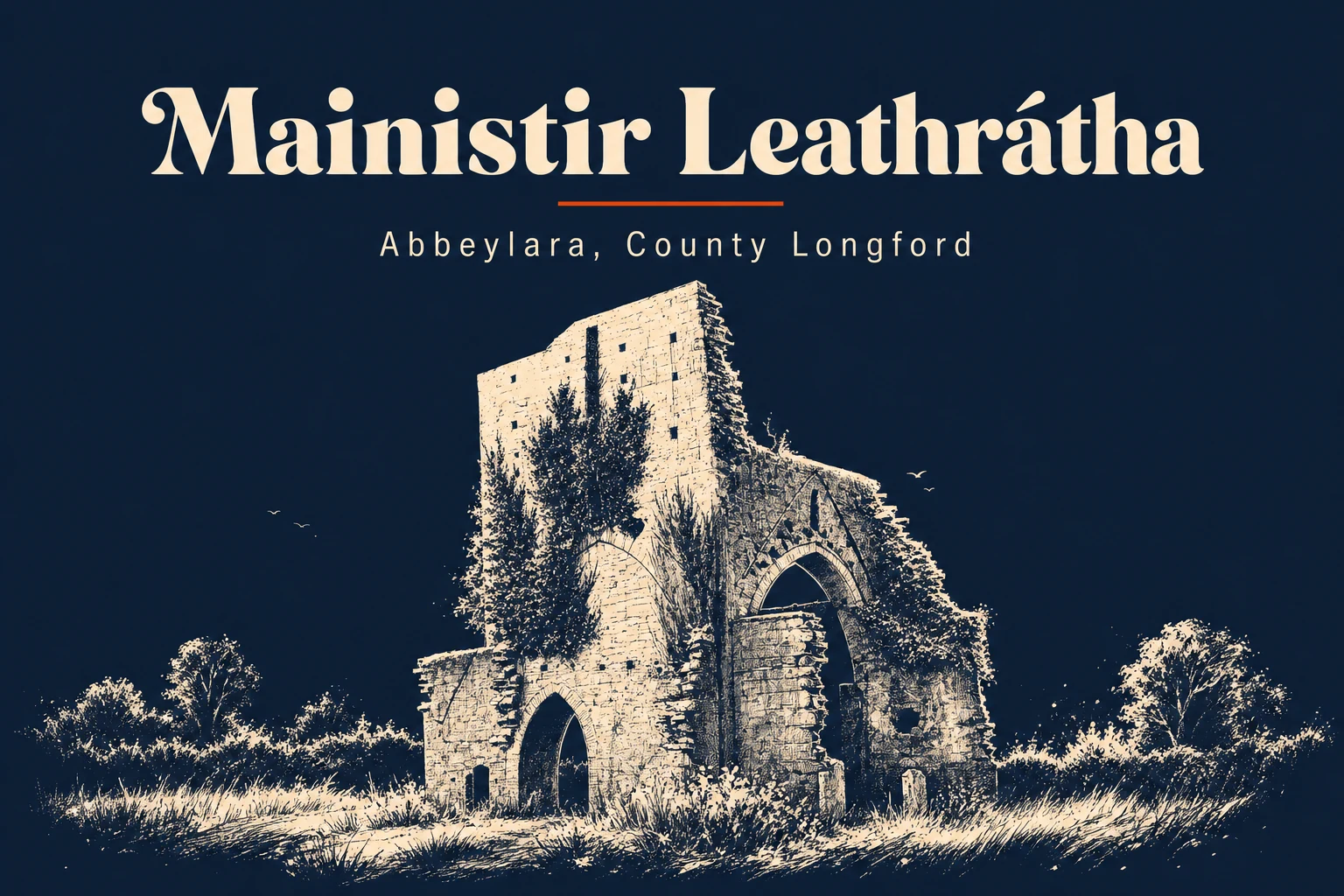
Abbeylara Abbey was founded in 1205 by the Hiberno-Norman magnate Risteárd de Tiúit (Richard Tuite), who is said to have been buried here after his death in 1210. It became a daughter house of St Mary's Abbey in Dublin, colonised by Cistercian monks in 1214, and it grew wealthy on land and parish churches. In 1315 Edward Bruce, brother of the Scottish king Robert the Bruce, seized and plundered the monastery and wintered his army in it. From 1411 to the dissolution in 1540 every abbot was an Irishman, most of them O'Farrells, the ruling family of the district. The monastery was suppressed under Henry VIII and the ruins and graveyard stand open on the approach to the village.

A prehistoric frontier and an eighth-century shrine

The Black Pig's Dyke and Lough Kinale

About a kilometre north of the village the Black Pig's Dyke (in Irish Duncla, the fortified ditch) crosses the parish - a prehistoric linear earthwork that ran in stretches across the north of Ireland, one of the longest surviving sections of it running roughly 10 km between Lough Kinale and Lough Gowna. The loughs themselves hold crannógs, the artificial island dwellings of early medieval Ireland. In 1986 a crannóg off the Toneymore shore of Lough Kinale gave up the Lough Kinale book shrine, an eighth-century piece reckoned the earliest and largest Irish book shrine known. It is now in the National Museum of Ireland in Dublin, not in the village, but the find belongs here.

John Carthy and the Barr Tribunal

The 2000 siege

On 20 April 2000, John Carthy, a local man in his late twenties, was shot dead by members of the Emergency Response Unit of An Garda Síochána at the end of a long siege at his home in Abbeylara. He had a shotgun and was in acute mental distress. The shooting led to the Barr Tribunal, a lengthy public inquiry into the Garda handling of the incident, and it remains one of the most contested fatal police actions in the history of the State. It is part of how the country knows the name of this village, and the village has lived with that for a quarter of a century.

04 / 07

Things to do outside.

Wear waterproofs. Bring a sandwich. Tell someone where you're going if it's the mountain.

The abbey ruins The Cistercian ruins and graveyard stand on the way into the village and are open to walk around. Not a manicured heritage site - a roofless church and burial ground in a field, with the older stonework still legible. Stout footwear if the ground is wet, which it usually is.
Short, on the village approachdistance
20-30 minutestime
Lough Kinale and Lough Derragh North of the village. Trout, tench, bream and pike water with active angling-club competitions, and small boats can work the lake and the River Inny. The shoreline and the quiet roads around the loughs make an easy ramble. This is the main reason most visitors come.
Lakeside roads and shore, choose your distancedistance
A morningtime
Black Pig's Dyke The prehistoric earthwork crosses the townlands about a kilometre north of the village. It is a low bank-and-ditch in farmland rather than a signed trail, so it takes some looking for and respect for the land it runs through. For those who like their history raw and unpackaged.
Field earthwork, around 1 km northdistance
Variabletime
05 / 07

When to go.

There is no bad time. There are different times.

Spring
Mar-May

The loughs and the Inny come good for the angling season, the back roads dry out, and the abbey ground is at its most walkable. Quiet and green.

◉ Go
Summer
Jun-Aug

Long evenings on the water, angling competitions, the best chance of an event in the pub. Still a quiet rural village - this is not a tourist town and never gets crowded.

◉ Go
Autumn
Sep-Oct

Good light on the abbey stones and the lakes, fewer midges, mild enough for the walks. A fair time to combine Abbeylara with Granard up the road.

◉ Go
Winter
Nov-Feb

Short days, wet ground around the ruins and the loughs, and very little open beyond the pub. Fine as a passing stop, thin as a destination.

◐ Mind yourself
06 / 07

What to skip.

Honestly? Don't bother.

If a local was sitting beside you, this is the bit where they'd lean in.

×
Expecting a heritage centre

The abbey is a roofless ruin in a field, not a visitor attraction with a car park and a tearoom. That is the appeal, but go in with the right expectations and the right boots.

×
Hunting for the Lough Kinale shrine here

The famous eighth-century book shrine came out of the lough nearby, but it lives in the National Museum of Ireland in Dublin. There is nothing of it to see in the village itself.

×
Treating Abbeylara as a full day on its own

It is a small village with one pub, an abbey ruin, and lake walks. Pair it with Granard (3 km west, far more to see) and the loughs, and it earns an afternoon. On its own it is an hour.

+

Getting there.

By car

Abbeylara is on the R396, 3 km east of Granard. From Granard it is a few minutes; Longford town is about 29 km west, Cavan about 26 km north, and Mullingar about 40 km south. From Dublin it is roughly two hours via the N4 to Edgeworthstown, then on through Granard.

By bus

Granard, 3 km west, is the transport hub for the area and sits on bus routes toward Dublin and Cavan. Abbeylara itself has only limited rural service - check Local Link Longford for the current rural timetables. In practice most visitors arrive by car.

By train

There is no railway near the village. The nearest stations are at Longford and Edgeworthstown on the Dublin-Sligo line; from either you would continue by car or local bus.