Anglo-Norman, early 13th century, besieged by Cromwell
Coolamber Hall House
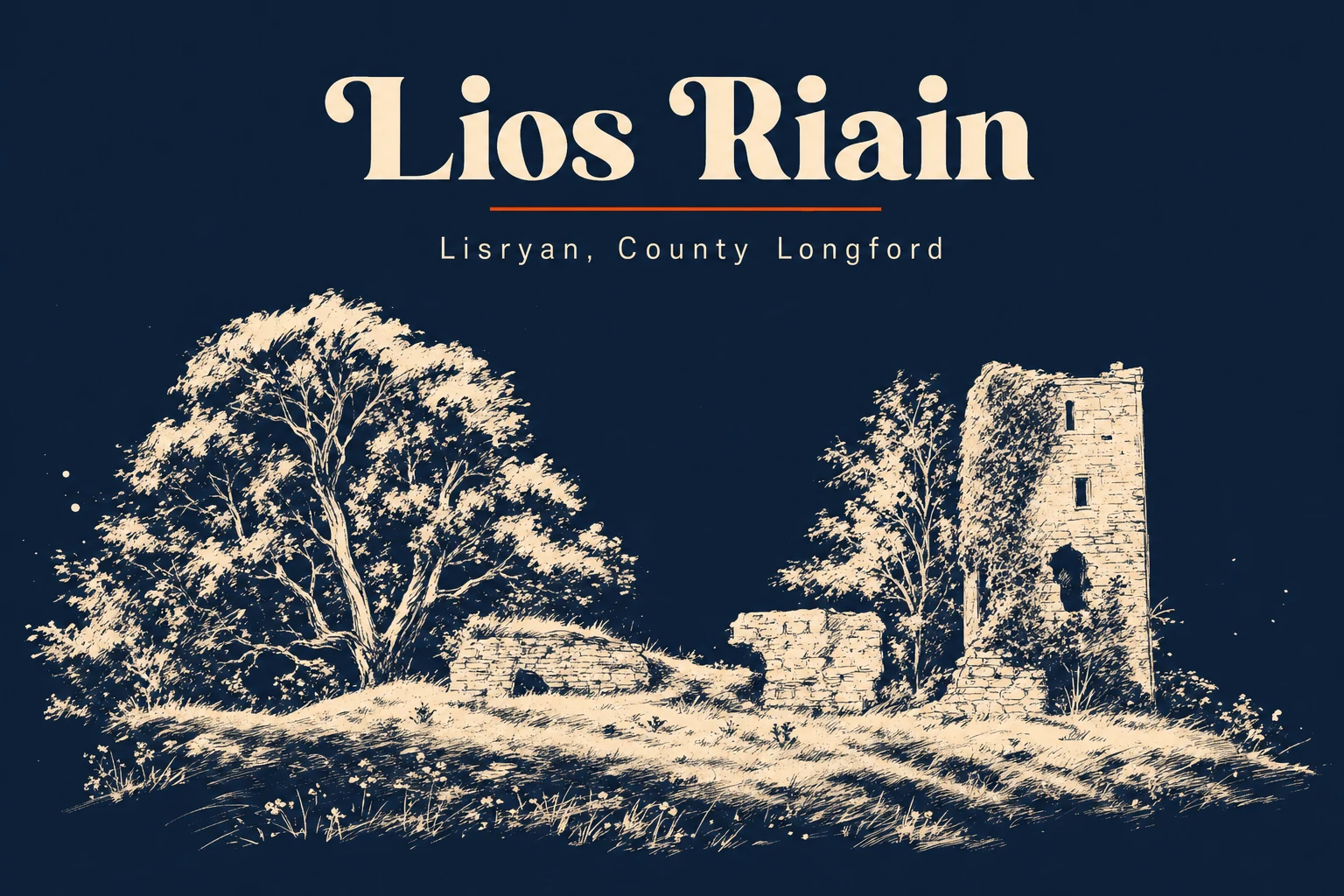
Just outside Lisryan, at Coolamber, stands the ruin of an Anglo-Norman hall house dating from the early thirteenth century - a rectangular two-storey block with a large first-floor hall and a separate four-storey service tower at the south-east corner, a late-medieval church to its north-west. The remains of a barrel vault survive at the north end of the ground floor; fireplaces and ogee-arched windows were cut into it in the sixteenth century. It sits on a semi-circular platform once enclosed by stone walls, on what was the boundary of the English Pale in the seventeenth century. It may have been the residence of Thomas Nugent, a commissioner of the Plantation of Longford under James I around 1620. It was besieged by Oliver Cromwell during his invasion of Ireland after 1649. It stands next to the road, highly visible, but on private property and not open to the public - this is a look-from-the-verge ruin, not a managed site.
John Hargrave, c. 1830, for the Blackalls
Coolamber Manor and the Governor of Queensland
A short way from the hall house is Coolamber Manor, a detached three-bay, two-storey-over-basement Georgian house built around 1830 to designs by the architect John Hargrave, who worked extensively across Longford in the 1820s. Late-Georgian classical, with giant-order pilasters between the bays and a full-height bowed projection, it is on record as the finest house of its date and type in the county, on a demesne of roughly 150 acres. It was built for the Blackall family. Samuel Wensley Blackall (1809-1871), High Sheriff of Longford and MP for the county, went into the colonial service - Lieutenant-Governor of Dominica, Governor of Sierra Leone, and finally second Governor of Queensland, where he died in office in 1871. His son Robert held Coolamber after him. In recent decades the house served as a drug rehabilitation centre; it is now closed and in disuse, sitting quiet on its own ground.