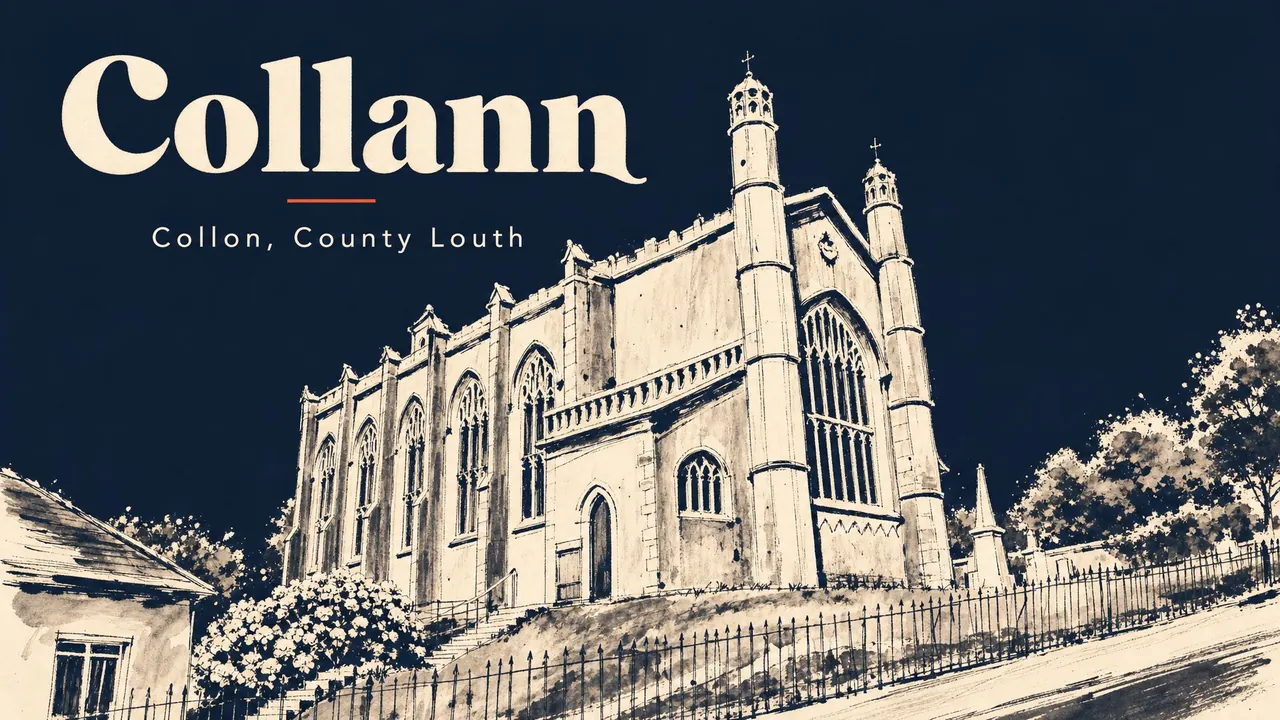
Collann · Co. Louth
A planned Georgian estate village four kilometres from the first Cistercian abbey in Ireland.
Collon is a Georgian estate village on the N2, halfway between Slane and Ardee, sitting on a low ridge above the Mattock river. Just under nine hundred people, three pubs, a Church of Ireland church designed in 1810 by Daniel Augustus Beaufort, a red-brick mill chimney from the 1860s on School Lane, and a long stone-walled boundary on the west side of the road that is the demesne of Collon House.
The whole place is a Foster project. Anthony Foster, Chief Baron of the Irish Exchequer, built the house around 1740. His son John - born here, MP for Dunleer, then Louth, then Speaker of the Irish House of Commons from 1785 until the Act of Union swept the Parliament off the map in 1800 - extended the house, laid out the streets, brought in linen weaving, and planted the oak woods that the family was famous for. He was a forester before there was a word for it. After the Union he retreated up the road to Oriel Temple, his folly by a small lake, and lived out his years there until he died in 1828.
The reason most people come is what is four kilometres south of the village. Old Mellifont - the first Cistercian abbey on the island, founded by St Malachy of Armagh in 1142 - is the OPW site that gives Collon its standing on any Boyne Valley itinerary. New Mellifont, the working abbey on Speaker Foster's old grounds at the edge of the village, has been a Cistercian house again since 1938. Two abbeys, eight hundred years apart, four kilometres of road between them.
Don't come for a checklist. Come for an hour at the ruined cloister at Old Mellifont, an afternoon walking the demesne, dinner and a bed at Collon House if you have booked weeks ahead, and a slow pint at Stanley's afterwards in a bar that has been pouring them since 1896.