County Louth Ireland · Co. Louth · Omeath Save · Share
Omeath, Co. Louth

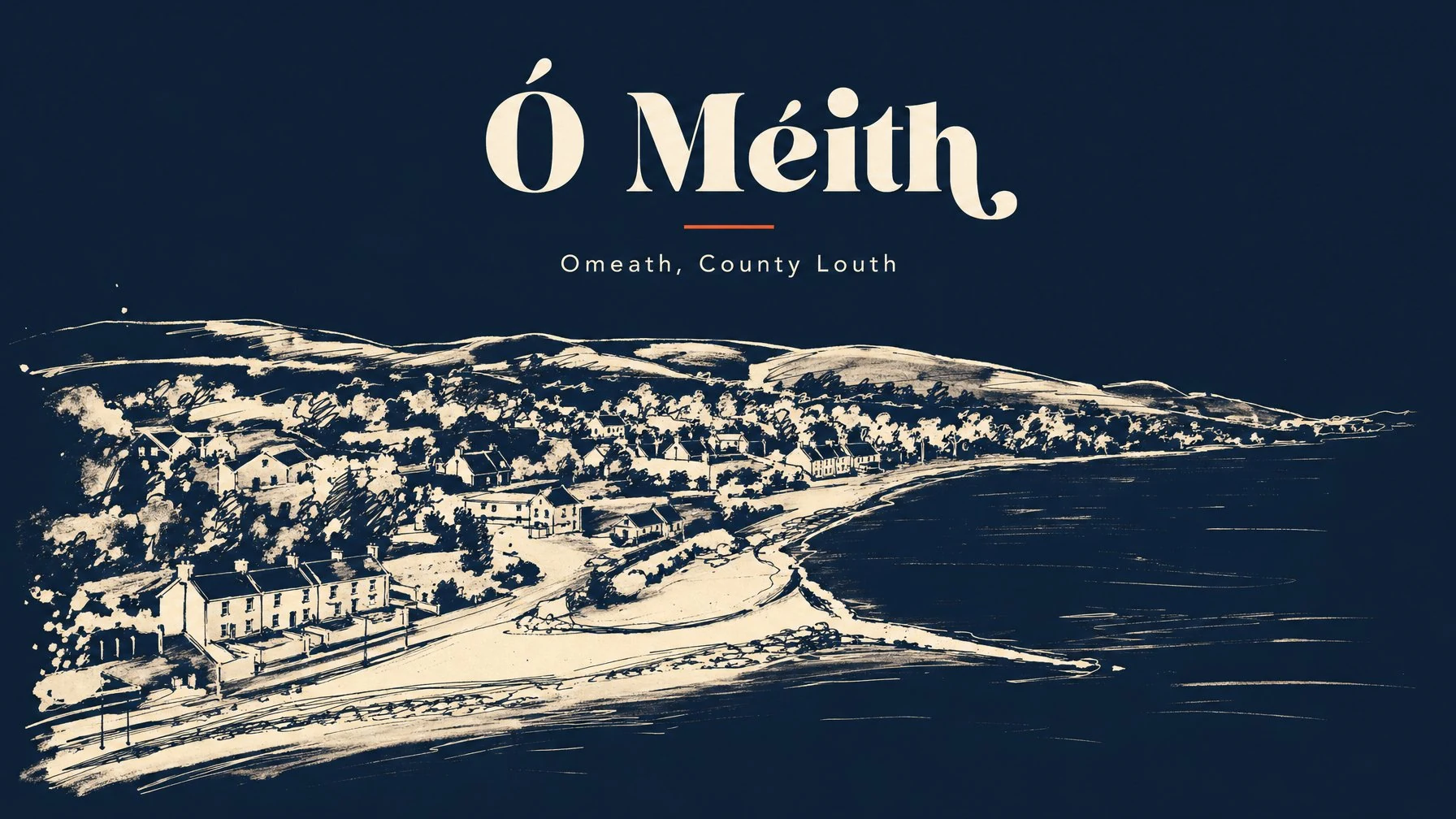
Omeath, Ó Méith, Co. Louth

Ó Méith · Co. Louth

The last village before the border, on the south shore of the lough, looking across at Warrenpoint.

Omeath sits on the south shore of Carlingford Lough at the end of the Cooley Peninsula, the last Irish village before the border with Co. Down. Six hundred people, one hotel, one pub, a pier, and a Calvary on the hillside above the road. The Mournes fill the view across the water. Warrenpoint is half a kilometre away across the lough - and, for now, the long way round by Newry to reach it.

It was a railway village. The Dundalk, Newry & Greenore line opened a station here in 1876 and Northern day-trippers came down for fresh air, fishing and the kind of drink they could not get on a Sunday at home. The line closed in 1951; the trackbed is now the Carlingford Lough Greenway. The older history is stranger - a Gaeltacht into the 1950s, the eastern outpost of Irish-speaking Ireland, with a dialect linguists travelled north from Dublin to record, and an Irish college in the Park Hotel where Padraig Pearse once stayed.

Don't come for a checklist. Come for a slow cycle on the Greenway from Carlingford with the Mournes on the right shoulder, a pint in Howe's - the village's one pub, going since the 1860s - a wander up to the Calvary that Italian missionaries built with French statues in 1908, and dinner in the Seaview at the reopened Grand Central Hotel where the lough does most of the work. An afternoon, a long lunch, and back to Carlingford for the night. Or a night here, which is the quieter call.

Change is coming. The Narrow Water Bridge is finally being built, joining Omeath to Warrenpoint by road around 2027. The old foot ferry has already stopped, and the grand Park Hotel that housed the Irish college has stood derelict since 2006. The village is smaller than it was and about to be better connected than it has ever been. Come and see it in the in-between.
Population
~603 (2016)
Pubs
1and counting
Walk score
Pier to the Calvary in twenty minutes
Founded
Settlement around the railway station opened 1876; pilgrim site since 1908
Coords
54.0903° N, 6.2640° W
01 / 09

At a glance.

Three things every local will eventually mention. Read these and you've already understood more than most day-trippers do.

02 / 09

The pubs.

None of these are themed Irish pubs, because they don't need to be. A few that earn the trip:

Howe's Bar (the Bay View Tavern)

Old, genuine, the heart of it
The village's only pub, on the shore road

Trading since the 1860s, built by William Howe as a shop and bar and kept by the family ever since. It is now the only pub left in Omeath - the other licence is in the hotel. The lough at the back, the Mournes across the water, a fire in the season and a local crowd that has been coming for generations. This is the pint in Omeath.

The Grand Central Hotel bar

Bright, panoramic, reopened
Hotel bar at the shore, weekend music

The bar of the village's one hotel - the old Granvue, reopened in 2024 under its original 1925 name. Big windows over the lough toward the Mournes, live music at the weekend, a new coffee shop alongside. A pint here before dinner in the Seaview is the proper Omeath evening.

PJ O'Hare's, Carlingford

Famous, deserved
Five minutes up the lough in Carlingford

Mentioned because Omeath people will tell you to drive five kilometres for a serious session. PJ O'Hare's on Tholsel Street is the answer; the leprechaun-in-the-wall story started there. The Greenway gets you there on a bike in twenty minutes.

03 / 09

Where to eat.

PlaceTypeLocal note
The Grand Central Hotel - Seaview Restaurant Hotel restaurant on the promenade €€€ The proper dinner in Omeath, in the reopened hotel on the shore. Seafood the strength - Carlingford Lough mussels and oysters, the catch of the day - and a window table at sunset with the Mournes opposite earns its money. Book ahead at the weekend.
Mena's chipper & Sister Chips Chipper by the pier and a 50s-style diner on the street Omeath has kept its chippers - Mena's down by the pier and Sister Chips dressed up as a 50s diner on the main street. Fresh fish, chicken, burgers, the long batter menu. Useful if you have come off the Greenway hungry and dinner is two hours away.
Carlingford for fine dining A note - If you want a proper night out, Ghan House in Carlingford is fifteen minutes by road or thirty by Greenway. Honest call: dinner there one night, lunch in Omeath the next.
04 / 09

Where to sleep.

PlaceTypeLocal note
The Grand Central Hotel The village's hotel, 10 rooms, on the shore The one hotel, and a story in itself. It opened in 1925 as the Grand Central in a wooden building by the railway station, was rebuilt in stone in 1939, ran over forty years as the Granvue under the Brennan family, and reopened in 2024 under new owners who took it back to its original name for its centenary. Ten rooms, lough and mountain views, the Seaview restaurant and a coffee shop downstairs. If you can get a sea-side room, take it.
Self-catering, or Carlingford A note Beyond the hotel, Omeath has holiday lets and lodges (the Greenway Lodge among them) and the Cooley Peninsula is thick with B&Bs. For more rooms and options, Carlingford is five kilometres up the Greenway - Ghan House, the Four Seasons, McKevitt's - close enough that the two villages make one stay.
05 / 09

Stories & lore.

The reason to come back. The things every local will eventually tell you about, usually after the second pint.

Rosminian Fathers, French statues, 1908

The Calvary

On 17 March 1908 the Rosminian Fathers blessed a hillside Calvary on the road out of Omeath toward Carlingford. The statues - Christ crucified, Our Lady of Sorrows, St John, and a few months later St Mary Magdalene - had been carried from France after the anti-clerical government of 1903 expelled the religious orders. The fourteen Stations of the Cross were blessed in April 1909. The Rosminians had founded St Michael's College in the village in 1901; they buried Father Aloysius Gentili's mission on the hill. The site has been a pilgrimage ever since, with a later oratory and Lourdes Grotto added. It is small, weathered, and surprisingly moving on a wet Wednesday.

The last eastern Gaeltacht

Omeath Irish

Native Irish was spoken in Omeath into the mid-twentieth century - the last Gaeltacht in the eastern half of the island. The dialect was its own thing, distinct from Donegal or Connacht, and it was holding on in pockets when the German linguist Wilhelm Doegen turned up in 1928 with recording equipment for the Royal Irish Academy. Anne O'Hanlon was reckoned to be the last native speaker; she died in 1960. Summer colleges in the village taught the language to children from across Ireland. The cadence is gone; the place-names are still here.

An Irish college, a future Rising, a long dereliction

The Park Hotel and Coláiste Bhríde

The grandest building in Omeath is now its saddest. The Park Hotel, on the Carlingford side of the village, housed Coláiste Bhríde, the Irish college founded by Eoin MacNeill in 1912 to teach the language in the last eastern Gaeltacht. Padraig Pearse stayed here; it is believed he worked on his graveside oration for O'Donovan Rossa while in Omeath. Two future Presidents of Ireland, Douglas Hyde and Sean T. O'Kelly, studied at the college before it moved to Rannafast in Donegal in 1926. The hotel itself closed in 2006 and has stood derelict ever since, planning permissions for a replacement coming and going with the economy. It still has the best view of the lough of any building in the village. It is also a ruin. Look at it from the road; don't go in.

Dundalk, Newry & Greenore Railway

The Greenway and the line

The narrow-gauge railway from Dundalk to Greenore opened in 1873 and a branch up the lough to Newry was added in 1876, with a station in Omeath. For seventy-five years it brought Belfast day-trippers down to a Free State village where the licensing laws were laxer and the air was good. The line closed in 1951. Louth and Newry, Mourne & Down District Council later put a Greenway on the trackbed; the Carlingford-to-Omeath section opened in 2014 and now runs into the village. The bicycles you see on the main street came down the old line.

A crossing lost, a crossing promised

The ferry, and the bridge

For two centuries a foot ferry crossed the half-kilometre of lough between Omeath and Warrenpoint, on and off, seasonal and weather-dependent. It no longer runs - turn up at the pier today and there is no boat. What is coming instead is bigger: the Narrow Water Bridge between Omeath and Warrenpoint finally went into the ground in 2024 and is due to open around 2027. When it does, Omeath will be a few minutes' drive from a Northern town for the first time since the railway closed in 1951. People in Howe's are divided on whether that is good. Until then, the only way across is the long road round by Newry.

06 / 09

Things to do outside.

Wear waterproofs. Bring a sandwich. Tell someone where you're going if it's the mountain.

Carlingford Lough Greenway (Omeath to Carlingford) The Greenway from the village pier to Carlingford, on the old railway formation. Flat, off-road, the Mournes filling the view across the water. Family-friendly. Most people start in Carlingford; starting in Omeath is the right call if you want the pint at the far end.
7 km one waydistance
1 hour by bike / 2 hours walkingtime
The Calvary walk From the village centre up the road toward Carlingford to the Calvary, then up through the Stations of the Cross on the hillside, the Lourdes Grotto and the Shrine of St Jude, and back down. Quiet, even at the height of summer. Worth the half-hour even if you have no skin in the religious side of it.
1.5 km loopdistance
30 minutestime
The pier and the promenade Down to the pier where the foot ferry used to leave, along the shore with the Mournes filling the far side and Warrenpoint's lights across the water. You can see the Narrow Water Bridge works taking shape up the lough. Quiet, especially at dusk. No boat to catch any more - just the view.
1 km there and backdistance
20-30 minutestime
07 / 09

When to go.

There is no bad time. There are different times.

Spring
Mar-May

Greenway empty, Mournes still snow-capped in March, the village quietening between winter and the season. Calvary peaceful. Probably the best time to come.

◉ Go
Summer
Jun-Aug

The Greenway is busy and the village has its few rooms booked out. Book the Grand Central weeks ahead for August. Long evenings on the lough are worth the squeeze.

◐ Mind yourself
Autumn
Sep-Oct

October light on the Mournes is the photograph. Greenway in low traffic, bar fires on, the season tapers gently. Locals' favourite.

◉ Go
Winter
Nov-Feb

The wind off the lough is a different proposition and half the daytime stuff shuts, but Howe's and the hotel bar stay open. For a quiet weekend with a Calvary walk and a pint, this is when.

◐ Mind yourself
08 / 09

What to skip.

Honestly? Don't bother.

If a local was sitting beside you, this is the bit where they'd lean in.

×
Expecting the foot ferry to Warrenpoint

It no longer runs. People still arrive at the pier expecting to cross to the North and find no boat and no schedule. The Narrow Water Bridge that will replace it is still under construction (due around 2027). For now the only way across is the long road round by Newry.

×
Looking for the Park Hotel as a hotel

It closed in 2006 and has been derelict ever since. It is a striking ruin with a serious history, but it is not somewhere to stay or drink. The village hotel is the Grand Central, down on the shore.

×
The "Gaeltacht summer school" experience

The language community is gone and the Irish colleges moved away decades ago. Don't expect to come and hear Omeath Irish in the bar. The people who spoke it are buried in the local churchyards.

+

Getting there.

By car

Dundalk to Omeath is 25 minutes on the R173 around the Cooley Peninsula. Carlingford to Omeath is 10 minutes on the same road. Belfast is 1 hour via the A1 to Newry, then the back road to the border.

By bus

Bus Éireann route 161 from Dundalk runs several times daily to Omeath via Carlingford - about 50 minutes from Dundalk. Local Link covers the gaps. No direct bus from Belfast; change at Newry.

By train

No train. The Dundalk, Newry & Greenore line closed in 1951 and is now the Greenway. Nearest station is Dundalk on the Belfast-Dublin Enterprise line.

By air

Dublin Airport (DUB) is 1h 20m by car. Belfast International (BFS) is 1h. Belfast is closer if you don't mind the border crossing.