County Mayo Ireland · Co. Mayo · Claremorris Save · Share
POSTED FROM
CLAREMORRIS
CO. MAYO · IE

Claremorris
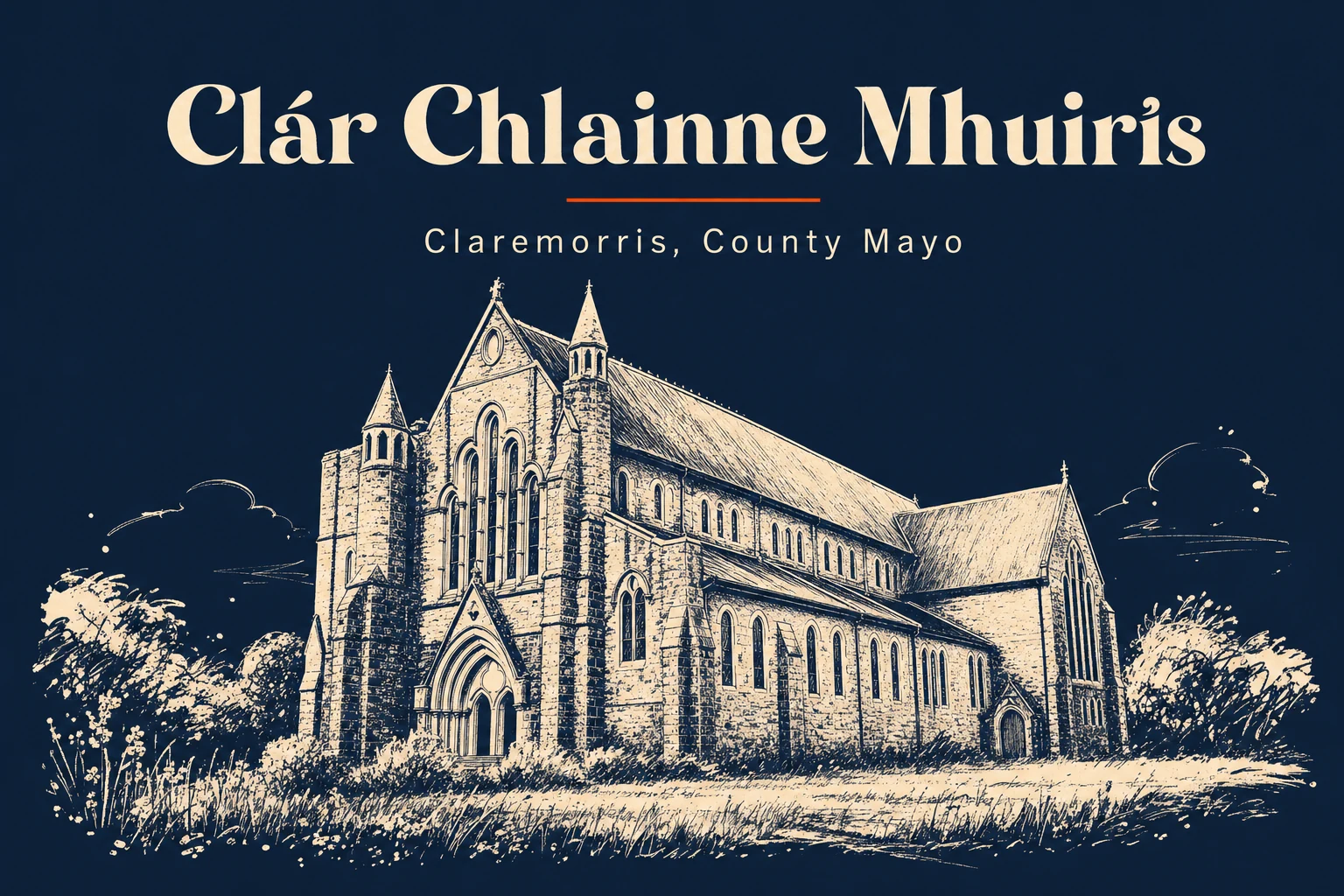
Clár Chlainne Mhuiris

The Ireland's West
STOP 08 / 08
Clár Chlainne Mhuiris · Co. Mayo

The junction town of south Mayo — trains, marts, and a square that still functions.

Claremorris is a market town in south-central Mayo at the crossing of the N17 and the N60 — a junction town in the most literal sense. The railway got here in 1862 and for a few decades this was the commercial hub of the whole region: five lines radiating out, goods moving through, farmers and merchants arriving for the Saturday mart. The mart is still going. The Saturday energy is still there, if quieter than the railway posters used to promise.

The town takes its name from Maurice de Prendergast, a Norman knight who arrived with Strongbow in 1170 and was granted the surrounding lands. Clár Chlainne Mhuiris — plain of the family of Muiris. The plain is still here: flat farming country ringed by low drumlins, the kind of south Mayo landscape that doesn't announce itself but rewards a second look on a clear morning when the light comes level across the fields.

In 1879 a gathering in Claremorris helped set in motion the Irish National Land League. Michael Davitt attended. Plans were made for the meeting at Irishtown that is usually called the beginning of the Land War. Three years of rent strikes and organised resistance followed, the boycott was invented, and the landlord system in Ireland was broken. This happened in stages, but Claremorris was part of where it started.

It is a service town, honestly — the kind of place people drive through on the way to Westport or Galway. The square, the mart, Gilligan's on the corner: these are the working parts. If you are passing through anyway, stop for the pint and the history. If you are making a detour, know what you are coming for.
Population
3,857 (2022)
Walk score
Town centre end to end in fifteen minutes
Founded
Late 17th century; railway 1862
Coords
53.7228° N, 8.9823° W
01 / 08

At a glance.

Three things every local will eventually mention. Read these and you've already understood more than most day-trippers do.

02 / 08

The pubs.

None of these are themed Irish pubs, because they don't need to be. A few that earn the trip:

Gilligan's Bar

Family-run, local, no fuss
Traditional pub, The Square, est. 1847

On the square since 1847 and still run by the family. Small, low-key, known for a good pint of Guinness. Quiz nights on Tuesday in winter. Live music at intervals — check their Facebook page before you go. The outdoor area at the back is covered and serves its purpose.

Flanagan's Gastro Pub

Food-driven, award-winning
Pub & restaurant, Brickens (5km from town)

Five kilometres outside town at Brickens. Family business over a century old, fully rebuilt as a food destination from 2010. The 45-day aged steaks are the reason most people drive out. Local sourcing throughout, brown bread made in house. Won Country Pub of the Year 2012 and several times since. Open Thursday to Monday, food from 12:30pm.

03 / 08

Where to eat.

PlaceTypeLocal note
Flanagan's Gastro Pub Pub restaurant, Brickens €€ The clear food destination for the area. Drive the five kilometres out — it is worth it. Aged steaks, proper sourcing, no tourist shortcuts. Thursday to Monday.
The Restaurant @ McWilliam Park Hotel restaurant €€ The main sit-down option in the town itself. Evening menu, locally sourced, reliable. The bar serves food noon to 8:30pm daily which covers most situations.
04 / 08

Where to sleep.

PlaceTypeLocal note
McWilliam Park Hotel 4-star hotel 103 rooms, leisure club with pool and gym, bar with live music on Saturdays. The biggest hotel in south Mayo and it functions like a regional hub — conferences, weddings, passing trade. Rates are reasonable by four-star standards. Book ahead for summer weekends.
Dalton Inn Hotel 3-star hotel Smaller and quieter than the McWilliam. Restaurant and bar on site, Claremorris Golf Club within three miles. Does the job without ceremony.
The Western Hotel 3-star hotel Town-centre hotel with free parking. The most central option if you are arriving by train and don't want to carry a bag far.
05 / 08

Stories & lore.

The reason to come back. The things every local will eventually tell you about, usually after the second pint.

Five lines into Claremorris, 1862–1895

The junction that made the town

When the railway reached Claremorris in May 1862, the town was already a functioning market centre. The junction made it something larger. By 1895 five lines converged here: the main route east to Athlone and Dublin, the extension west to Castlebar and Westport, the branch north to Ballina (1873), the line south to Ballinrobe (1893), and the cross-country route to Collooney in Sligo (1895). Goods from the west of Mayo — turf, cattle, wool — moved east through Claremorris. Merchants came west. The Saturday mart was the commercial engine and the railway was the fuel. The Ballinrobe line closed in 1959, the Collooney route in 1975. The Ballina branch and the Dublin–Westport main line survive.

Land League origins, 1879

The meeting before Irishtown

The meeting at Irishtown on 20 April 1879 is usually marked as the start of the Land League — fifteen to twenty thousand people assembled on a plain a few miles from Claremorris to hear demands for rent reduction and an end to evictions. That meeting was planned at a large gathering in Claremorris itself, attended by Michael Davitt. Through an irony that the railway makes pointed, Davitt missed the Irishtown meeting because he missed his train. He had helped set it in motion from Claremorris. The National Land League was formally founded in Dublin later that year with Davitt as one of its secretaries. Within three years the landlord system in Ireland was cracking.

The Norman in the place name

Clár Chlainne Mhuiris

The plain of the family of Muiris — that is what the Irish name means. The Muiris in question is Maurice de Prendergast, a Norman knight who crossed to Ireland with Strongbow in 1170 and received lands in south Mayo as part of the Norman settlement. He is long dead and the Prendergast family lands have passed through many hands, but the name stuck to the plain, and the plain stuck to the town. Claremorris in its English spelling is a loose phonetic rendering. The Irish is more accurate: a flat landscape associated with a twelfth-century Norman who most people in the town have never thought about.

Since 1904, with breaks for two wars and a pandemic

The Show at the Racecourse

The Claremorris Agricultural Show was first held in 1904 in Hollymount, found its home in Claremorris parish shortly afterwards, and has been running on August Bank Holiday Sunday ever since — with seventeen cancellations along the way: the First World War, the Second, foot-and-mouth outbreaks, and the two COVID years of 2020 and 2021. The 104th show ran in August 2024 at the Racecourse grounds. Two hundred and seventy-five show classes: cattle, sheep, horses, vintage machinery, farm and garden, cookery, dog show. The poultry classes came back in 2024 after a long absence. It is a farming day. The people who show cattle have been showing cattle here for generations.

06 / 08

When to go.

There is no bad time. There are different times.

Spring
Mar–May

The town functions without tourist pressure. Market days, the mart, a quiet pint in Gilligan's on a Thursday evening. South Mayo in April light.

◉ Go
Summer
Jun–Aug

August Bank Holiday Sunday is the Agricultural Show. Worth timing a trip around if you have any interest in how a farming county actually works. Book accommodation ahead for show weekend.

◉ Go
Autumn
Sep–Oct

Flat drumlin country looks its best in October. Quiet, functional, the mart running. No particular tourist season here — it is just the town being itself.

◉ Go
Winter
Nov–Feb

Short days and not much reason to linger unless you have specific business in south Mayo. The train is warm. Flanagan's is open Thursday to Monday.

◐ Mind yourself
07 / 08

What to skip.

Honestly? Don't bother.

If a local was sitting beside you, this is the bit where they'd lean in.

×
Expecting a destination food scene in the town centre

The good food is at Flanagan's in Brickens, five kilometres out. The town centre has the hotel restaurants and takeaways. Neither is embarrassing, neither is the reason you came.

×
Driving through without stopping at the station

Claremorris station is worth sixty seconds of your time — a Victorian junction station on a line that once had five radiating routes. The building is still there. The silence where the other lines used to go is its own kind of history.

×
Treating it as a base for Knock

Knock is seventeen kilometres north. Claremorris is the train stop for Knock pilgrims who come by rail. If the shrine is your purpose, stay in Knock. If south Mayo is your purpose, stay in Claremorris.

×
The town on a Sunday afternoon in winter

It is a market town. Market towns close on Sunday afternoons in winter. The square is quiet, the mart is empty, most of the food options are shut. Plan accordingly.

+

Getting there.

By car

At the junction of the N17 (Galway–Sligo) and the N60. Galway city is 60km south, about 50 minutes. Knock is 17km north, 20 minutes. Castlebar is 27km northwest, 25 minutes. Ballyhaunis is 22km east on the N60.

By bus

Bus Éireann services connect Claremorris to Galway, Castlebar, and Dublin. The 64 (Galway–Derry) runs along the N17. Check current timetables — frequency is modest outside peak periods.

By train

Claremorris station is on the Dublin Heuston–Westport and Dublin Heuston–Ballina lines. Three to four trains daily in each direction. Dublin Heuston is approximately 2h 30m. Westport is 50 minutes. Ballyhaunis, the next stop east, is ten minutes. The station is a five-minute walk from the square.

By air

Ireland West Airport Knock (NOC) is 17km north — 20 minutes by car. Galway and Shannon are both within 70 minutes. Dublin is 3 hours by road.