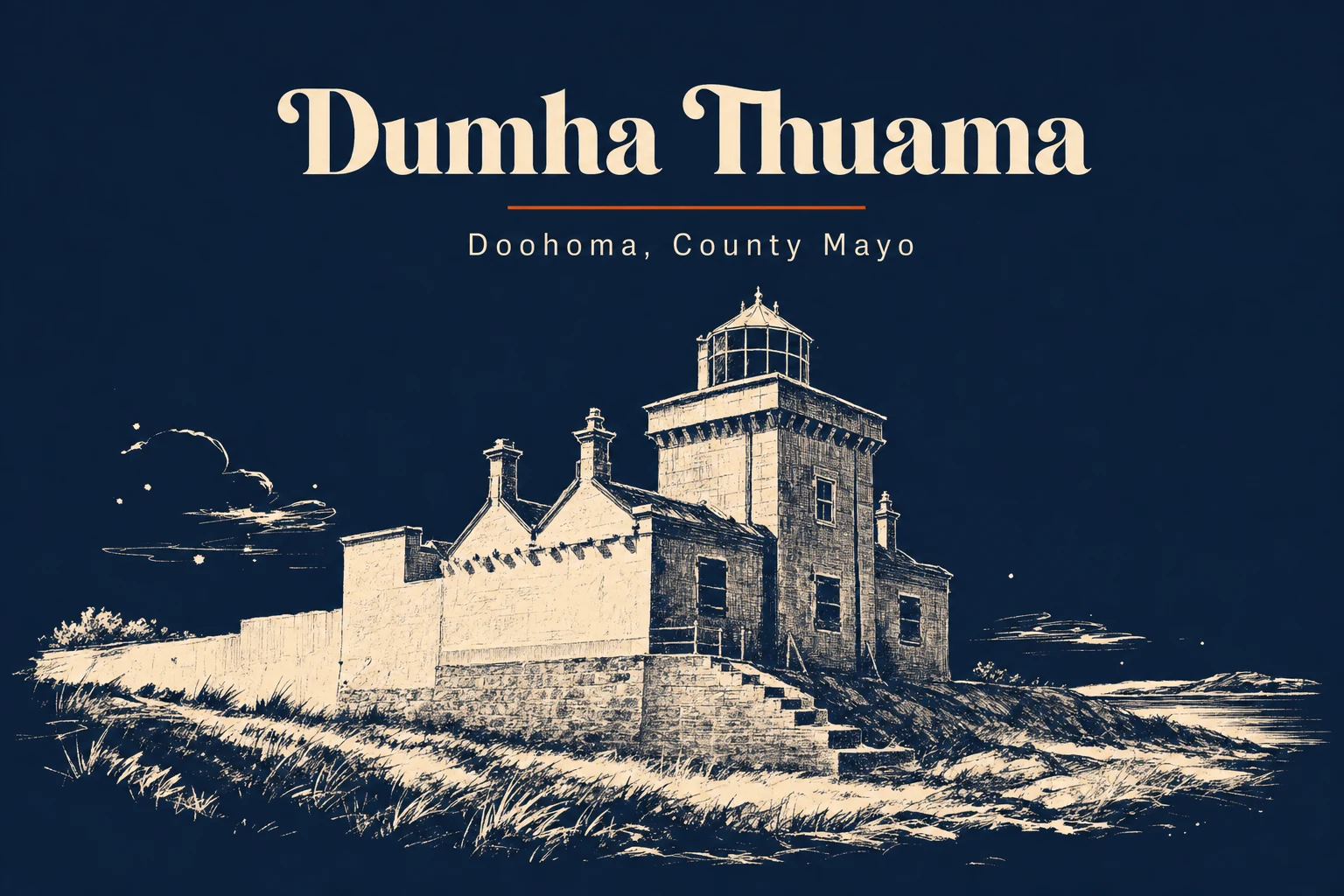
Blacksod, June 1944
The bay and the weather
On 3–4 June 1944, Maureen Sweeney — a twenty-one-year-old meteorological assistant at Blacksod Lighthouse, at the far south of the Mullet Peninsula across the bay from Doohoma — recorded a deep Atlantic depression that nobody else in the Allied network was positioned to see. The reading was relayed to Valentia, then to Eisenhower's headquarters at Southwick House. General Stagg used it to forecast the storm bearing down on the English Channel. Operation Overlord was pushed back twenty-four hours — from June 5th to June 6th. The seas on the 5th, historians later concluded, would likely have wrecked the landings. Maureen Sweeney lived to 99. The lighthouse where she worked still stands. The bay they share looks much as it did. The full story belongs to Belmullet; this end of the water is where you look across and understand why the lighthouse mattered.
The working shore
The lobster men
Lobster and crab fishing out of Doohoma follows a pattern as old as the settlement itself. The bay's relatively sheltered water — sheltered by the Mullet Peninsula to the west, by the mainland on the south and east — allowed small boats to work the pots more days of the year than the open coast would. By the nineteenth century, when Doohoma and Geesala were noted as trading ports for building materials heading inland to Westport and Castlebar, the fishing had already been the economic spine of the place for generations. The trade in timber and stone came and went with the roads. The lobster pots are still there.
Distance as a way of life
The Erris edge
The Barony of Erris has always been one of the most remote inhabited territories in Ireland — cut off by bog to the south and east, by the Atlantic to the west, and by the difficulty of the roads. Pre-Famine population figures were high for somewhere so isolated; post-Famine emigration was correspondingly severe. Doohoma, sitting at the edge of the edge, absorbed both pressures. The Gaeltacht — the Irish-speaking heartland — runs up through Geesala and the Mullet; Doohoma sits on its fringe, Gaeltacht in culture if not always in official designation. What stayed was a community that knows how to be small without making anything of it.