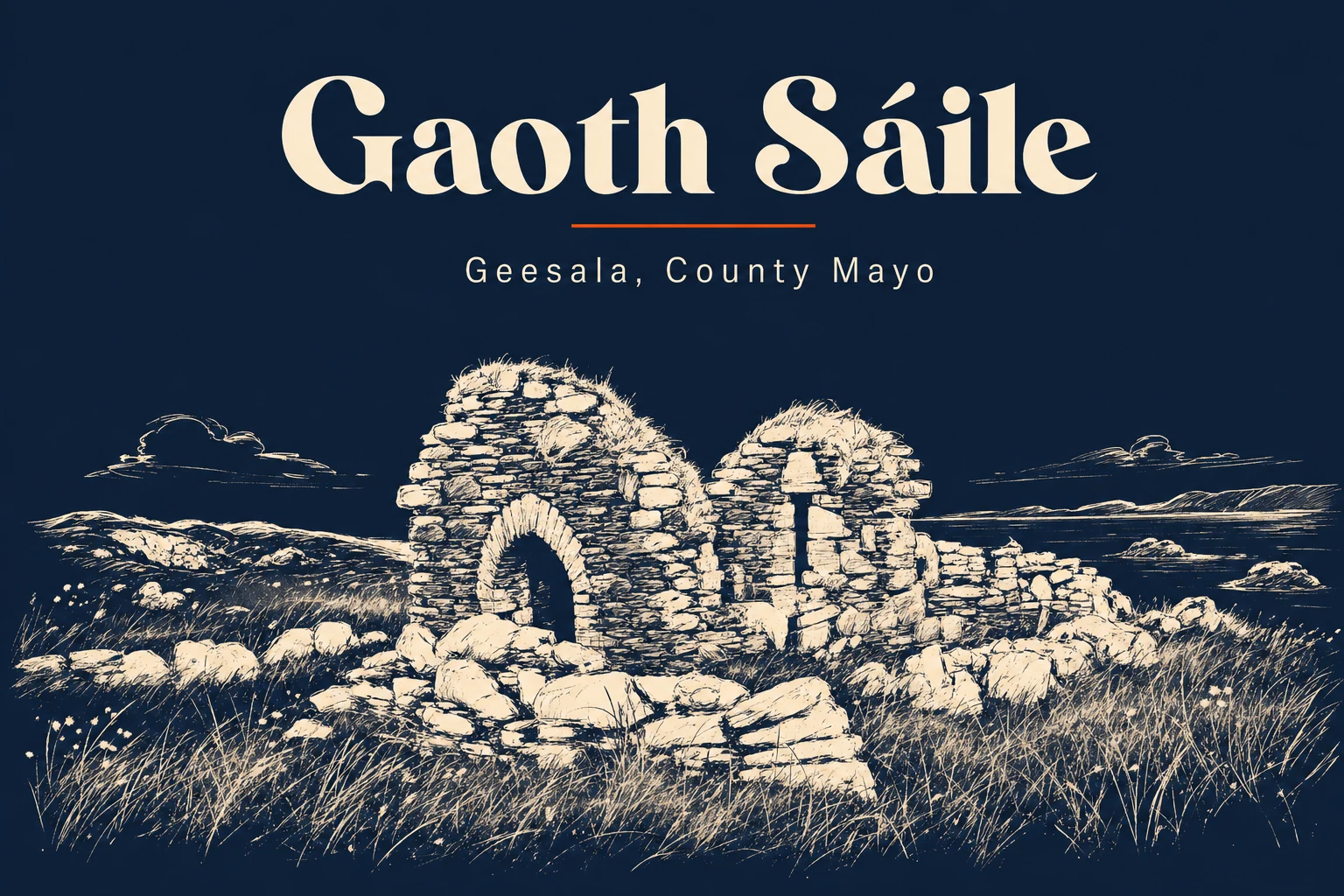
Gaoth Sáile · Co. Mayo
Irish-speaking Erris. Synge came here and wrote a play about what he heard.
Geesala means 'salt wind inlet' - Gaoth Sáile. The name is straightforward and the place is too. A scattering of houses on the Erris peninsula in northwest Mayo, a handful of services, a hotel that used to be called Ostán Synge until new management changed it. The surrounding landscape is blanket bog and low hills and, to the north, the Atlantic. Belmullet is twenty-something kilometres west and is the nearest town in any useful sense of the word.
J.M. Synge came through Erris in the early 1900s, staying with Yeats at the Erris Hotel in Belmullet and making his way on foot to Geesala and the surrounding townlands. He watched girls picking shellfish on Doolough strand and wrote down what he heard people say, and when he came to write The Playboy of the Western World he set it in a shebeen in the Geesala area. The play's preface mentions 'the kind of talk one could hear in any little hillside cabin in Geesala, or Carraroe, or Dingle Bay.' He wasn't romanticising; he was reporting. The old hotel kept his name until recently.
The Erris Gaeltacht has contracted since Synge's time - the strongest-speaking communities are now further west on the Mullet Peninsula - but Geesala remains inside the language boundary. The festival in August, the parish school, the signage: all bilingual at minimum, Irish-first in practice. It is a lived thing, not a performance.
The village has a hotel, two pubs, a post office, a general store, a community centre, and a GAA pitch. That is the inventory. It is enough for what Geesala is - a Gaeltacht community on the edge of the Erris bog, doing its own thing, not particularly interested in being anybody's destination.