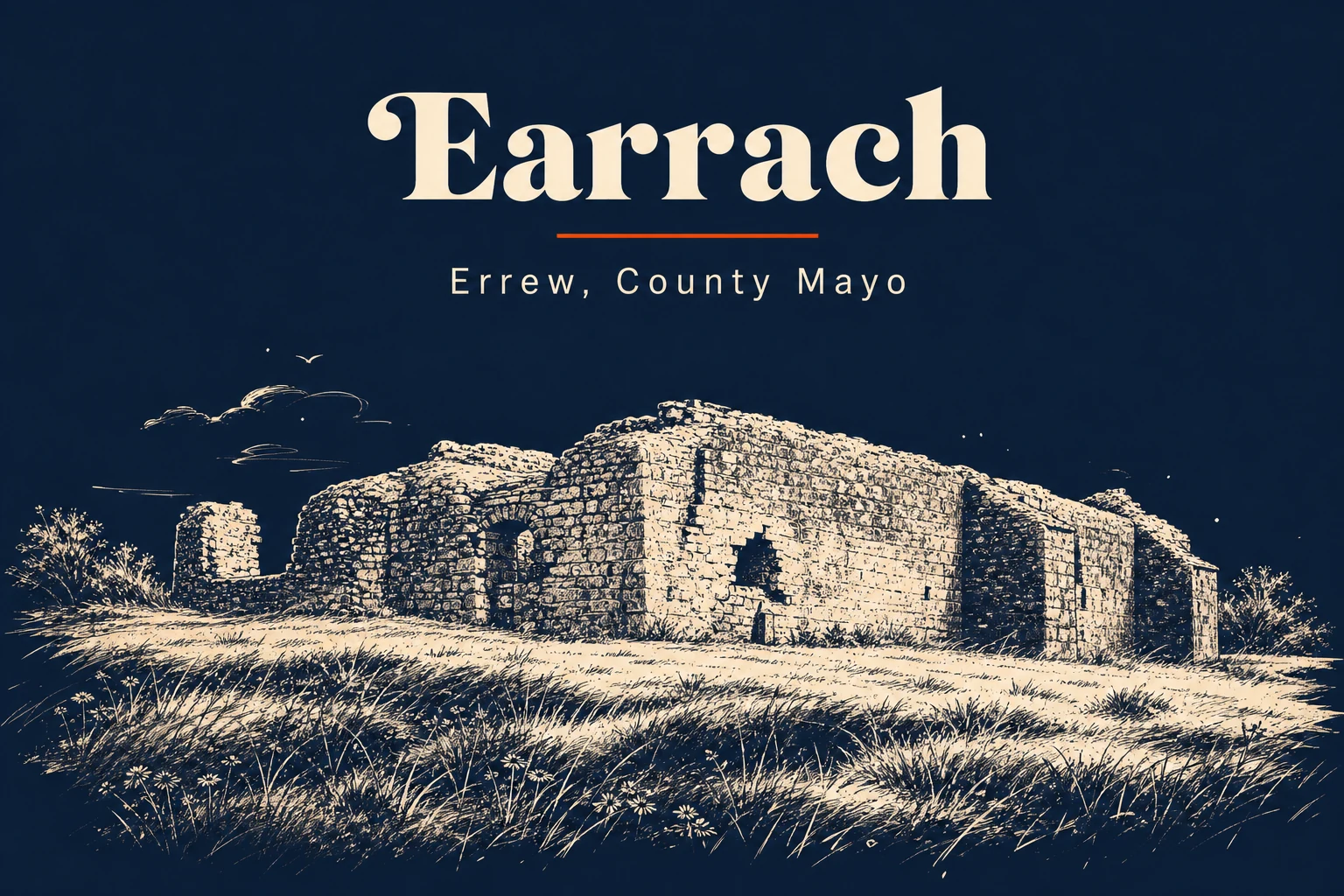
Augustinian monastery, founded 13th century
Errew Abbey
The Augustinian priory at Errew was founded in the 13th century, most likely through the patronage of the Barrett family — Cambro-Norman lords who controlled this stretch of north Mayo during the medieval consolidation. The site on the Lough Conn peninsula was almost certainly already a place of religious significance: the tradition of Saint Tiernan's 6th-century foundation is consistent with the pattern of Augustinian houses built atop older Irish monastic sites throughout the west. The monastery's Irish name — Mainistir Taobh Thiar do Shruth, 'abbey west of the stream' — suggests an earlier topographic identity that survived the new order's arrival. The trefoil-headed windows in the nave are the most intact surviving feature. The sedilia — stone seats for clergy — are still visible in the chancel wall. The ruins were surveyed in the 19th century and the stonework is considered good quality for a rural Connacht house of this period.
The Mias Thighernáin and Lough Conn
The Plate of Saint Tiernan
The relic known as the Mias Thighernáin — Saint Tiernan's dish, or plate — is one of the odder strands of the Errew tradition. According to local records, the sacred vessel associated with the 6th-century founder lay at the bottom of Lough Conn for an extended period — the folklore doesn't agree on how long — before surfacing to be recovered. The O'Flynn family were the hereditary keepers of the relic. What exactly the dish was, where it came from, or where it ended up is unclear; the records are fragmentary. But the story is old enough and specific enough to suggest a real object at its centre, worked over by centuries of retelling until the plain fact has become unrecoverable beneath the miracle.
Never stocked, always wild
Lough Conn fishing
Lough Conn is one of the few significant Irish fishing lakes that has never been artificially stocked — all the brown trout and salmon in it are wild. The lake runs roughly 14 kilometres from Crossmolina south to the Pontoon narrows, where it connects to Lough Cullin. The western shore, where Errew sits, gives access to some of the most reliable trout water. Anglers have been working this stretch for as long as anyone can verify; the Enniscoe estate on the eastern shore maintained fishing rights through the 19th century and into the 20th. The season runs February to September for salmon; trout fishing continues longer. The boatmen who work the lake are a specific type — experienced, taciturn about their best marks, and worth listening to if they choose to talk.