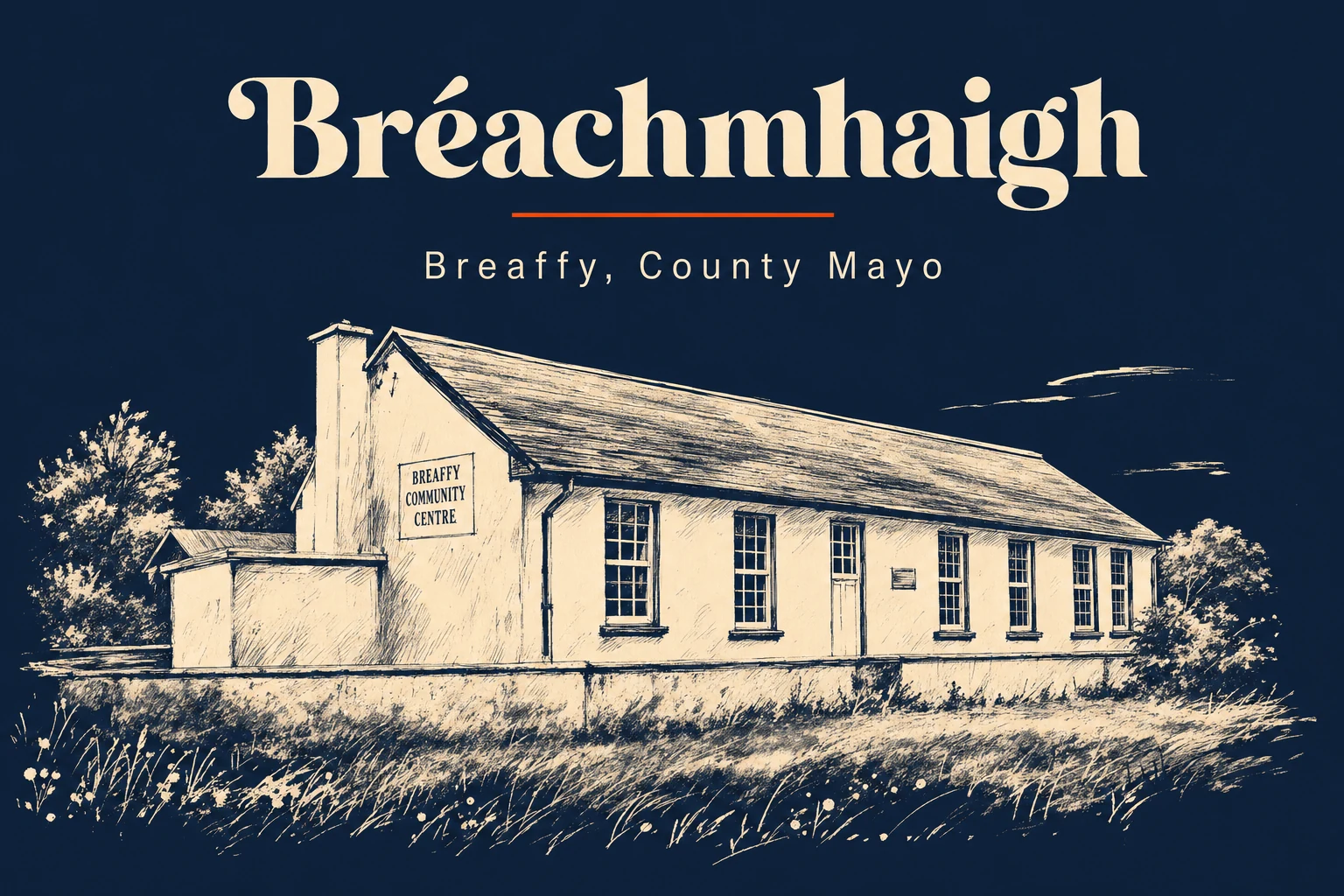
Bréachmhaigh · Co. Mayo
A baronial hotel, a serious GAA club, and Castlebar's eastern edge.
Breaffy is not a village you arrive at so much as pass through on the way from Castlebar to somewhere else. It sits 3.7 kilometres south-east of the county town - close enough that the housing estates are catching up. The original parish had the church, the school, the GAA club, and the Browne family's estate. Three of those four still define it.
The Brownes arrived on Cromwellian settlement land in 1680, when John Browne received 200 acres in what was then open agricultural plain. Two centuries of consolidation followed, and in 1890 Dominick Andrew Browne commissioned English architect William Fawcett to build a Scottish baronial mansion on the estate - polygonal turrets, battlements, stepped gables, the full Victorian landed-gentry statement. He had to make his own bricks and burn his own lime; there was no infrastructure for that kind of ambition in rural Mayo. Three generations of Dominicks held the estate until 1961. The house is now Breaffy House Hotel.
The GAA club has done more than the house to keep Breaffy as an address people identify with rather than just a postcode near Castlebar. Founded 1953, it draws from four parishes and has consistently produced county footballers. Aidan O'Shea, Seamus O'Shea, Rob Hennelly - three of the bigger names in recent Mayo football came out of this club. On match days at the grounds, the Breaffy in the club's name means something.
Everything else - the National Museum at Turlough Park five minutes away, Croagh Patrick an hour west, the town centre a five-minute drive - belongs to Castlebar's orbit. Breaffy earns one night if you're staying at the hotel. It earns a look if you're interested in what a Victorian Mayo demesne actually looks like when it's been repurposed rather than burned. It does not earn more than that.