County Mayo Ireland · Co. Mayo · Balla Save · Share
POSTED FROM
BALLA
CO. MAYO · IE

Balla
Balla

STOP 05 / 05
Balla · Co. Mayo

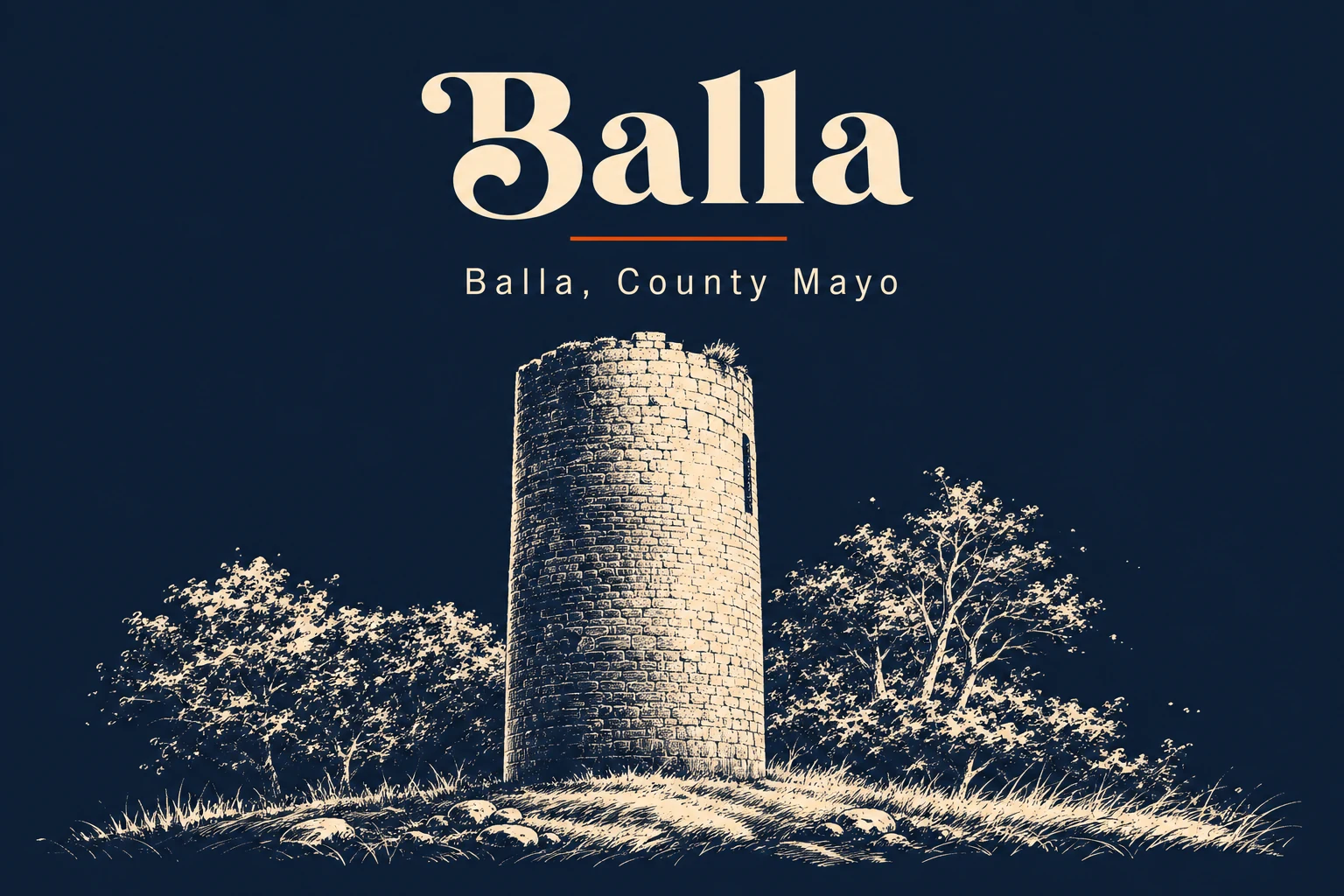
A round tower stump, a holy well, and the N60 running through the middle.

Balla is a small N60 village between Castlebar and Claremorris — population around five hundred, one main street, and most drivers between the two towns go through it without slowing down. That is most of the story of modern Balla. The older story is different.

In the 7th century a saint called Cronan — known locally as Mochua, Mochua of Balla — founded a monastery on the rise above what is now the village. The site lasted. By the medieval period there was a round tower, a church, an enclosure. The tower fell or was taken down at some point — what is left is the base, perhaps three metres high, with the original doorway visible. Beside it the medieval church ruins and the old graveyard. It is the kind of monastic site that, in a different county, would be on every postcard. Here it sits behind a low wall on the edge of the village and most people drive past it.

The other thing Balla is known for is Tobermurry, the holy well — Tobar Mhuire, the Well of Mary. It was one of the major pattern-day wells of Connacht, particularly active on Garland Sunday, the Sunday closest to the first of August. Pilgrimage to the well faded through the late nineteenth century but never quite stopped, and the rounds are still walked.

Treat Balla as a fifteen-minute stop on the way to somewhere else. Park near the church, walk to the round tower stump, read the panel, walk to the well. That is the village. The N60 will be waiting.
Population
~500
Founded
7th century monastic site
Coords
53.8050° N, 9.1278° W
01 / 05

At a glance.

Three things every local will eventually mention. Read these and you've already understood more than most day-trippers do.

02 / 05

Stories & lore.

The reason to come back. The things every local will eventually tell you about, usually after the second pint.

The seventh-century saint

Mochua of Balla

Cronan Mochua — Mochua meaning 'my Cua', the affectionate form of Cronan — was a contemporary of the better-known Mayo saints. He founded the monastery at Balla in the 7th century, and the place takes its ecclesiastical history from him. He has a feast day at the end of March. The monastery itself outlived him by a thousand years before falling out of use.

What survives

The round tower stump

Only the base of the round tower remains — roughly three metres of stonework with the original raised doorway still visible. The rest is gone. Whether it fell, was struck by lightning, or was pulled down for stone, the records do not agree. What is on the ground is what is on the ground. Beside it, the medieval church ruins and the lichen-covered graveyard.

The well that kept its pattern

Tobermurry and Garland Sunday

Tobermurry — Tobar Mhuire, the Well of Mary — was one of the most-walked pilgrimage wells in Connacht. The big day was Garland Sunday, the Sunday before or closest to the first of August, marking the old Lughnasa festival folded into the Christian calendar. The pattern-day crowds dwindled through the late 1800s as the church discouraged the more boisterous gatherings, but the rounds were never abandoned. People still walk them.

Modern Balla

The N60 village

The railway came in 1862 and left for good in 1974. Since then the road has done what the railway used to. The N60 between Castlebar and Claremorris runs through the village — not around it — which means trucks, tractors, and the steady commuter traffic between the two big Mayo towns. The village itself is one main street, a few side roads, the church, and the monastic site behind it. That is the full architecture.

03 / 05

When to go.

There is no bad time. There are different times.

Spring
Mar–May

The graveyard around the round tower stump is greenest in spring. Mochua's feast day falls at the end of March if you want a date.

◉ Go
Summer
Jun–Aug

Garland Sunday — the Sunday closest to the first of August — is the traditional pattern day at Tobermurry. Quiet now, but the day to be there.

◉ Go
Autumn
Sep–Oct

Light is good on the round tower stones. Through-traffic eases once the schools go back.

◉ Go
Winter
Nov–Feb

The monastic site has no shelter. Bring a coat. The well rounds are still walked, weather regardless.

◐ Mind yourself
04 / 05

What to skip.

Honestly? Don't bother.

If a local was sitting beside you, this is the bit where they'd lean in.

×
Expecting a full round tower

Only the base survives. About three metres of wall, the doorway, and that is it. The site is worth the stop; the silhouette is not.

×
Treating Balla as a destination

It is not a half-day stop. Fifteen minutes for the monastic site, ten more for the well, and back on the N60.

×
Looking for the railway station

The line closed to passengers in 1963 and finally in 1974. The station building survives in other use but there are no trains and no plans for any.

×
Confusing the well with St. Patrick

The well is Tobermurry — Mary's well — and the saint of Balla is Cronan Mochua, not Patrick. Older guidebooks mix this up. They are wrong.

+

Getting there.

By car

On the N60 between Castlebar (12 km north) and Claremorris (8 km south). Twenty minutes from either. Knock Airport is half an hour east via the N17.

By bus

Bus Éireann services on the Castlebar–Claremorris–Galway corridor stop in the village. Check current timetable; service is light.

By train

No station. The Westport–Dublin line passes nearest at Claremorris, eight kilometres south.

By air

Ireland West (Knock, NOC) is 30 km east — the closest airport in the country to the village. Shannon is two hours; Dublin three.