County Mayo Ireland · Co. Mayo · Belcarra Save · Share
POSTED FROM
BELCARRA
CO. MAYO · IE

Belcarra
Béal Carra

The Joyce Country & Western Lakes Geopark
STOP 06 / 06
Béal Carra · Co. Mayo

A ruined house, a marl lake, and the landscape that made a novelist.

Belcarra sits on the north-west shore of Lough Carra, a few miles from Castlebar and a long way from anywhere that advertises itself. The village is small — a crossroads, a church, a GAA pitch, a scatter of houses along the shore road. The lake is the reason anyone comes.

Lough Carra is a marl lake, which means the limestone dissolves into the water and makes it alkaline, shallow, and unusually clear. The bottom is white. On a still day in May the surface looks almost tropical, which is not a word that earns itself often in County Mayo. The trout fishing is serious — the mayfly hatch in late May draws anglers who have been booking the same week for a decade. Boats go out from the western shore. The wind decides everything.

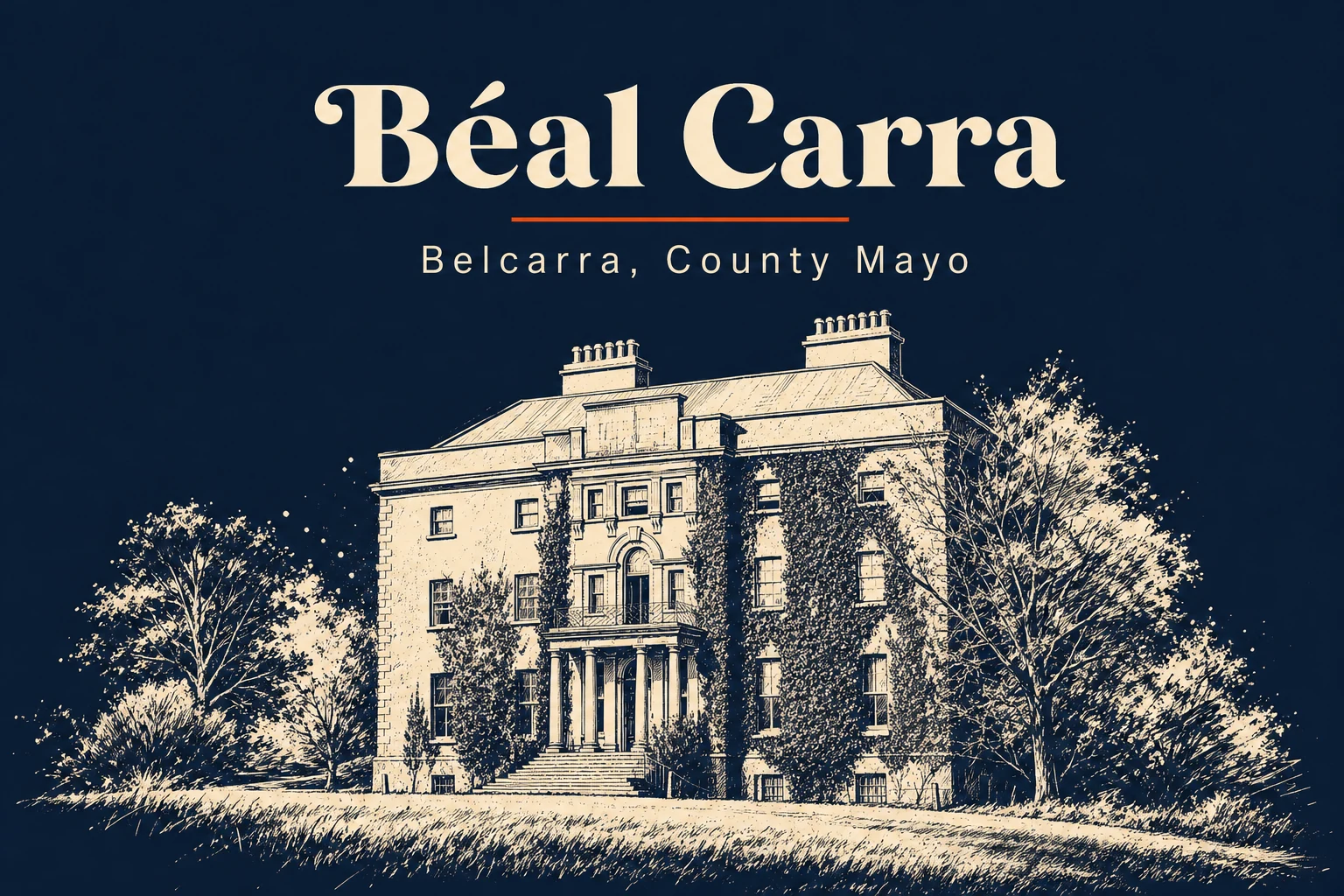
Moore Hall stands empty on the eastern shore, a Georgian mansion burned by Anti-Treaty forces in February 1923. George Moore, one of the more significant Irish novelists of the nineteenth century, was born here in 1852. His father John Moore Moore had built it in 1795 on the proceeds of a Spanish wine business. George left Mayo young, went to Paris to learn to paint, stayed to write instead, and came back rarely. The house was burned a year after he died. The walls still stand in the forestry. Coillte manages the land; the ruin is accessible on foot.

The connection to the Boycott episode is indirect but real. Father John O'Malley of The Neale — the priest who actually coined the word 'boycott' in a parlour conversation with an American journalist in late October 1880 — ministered to the parishes around Lough Carra. The tenants who withdrew labour from Captain Boycott's Lough Mask estate that autumn were from this same landscape. The land reform the episode accelerated changed every farm in it.
Walk score
Village in five minutes; the lake is the walk
Coords
53.7333° N, 9.2167° W
01 / 06

At a glance.

Three things every local will eventually mention. Read these and you've already understood more than most day-trippers do.

02 / 06

Stories & lore.

The reason to come back. The things every local will eventually tell you about, usually after the second pint.

The novelist who left and wrote about leaving

George Moore

George Moore was born at Moore Hall in 1852, the eldest son of John Moore MP. He left Mayo at seventeen for London, then Paris, studied painting under Cabanel, ran out of money, began writing instead. A Mummer's Wife (1885), Esther Waters (1894), The Untilled Field (1903) — a body of work that put him in the first rank of English-language fiction. He came back to Ireland for a decade from 1901, working with Yeats and the Abbey Theatre crowd, then left again for London. Hail and Farewell, his three-volume memoir of that period, is still the sharpest account of the Irish Literary Revival written from the inside. He died in London in 1933, a year before his house was finally declared a ruin. His ashes were brought back and buried on Castle Island in Lough Carra — a small island in the lake below where he grew up.

Built in 1795. Burned in 1923.

Moore Hall

John Moore Moore built the hall in 1795 on a wooded peninsula above Lough Carra, using money from the family's wine trade with Spain. It was a substantial Georgian house — two storeys, eleven bays, cut limestone — and the Moore family lived there for four generations. John Moore, George's father, was a Mayo MP and an early supporter of Charles Stewart Parnell; he died in 1879, a year before the Land League agitation peaked around the lake. The house was burned in February 1923 by Anti-Treaty IRA forces, who used it as a barracks during the Civil War and torched it on withdrawal. No one was hurt. The contents, including a library of several thousand volumes, were lost. Coillte now manages the surrounding plantation and the roofless shell of the hall. There is a car park at the end of the forest road. The walk to the ruin takes about fifteen minutes through commercial spruce.

One of the few marl lakes in Ireland — and one of the best trout fisheries

Lough Carra and the marl

Lough Carra is roughly seven kilometres long and three wide, sitting on a limestone plain between Castlebar and Ballinrobe. It is one of a small number of marl lakes in Ireland — the alkaline limestone weathers directly into the water column, making the lake unusually clear and biologically rich. The white marl bottom, visible through the shallow water on calm days, accounts for the distinctive colour. The lake holds a strong population of wild brown trout. The mayfly — Ephemera danica — hatches in the second half of May, triggering the dry-fly season that anglers mark their year by. Boats are available from the western shore. The season runs March to September under Western Regional Fisheries Board rules. Pike also run in the lake's northern bays; the trout anglers regard this with feelings.

The priest who named the tactic

Father O'Malley and the word

Father John O'Malley was parish priest of The Neale — six kilometres south of Belcarra, between Lough Mask and Lough Carra — through the Land League period. When Charles Boycott's estate workers withdrew their labour in September 1880, it was O'Malley who managed the moral and pastoral dimensions of the protest for the local Catholic community. And it was O'Malley who, in a conversation with American journalist James Redpath sometime in late October 1880, hit on the word 'boycott' as a name for the tactic of total social exclusion. Redpath wired it to his Boston paper. Within weeks it was in the London newspapers. The OED admitted it in 1888. Father O'Malley lived out his years at The Neale; he is buried in the parish churchyard there.

03 / 06

Things to do outside.

Wear waterproofs. Bring a sandwich. Tell someone where you're going if it's the mountain.

Moore Hall Ruin Walk Forest road through Coillte commercial spruce to the ruin on the lakeshore. The path is clear but not signposted beyond the car park at the end of the Moore Hall access road off the R330. Boots recommended — it's forestry track, not tarmac. The ruin is roofless, the walls intact, the lake visible through the trees behind it.
3 km return from car parkdistance
1 hourtime
Lough Carra Shore No formal looped walk, but the western shore road along the R330 gives access to the lake at several points. Park at the fishing pier south of Belcarra village and walk the shore. The marl bottom is clearest in calm weather. The fishing boats go out early; be there before eight if you want the lake to yourself.
Variabledistance
As long as you havetime
04 / 06

When to go.

There is no bad time. There are different times.

Spring
Mar–May

The trout fishing opens in March. Late May is the mayfly hatch — the two weeks that serious anglers have booked for months. Lough Carra at its most alive.

◉ Go
Summer
Jun–Aug

Fishing continues to September. The lake is quiet by tourist standards — this is not a swimming or watersports crowd. The long evenings make the shore walk worth doing late.

◉ Go
Autumn
Sep–Oct

Season closes in September. October is the time to walk to Moore Hall without the fishing traffic. The forestry turns colour around the ruin. Quiet in the right way.

◉ Go
Winter
Nov–Feb

Nothing specific closes — there is little enough to close. The lake is empty of boats. The ruin walk is muddy. Come if the solitude is the point.

◐ Mind yourself
05 / 06

What to skip.

Honestly? Don't bother.

If a local was sitting beside you, this is the bit where they'd lean in.

×
Driving to Moore Hall expecting a heritage site

The ruin is managed by Coillte forestry, not a heritage body. No signage beyond the car park, no visitor centre, no café, no opening hours because there are no doors. It is a roofless shell at the end of a plantation track. Worth it on those terms; not on any other.

×
Fishing Lough Carra without a permit or a boat

The lake is managed under Western Regional Fisheries Board rules. A permit is required (day tickets available). The best fishing is from a boat on the open water — bank fishing on a marl lake with a smooth limestone bottom has its limits. Ask locally about boat hire before you arrive.

×
Looking for Captain Boycott's house from the Belcarra road

Lough Mask House, where Boycott actually lived, is six miles south near Ballinrobe — private, lived in, not signposted. The Belcarra and Carra area is the surrounding landscape of the story, not the address. Ballinrobe has the plaque and the detail.

×
Expecting a village with services

Belcarra is a crossroads and a lakeshore. No pub, no restaurant, no accommodation within the village. Castlebar is ten minutes by car and has everything. Come for the lake and the ruin; sleep somewhere else.

+

Getting there.

By car

Castlebar to Belcarra is 10 km on the R330, about 12 minutes. Ballinrobe is 18 km south on the R330. From Galway, allow 1 hour 15 minutes via the N84 through Ballinrobe.

By bus

No direct bus service to Belcarra. Bus Éireann routes serve Castlebar and Ballinrobe; a car is needed for the last 10 km.

By train

Castlebar station is on the Dublin–Westport line. Belcarra is 10 km by road from there.

By air

Ireland West Airport (NOC) at Knock is 35 minutes by car. Shannon (SNN) is 2 hours. Dublin (DUB) is around 3 hours.