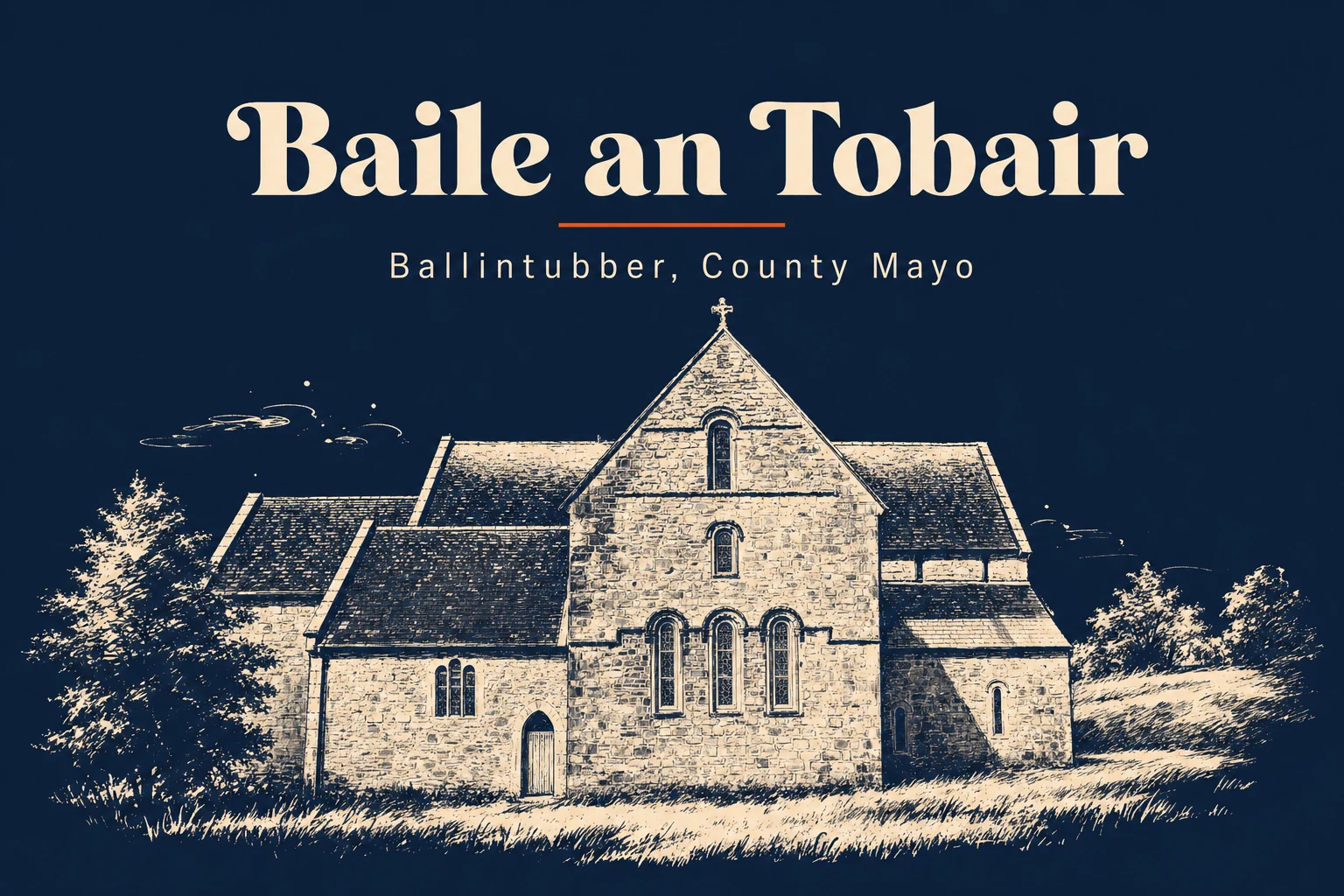
Baile an Tobair · Co. Mayo
Eight hundred years of continuous Mass, even after Cromwell burned the roof off.
Ballintubber is a small village on the R330 between Castlebar and Claremorris, in the flat agricultural midlands of Mayo. There is almost nothing to the village itself - a crossroads, a few houses, a car park. The abbey is the reason to come, and the abbey is enough.
Ballintubber Abbey was founded in 1216 by Cathal Crobhdearg O'Connor, King of Connacht, on the site of an earlier church beside a holy well - Tobar Phádraig, Patrick's Well, which gives the village its name. In 1653 Cromwell's forces burned the roof. The friars stayed anyway. Mass was said in the open nave, in the rain, under the open sky, for three hundred and thirteen years. The congregation never left.
That is the full story. Every other piece of history - the medieval cloister, the original doorway, the connection to the royal line of Connacht, the Famine-era struggles to keep the building standing - sits inside that one fact. A church that kept going after the roof was gone is either stubborn or holy. In Ballintubber, the distinction is treated as irrelevant.
The abbey is also the start point of the Tóchar Phádraig, the old pilgrim road to Croagh Patrick, which runs about 35 kilometres through Aughagower to Murrisk at the foot of the mountain. The route is partly waymarked and partly a matter of asking the right person. A few organised walks happen each year. You can register at the abbey and set off under your own steam. Most people who come to Ballintubber either spend an hour at the abbey and leave, or start walking west and don't stop until they reach the Reek. Both are correct approaches.