County Mayo Ireland · Co. Mayo · Hollymount Save · Share
POSTED FROM
HOLLYMOUNT
CO. MAYO · IE

Hollymount
Maolla, Co. Mayo

The Wild Atlantic Way
STOP 08 / 08
Maolla · Co. Mayo

An estate village on the south Mayo plain - a roofless Georgian Gothic church, a Vesey demesne gone to grass, and a GAA club that punches well above its size.

Hollymount is an estate village on the plains of south Mayo, sitting on the R331 roughly midway between Ballinrobe and Claremorris. It takes its name from the Hollymount demesne, the estate Archbishop John Vesey of Tuam acquired in 1698, and most of the village's history is really the history of that big house and the church the family built. The land is flat here, not the drumlin-and-mountain Mayo of the postcards - good grazing country, hedged fields, a wide sky.

The estate is the spine of the place. Vesey built a manor house in the early 1700s; it came to the Lindsey family through a 1757 marriage to his granddaughter Frances, and they held it until the whole thing was broken up and sold to the Congested Districts Board in 1915. The timber had already started coming down in 1908, thousands of tons of it railed out from Hollymount Station. What survives of the house is a neglected fragment in unkempt grounds, with a walled garden gone wild beside it.

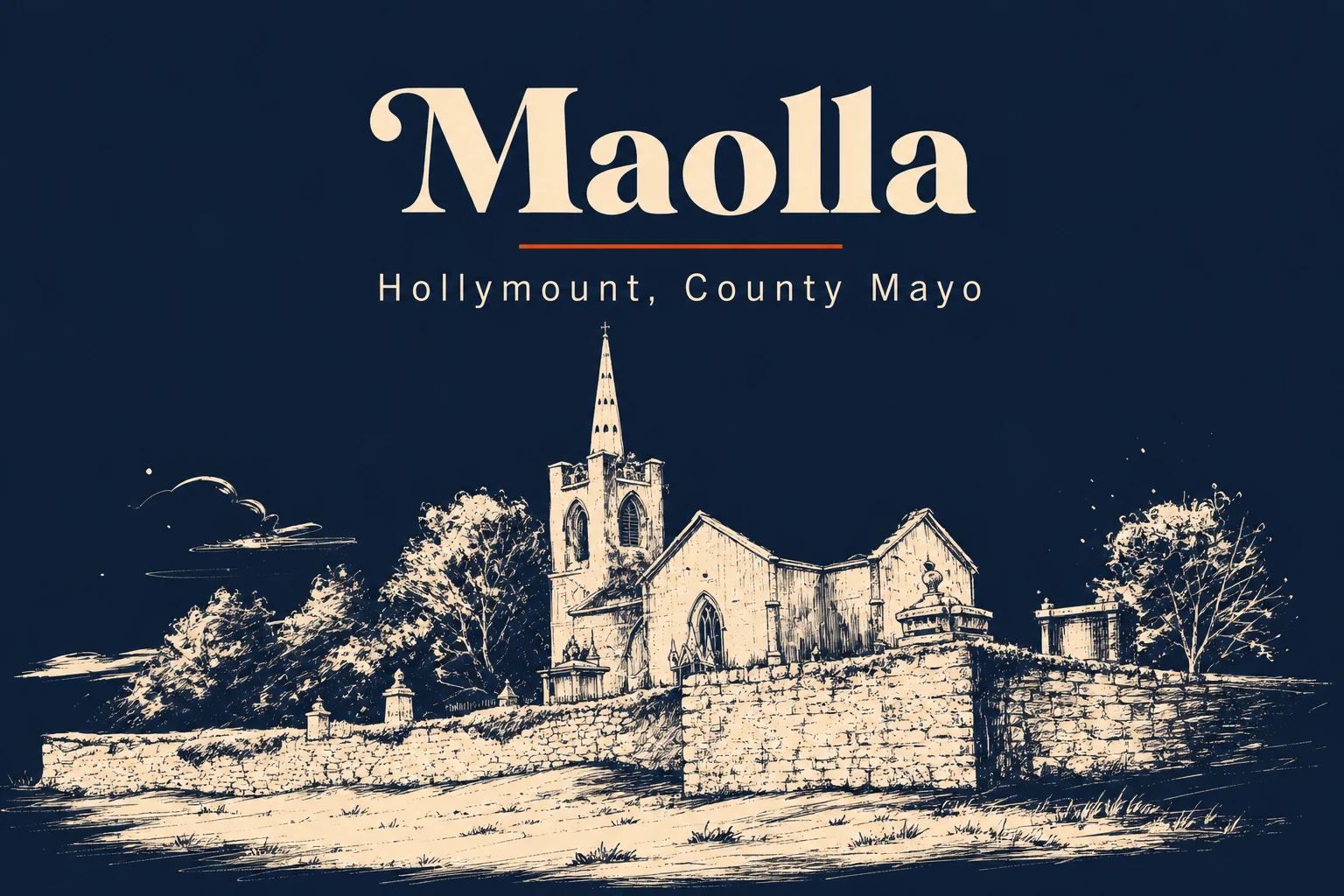
North of the village stands the real set-piece: the roofless Church of Saint Charles the Martyr, a Board of First Fruits church of 1816 in banded grey limestone, Georgian Gothic, cruciform, with a square tower and octagonal spire. It was deconsecrated in 1959, its fittings dispersed - the east window to Co. Armagh, the doorcase to Ballintubber Abbey - and dismantled by the early 1960s. It is a handsome ruin and the one thing in Hollymount genuinely worth stopping the car for.

Be honest with yourself about what this is. Hollymount is a working rural village with a post office, a mini-mart, a couple of pubs and a community centre, not a destination. Come for the church ruin, the quiet, and the texture of a south Mayo crossroads on an ordinary weekday. If you want a town, Ballinrobe and Claremorris are each about fifteen minutes off.
Population
A few hundred (rural village, townland of Kilrush)
Founded
Estate village; Hollymount estate acquired by Archbishop John Vesey, 1698
Coords
53.6606° N, 9.1175° W
01 / 08

At a glance.

Three things every local will eventually mention. Read these and you've already understood more than most day-trippers do.

02 / 08

The pubs.

None of these are themed Irish pubs, because they don't need to be. A few that earn the trip:

The village pubs

Small, local, what you would expect
Rural local bars

Hollymount has a couple of public houses serving the village and the surrounding townlands - ordinary rural locals rather than destination bars, and opening hours can be quiet on a weekday. We are not going to name and rank them as if this were a pub crawl; it is a small village. For a proper choice of pubs, music and food, Ballinrobe and Claremorris are each about fifteen minutes away.

03 / 08

Where to sleep.

PlaceTypeLocal note
The Old Kirk and Manse Self-catering in a restored 1856 Presbyterian church and manse The standout place to stay in the parish. The former Presbyterian kirk of 1856 and its manse, derelict for decades, were restored over 2021-2023 and now let as self-catering accommodation with an events space, sleeping up to eight in the manse. Set in a walled garden. Heritage with central heating - the most distinctive bed in Hollymount by a distance.
04 / 08

Stories & lore.

The reason to come back. The things every local will eventually tell you about, usually after the second pint.

Archbishop to Congested Districts Board, 1698 to 1915

The Vesey demesne

Hollymount exists because of its big house. John Vesey, Church of Ireland Archbishop of Tuam, acquired the estate in December 1698 and built a manor house early in the 1700s. It passed to Thomas Lindsey through his 1757 marriage to Frances Vesey, the Archbishop's granddaughter, and the Lindseys held Hollymount through the 1700s and 1800s. The end came slowly: timber felling began in 1908, thousands of tons railed out from the station, and the estate was sold to the Congested Districts Board in 1915 and divided among tenants. The house today is a fragment in neglected grounds with a disused walled garden, recorded as a contributing piece of a fragmented estate. It is not open and not really visitable - this is the backstory, not a stop on a tour.

A Board of First Fruits church in ruins, 1816

St Charles the Martyr

The church north of the village is the one piece of architecture worth the detour. Built in 1816 with a Board of First Fruits grant, it is a cruciform Georgian Gothic church - single-bay double-height nave, transepts and chancel, a three-stage square tower with an octagonal spire at the west end - built in banded grey 'sparrow-pecked' limestone with diagonal buttresses and a battlemented parapet. The Protestant congregation faded with the rest of the southern Irish Church of Ireland: it was deconsecrated in 1959, the east window removed to St John's in Co. Armagh in 1962, and the building dismantled by 1963. The doorcase went to Ballintubber Abbey and a wall monument to Ballinrobe. What stands now is a roofless, weathered shell, and it is genuinely fine.

Scottish and Northumbrian Presbyterians, 1856

The Old Kirk

Hollymount has a quieter Protestant story too. In the 1850s a small group of Scottish and Northumbrian Presbyterians settled here after the Famine - around thirty of them - and opened a church known locally as 'the kirk' in 1856. The congregation declined with the years and by 1930 there was no longer a gathering in Hollymount. The kirk and its manse fell derelict, then were bought in 2021 by Melissa and Shane Gilligan and restored over two years. They now run as The Old Kirk and Manse, an events space and self-catering let. A small, real footnote of post-Famine migration that has come back to life.

Football and republicans

Hollymount-Carramore and the Staggs

For a village this size, Hollymount carries a real GAA reputation. The old Hollymount club, founded in 1954, won Mayo senior football championships in 1990, 1991 and 1994; it amalgamated with neighbouring Carramore in 2011 as Hollymount-Carramore, who reached the All-Ireland Intermediate club final in 2016. Mayo footballer Stephen Coen is a clubman. The village's other claim is harder: Frank Stagg, the Provisional IRA hunger striker who died in Wakefield Prison in 1976 after sixty-two days, was born at Bloomfield, Hollymount, in 1941. His brother Emmet Stagg became a long-serving Labour Party TD for Kildare North.

05 / 08

Things to do outside.

Wear waterproofs. Bring a sandwich. Tell someone where you're going if it's the mountain.

The church ruin and demesne The walk to make. Head north out of the village to the roofless Church of St Charles the Martyr in the old demesne, then back down the estate lanes. Field-edge and lane walking rather than a marked trail - the big-house grounds are unkempt and private, so look from the lane and respect boundaries. Good light in the morning on the grey limestone.
Short, on lanesdistance
30-45 minutestime
Village to Robeen A flat ramble out the country roads toward the neighbouring parish of Robeen. No marked path - this is a quiet-roads walk through south Mayo grazing land, all hedges and gateways and the odd tractor. Pleasant, undramatic, the genuine texture of the place.
About 4 km returndistance
1 hourtime
06 / 08

When to go.

There is no bad time. There are different times.

Spring
Mar-May

Grazing land greening up, long bright mornings on the church limestone, hedgerows coming into leaf. A good, quiet time to look at the ruin and walk the lanes.

◉ Go
Summer
Jun-Aug

Long evenings and the best chance of catching a Hollymount-Carramore match. The flat south Mayo country is at its most pleasant for easy walking. Still very quiet - this is not a tourist village.

◉ Go
Autumn
Sep-Oct

Low light suits the ruined church. Club championship season for the GAA. Calm, often the nicest weeks of the year here.

◉ Go
Winter
Nov-Feb

Short days and not much open. The pubs and shop keep going but there is little to draw you in poor weather. Base yourself in Ballinrobe or Claremorris and day-trip out if the church ruin is what you are after.

◐ Mind yourself
07 / 08

What to skip.

Honestly? Don't bother.

If a local was sitting beside you, this is the bit where they'd lean in.

×
Looking for a castle

Earlier write-ups (including ours) called the ruin a medieval castle. It is not. The roofless building north of the village is the Church of St Charles the Martyr, a Georgian Gothic Board of First Fruits church of 1816. Go and see it as what it actually is - it is the better story.

×
Expecting a visitable big house

The Hollymount demesne and its manor were broken up and sold off in 1915. What remains of the house is a neglected fragment in private, unkempt grounds with a walled garden gone wild. There is no tour, no tea room, no open day. View the church and the estate lanes from public ground.

×
Treating Hollymount as a day out on its own

This is a small working village - post office, mini-mart, a couple of pubs, a community centre, a GAA pitch. Half an hour does the church and the lanes. Pair it with Ballinrobe, Claremorris or a run down toward Cong, all close by, rather than building a day around the village itself.

+

Getting there.

By car

Hollymount is on the R331 midway between Ballinrobe and Claremorris, roughly 12-15 minutes from each. From Galway, head to Claremorris on the N17 (about an hour) or to Ballinrobe via Headford, then the R331. The village is a crossroads - you will be through it before you know it, so slow down for the church turn.

By bus

There is no direct intercity bus stop at Hollymount. The nearest scheduled services and Local Link rural routes run through Ballinrobe and Claremorris; check TFI Local Link Mayo for the small connecting runs. Realistically this is a place you reach by car.

By train

Hollymount had its own railway station on the Ballinrobe-Claremorris branch from 1892, but it closed to passengers in 1930 and entirely by 1960. The nearest working station today is Claremorris, on the Limerick-Galway-Westport line (the Western Rail Corridor), about 15 minutes by road.