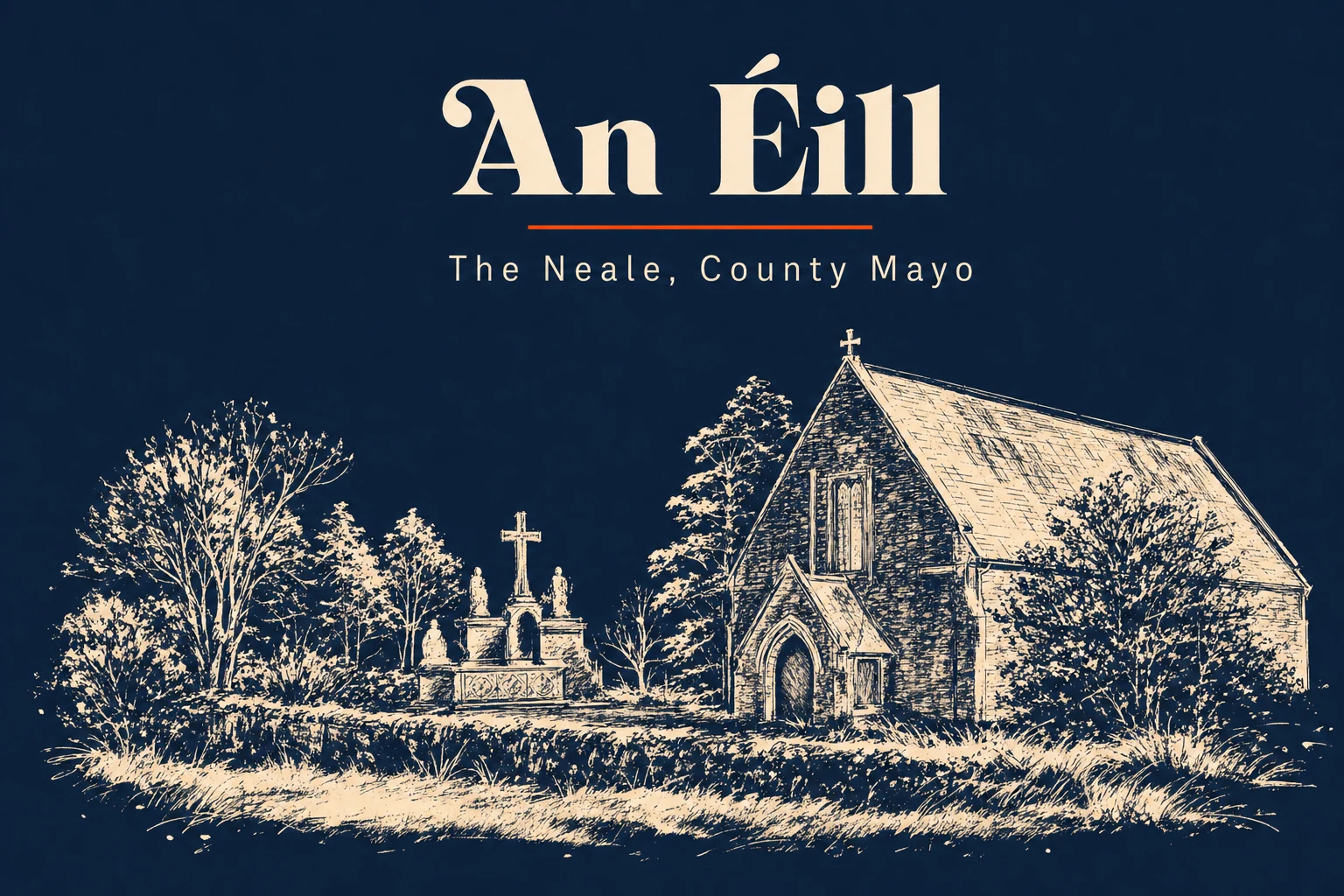
Fr John O'Malley, the Neale, autumn 1880
How the word boycott was made
Captain Charles Cunningham Boycott was land agent for the Earl of Erne's estate at Lough Mask House. In 1880, a poor harvest year, the tenants asked for a rent reduction; Boycott refused and moved to evict. The Land League, with Charles Stewart Parnell and Michael Davitt prominent in the movement, urged a new tactic - not violence, but total social isolation. Fr John O'Malley, parish priest of The Neale and president of the Ballinrobe Land League, is credited with naming it. The story goes that he wanted a word his parishioners could say more readily than 'ostracisation', and settled on the agent's own surname. Workers downed tools, shops refused service, his servants left. Boycott could not save his own harvest without an armed expedition of Orangemen and soldiers shipped in from Ulster - which cost the state far more than the crop was worth. He left for England that December. The word he left behind is now in English, French, German, Dutch, Spanish, and a dozen more.
An Egyptian folly in a Mayo field, c. 1760
The Pyramid
Behind the village stands a step pyramid about 30 feet tall on a base nearly 40 feet wide, built around 1760 by the Browne family of Neale House and once crowned by a lead figure of Apollo. It is said to have been designed by James Caulfeild, the Earl of Charlemont, for his brother-in-law Sir John Browne, 1st Baron of Kilmaine. One local account holds that Lord Kilmaine had it built partly as relief work, paying poor tenants to gather and pile the estate's loose stones in a hungry year. The Office of Public Works restored it in 1990. It is one of very few pyramids in Ireland, and it sits, unsung, in the grass.
A carved stone that names the village
The Gods of The Neale
A carved stone slab depicting a unicorn, a griffin and an angel, set up on the old demesne, bears a long and much-argued inscription that refers to the figures as Deithe Feile, Diana Ffeale and the Gods of The Neale. The village name - An Éill - is bound up with it. Antiquarians have puzzled over the lettering for two centuries without a settled reading; it mixes Irish, Latin and invented antiquity in a way that has resisted clean translation. Whatever the Brownes intended by it, the stone gave the place its name.
The last folly, 1865
The Temple of the Winds
The newest of the Neale follies is the Temple, built in 1865 by John Browne, Baron of Kilmaine, a hexagonal structure of six plain Doric columns honouring his earlier title of Lord Mount Temple. It once had a timber roof and was used by the women of the Big House as a quiet room for meetings, knitting and afternoons out of the weather. It was never fully finished. It stands roofless now, a small classical shape on the estate ground.