County Mayo Ireland · Co. Mayo · Toormakeady Save · Share
POSTED FROM
TOORMAKEADY
CO. MAYO · IE

Toormakeady
Tuar Mhic Éadaigh

The South Connacht Gaeltacht
STOP 06 / 06
Tuar Mhic Éadaigh · Co. Mayo

An Irish-speaking village where the mountains and the lake meet, and they haven't let go since.

Toormakeady is a small Gaeltacht village on the western shore of Lough Mask in south-west Mayo, population around six hundred. The Partry Mountains rise behind it. The lake sits in front. Between them is a place where Irish is the working language — not tourist Irish, not heritage Irish, but the language you actually speak to each other. The shop signs are in Irish first. The pubs conduct business in Irish. Children grow up hearing both languages at once and don't think it strange.

The landscape is exceptional. The lake is the bigger of the two big inland waters of south Mayo — brown trout, limestone deep, ringed by hills that change colour with the light. There is a waterfall near the village, Toormakeady Falls, that drops off the edge of the plateau. In wet seasons it is substantial. In dry seasons it is a whisper. Either way, the walk to it is worth the damp feet.

On May 3rd, 1921, an IRA column ambushed a Royal Irish Constabulary patrol just outside the village during the War of Independence. The fight was brief but fierce. It is the sort of history that most small villages have tucked away — a moment when the outside world's conflict arrived at the local pub and then left. In Toormakeady it is still part of the place. The language and the lake are what make it home. The ambush is what reminds you that home has a history that mattered beyond the lake.
Population
~600
Coords
53.8667° N, 9.5167° W
01 / 06

At a glance.

Three things every local will eventually mention. Read these and you've already understood more than most day-trippers do.

02 / 06

The pubs.

None of these are themed Irish pubs, because they don't need to be. A few that earn the trip:

Toormakeady Inn

Locals, Irish-language
Village pub, main street

The pub in the village. Traditional, small, the centre of whatever local life there is. Do not expect vast choice or late hours or any English being the default language at the bar. That is exactly the point.

03 / 06

Stories & lore.

The reason to come back. The things every local will eventually tell you about, usually after the second pint.

The language doesn't need a reason

An Ghaeltacht

Toormakeady is part of the South Connacht Gaeltacht — one of the official Irish-speaking areas where Irish is meant to remain the community language. In most Gaeltacht villages this is aspirational. In Toormakeady it is the fact on the ground. People speak Irish to each other. Children learn it first. The road signs argued about which name to use, and the Irish one won. It is a place where the language is not archaeology.

Eas Thuar Mhic Éadaigh

The Waterfall

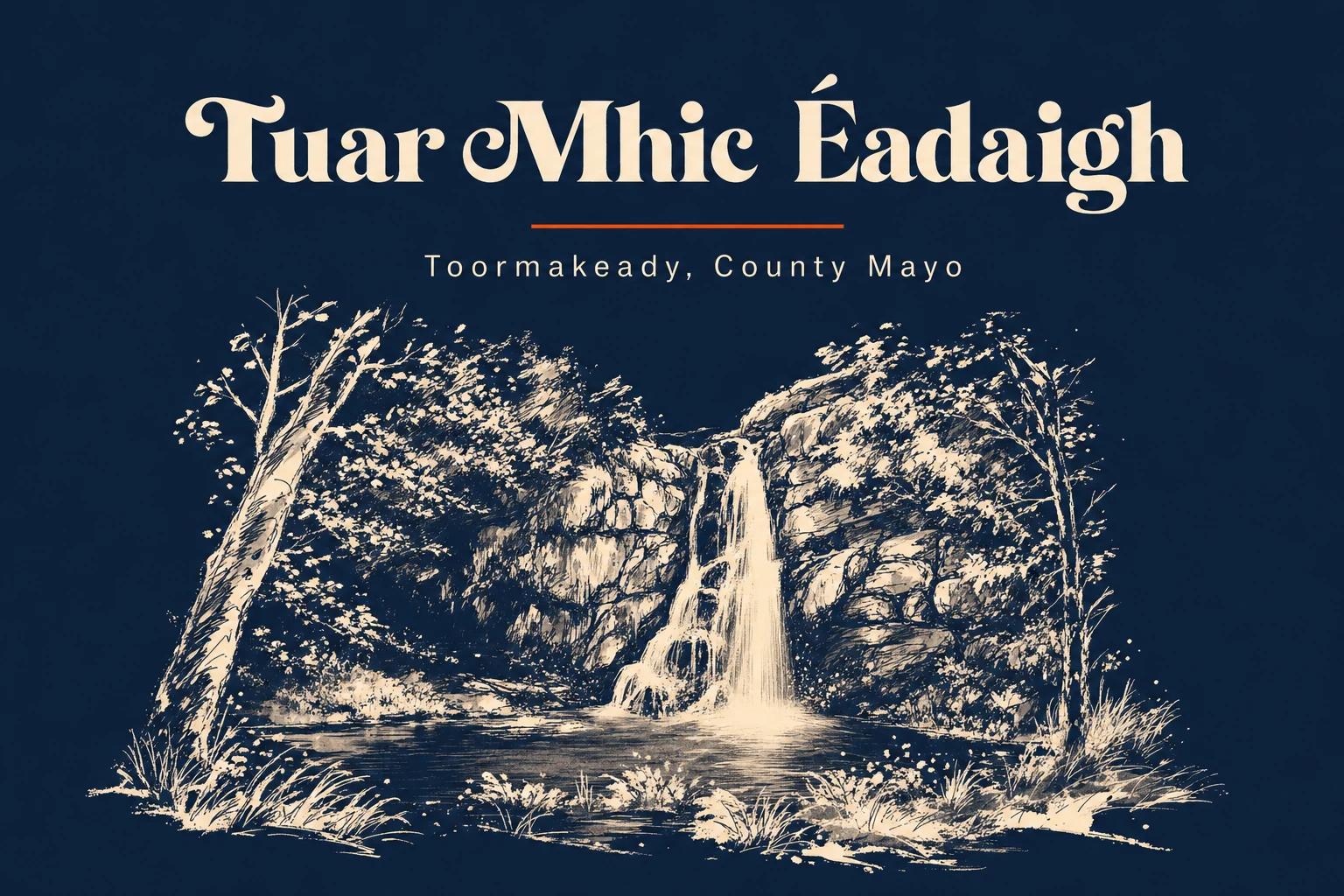
Toormakeady Falls drops off the edge of the upland plateau just outside the village, fed by drainage from the higher land. In late autumn and through winter, when the rainfall is heavy, it is substantial — a serious ribbon of water coming down the cliff. In dry seasons it diminishes to a few threads. Either way, the walk to it follows a small stream bed through typical south Mayo hill country, boggy in places, with the lake visible below through the trees.

May 3rd, 1921

The Ambush

An IRA flying column ambushed a Royal Irish Constabulary patrol just outside Toormakeady on May 3rd, 1921, during the War of Independence. The fight lasted minutes. The casualties were light. The event is the sort of historical moment that most small villages possess — a day when the larger conflict touched down, and then moved on. In Toormakeady, it is still talked about. Most places have a story like this tucked somewhere. This village chose not to hide it.

04 / 06

Things to do outside.

Wear waterproofs. Bring a sandwich. Tell someone where you're going if it's the mountain.

Toormakeady Waterfall Follows a small stream from the edge of the village up to the waterfall at the cliff edge. Boggy in sections, well-trodden path. In dry seasons the water is modest. After rain it is dramatic. The views of Lough Mask from the high ground are worth the climb regardless.
5 km returndistance
1 hour 30 mintime
Lough Mask shore walk The lake edge offers paths and clearings. The southern sections have better access. Do not assume the shore is walkable everywhere — check conditions and ask locally. The light on the water in the late afternoon is the reason you came.
Variabledistance
Whatever you havetime
05 / 06

When to go.

There is no bad time. There are different times.

Spring
Mar–May

The waterfall is in good form. The mountains are still ragged from winter. The village is itself — no tourist season, just people living there.

◉ Go
Summer
Jun–Aug

Lighter evenings and warmer days, but the village is small and does not shift for tourism. Accommodation is scarce. The lake is good for swimming if you are that sort of person.

◐ Mind yourself
Autumn
Sep–Oct

The light is sharp. The waterfall begins to have water again after the summer. The mountains look their best in October. Very few other visitors.

◉ Go
Winter
Nov–Feb

Short days, cold water, limited pub hours. The waterfall is spectacular after heavy rain. The isolation is real and not for everyone.

◐ Mind yourself
+

Getting there.

By car

From Ballinrobe (south), it's 30 km north-west via Headford and Cong, then westward to Toormakeady — about 45 minutes. From Westport (north), 40 km south on local roads — 50 minutes. The final roads are small and quiet.

By bus

No direct service. Bus Éireann services from Galway to Westport pass Ballinrobe. You would need to taxi or rent a car from there.