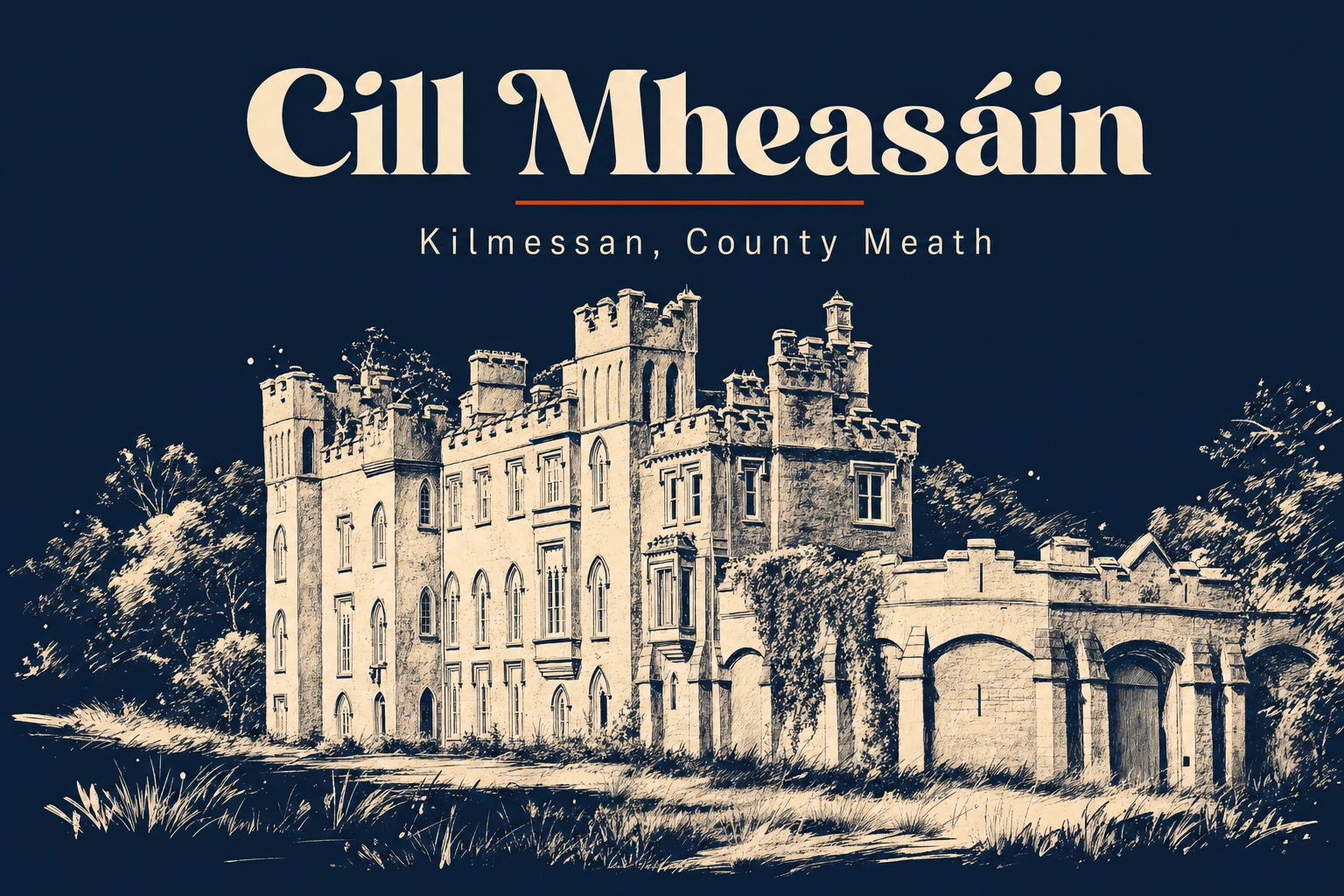
Cill Mheasáin · Co. Meath
A tidy Boyne Valley village with two pubs, a hurling club that owns Meath, and a Victorian railway junction that became a country hotel.
Kilmessan is a tidy village in the south of the Boyne Valley, five miles east of Trim and roughly the same again from Navan and Dunshaughlin, about six kilometres off the M3. It is small - just over nine hundred people at the last count - but it has held on to the things a village needs: a shop, a post office, a pharmacy, a primary school, two pubs, and the kind of GAA club that punches well above the population.
The name is the oldest thing here. Cill Mheasáin means the church of Messan, an early Christian foundation that gave the place its identity long before the railway or the hotel. The parish church you see today, the Church of the Nativity of Our Lady, was rebuilt by the architect William Hague around 1895 on a site used since about 1820, and it is joined in one parish with Dunsany next door.
The headline for most visitors is the Station House Hotel, the old railway junction turned country hotel. Kilmessan was a real junction on the Midland Great Western Railway from 1862 - the station was even burned during the Civil War in 1922 - and when the trains finally stopped the buildings sat idle until the Slattery family reopened them as a hotel at Easter 1984. The platforms, the signal cabin lines, the railway bones are still legible if you look.
The other thing worth knowing is that Kilmessan sits in the middle of the great royal landscape. The Hill of Tara is a short drive north, Trim with its enormous Norman castle is fifteen minutes south, and the Brú na Bóinne sites at Newgrange are well within reach. Kilmessan itself is not a tourist village - it is a place to sleep, eat, and use as a base, with Dunsany Castle and its medieval church a couple of fields away.