County Meath Ireland · Co. Meath · Skryne Save · Share
POSTED FROM
SKRYNE
CO. MEATH · IE

Skryne
An Scrín, Co. Meath

The Ireland's Ancient East
STOP 07 / 07
An Scrín · Co. Meath

A hill higher than Tara, a medieval tower you can see for miles, and one of the last great untouched pubs in Ireland at the foot of it.

Skryne is a hill before it is a village. It rises out of the Meath plain ten kilometres southeast of Navan, and at 135 metres it stands a little higher than the Hill of Tara, which faces it across the fields two kilometres to the west. The two hills have looked at each other for a very long time. The name comes from Scrín Cholm Cille - the shrine of Colmcille - after the relics of St Columba were carried here for safekeeping in the 9th century and a monastery grew up around them. The older name for the place was the Hill of Acaill.

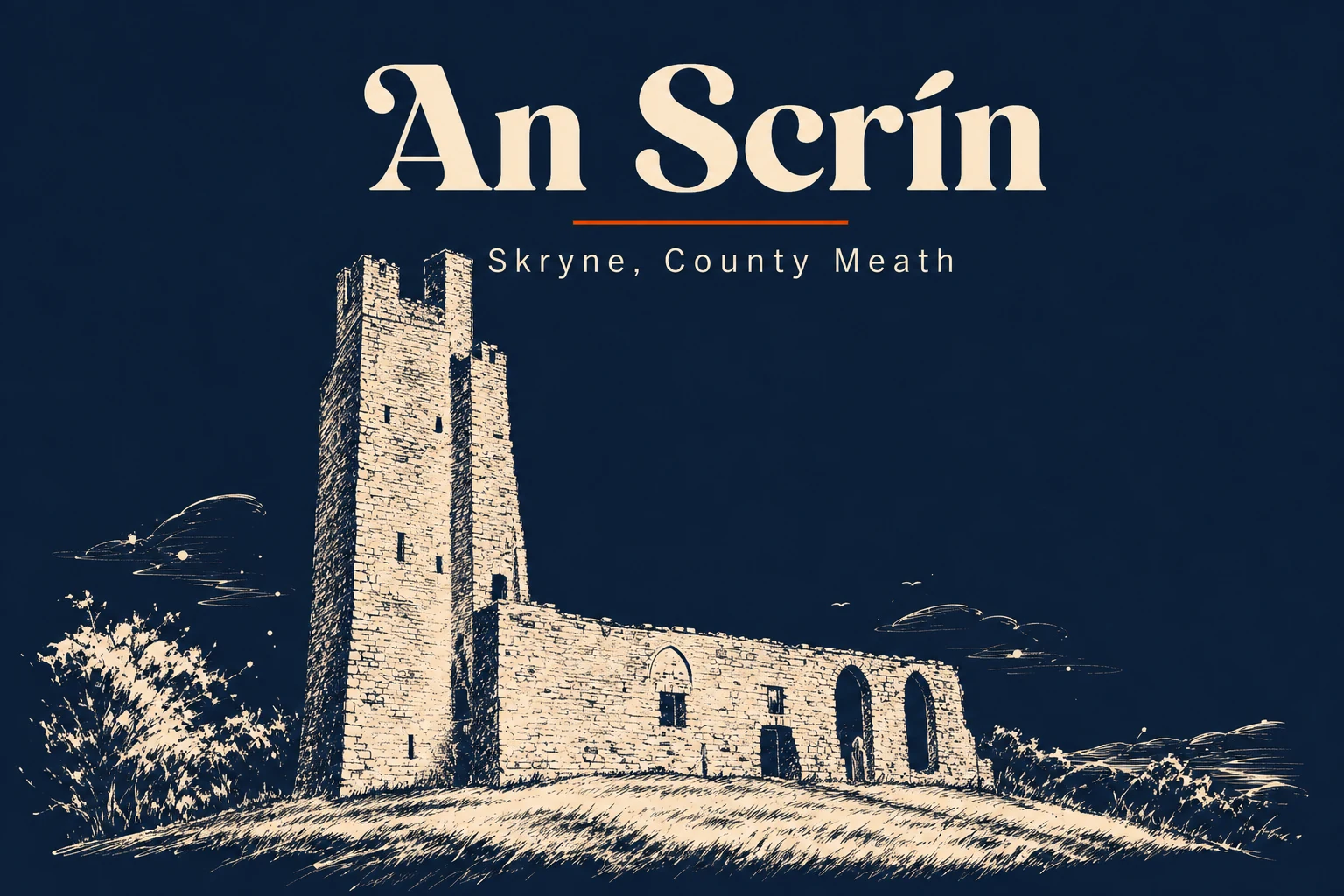
What you see on the summit now is later. Around 1170 Hugh de Lacy, the Norman Lord of Meath, granted Skryne to Adam de Feypo, whose descendants used the title Baron Skryne for the next few centuries. In 1341 Francis de Feypo, the last of that line, built a church here as a house for Augustinian canons, and the three-storey bell tower was added in the 15th century. The ruin is well preserved and it is a National Monument. Inside there is a carved effigy thought to be Colm Cille himself, and the 16th-century Marward Stone marking the burials of the Barons Skryne.

The village itself is barely a village - a scatter of houses, the church on its hill, Skryne Castle below, and the one thing that pulls people up the lane on purpose: O'Connell's pub. Come for the hill and the view back at Tara, climb to the tower, and finish with a pint in a bar that has refused to change for a century. That is the whole of it, and it is enough.
Population
Rural parish, a few hundred (no town census)
Founded
Scrín Cholm Cille, named for a shrine of Colmcille; church built 1341
Coords
53.5861° N, 6.5611° W
01 / 07

At a glance.

Three things every local will eventually mention. Read these and you've already understood more than most day-trippers do.

02 / 07

The pubs.

None of these are themed Irish pubs, because they don't need to be. A few that earn the trip:

J. O'Connell's

The real thing - no music, no TV, no wifi
Traditional country pub, foot of the Hill of Skryne

Run by the O'Connell family for six generations, close to two hundred years, now in the hands of Rachael O'Connell. There is no music, no television and no wifi, and that is the entire point - a fire in the hearth, carefully poured pints and conversation. Locals call it Mrs O's, or Yankee's after Rachael's grandfather James, born in New York to Irish emigrants. It is the pub from the Guinness white Christmas advertisement, and unlike most things that get on television it is exactly as good as it looks. The only pub in Skryne, and one of the last untouched country bars in Leinster.

03 / 07

Stories & lore.

The reason to come back. The things every local will eventually tell you about, usually after the second pint.

The shrine that gave the hill its name

Scrín Cholm Cille

In the 9th century the shrine and relics of St Colmcille were brought to this hilltop monastery for safekeeping - this is what gave Skryne its name, Scrín Cholm Cille, Colmcille's shrine. The earlier name for the place had been the Hill of Acaill. The monastery was plundered repeatedly between the late 10th and 12th centuries, the usual fate of a wealthy religious house in a contested landscape. Nothing of the early monastery survives above ground, but the dedication and the name carried forward into everything built here since.

Francis de Feypo's tower

The church on the hill, 1341

The ruin on the summit was built in 1341 by Francis de Feypo, the last de Feypo Baron Skryne, as a house for Augustinian canons. It is a nave-and-chancel church with mural stairs that once led to a rood screen, and an arched tomb recess. The bell tower, three storeys with a base-batter, was added in the 15th century and is what makes the hill a landmark across half the county. Look for the carving of a man near the door, thought to be Colm Cille, and the 16th-century Marward Stone over the vault of the Barons Skryne. It is a National Monument. Matthew Corbally, MP for Meath in the 19th century, lies in a vault in the church.

A Norman seat with a ghost

Skryne Castle and Lilith Palmerston

The castle below the hill traces back to Adam de Feypo, who built a stronghold here after Hugh de Lacy granted him the lands around 1170. In later centuries it was the seat of the Wilkinson family - Turlough O'Carolan, the blind harper, composed Planxty Wilkinson for the Wilkinsons of Tara and Skryne. The ghost story is the one the place is known for: in 1740 a local squire pursued Lilith Palmerston, a maid at the castle, and when she spurned him he strangled her and was hanged for it. A white figure and shrieks are reported. The castle is privately run today as an events venue and is not a public visitor attraction - admire it from the lane.

Thirteen county titles and never relegated

Skryne GFC

For a parish this small, Skryne GFC carries serious weight in Meath football - thirteen senior county championship titles, and the club has never been relegated from the senior grade. The last championship came in 2010. In a county where football is the main currency, that is a record that makes the small place loom large on a Sunday.

04 / 07

Things to do outside.

Wear waterproofs. Bring a sandwich. Tell someone where you're going if it's the mountain.

The Hill of Skryne and the tower Park near O'Connell's and walk up to the church ruin on the summit. The path is short but the hill is 135 metres and the reward is the view - the Hill of Tara directly west, and the Meath plain spreading in every direction. The tower is a National Monument; the ruin is open to walk around. Boots in winter, the ground holds water.
Short climb from the lanedistance
30 to 45 minutestime
05 / 07

When to go.

There is no bad time. There are different times.

Spring
Mar-May

Clear light across to Tara, the hill green, and the climb at its best. Pair it with a Boyne Valley day and finish in the pub.

◉ Go
Summer
Jun-Aug

Long evenings on the hill and a pint outside O'Connell's. The Tara and Boyne Valley sites nearby fill out a full day.

◉ Go
Autumn
Sep-Oct

The best season for the view and the warmest season for the fire in the pub. Quiet on the hill midweek.

◉ Go
Winter
Nov-Feb

Short days and a hill that holds the wind, but a winter pint by the fire in O'Connell's is the version of Skryne that earns its reputation. Mind the ground underfoot.

◐ Mind yourself
06 / 07

What to skip.

Honestly? Don't bother.

If a local was sitting beside you, this is the bit where they'd lean in.

×
Treating Skryne as a village with services

It is not Navan or Trim. There are no shops, no hotel, no row of pubs. There is a hill, a church ruin, a castle you view from outside, and one pub. Come for those and you will not be disappointed. Come expecting a town and you will wonder where it went.

×
Trying to get inside Skryne Castle uninvited

The castle is privately run as an events venue, not a public attraction. The ghost story is good but you will not be tramping the corridors looking for Lilith. View it from the lane and leave it at that.

×
Expecting music or a screen in O'Connell's

There is deliberately none. No music, no TV, no wifi. If that is what you are after, you are in the wrong pub and arguably the wrong century. The whole charm is the absence.

+

Getting there.

By car

Skryne is about 45 minutes northwest of Dublin and 10 km southeast of Navan. The Hill of Tara is a 5-minute drive west. Access is by minor roads off the M3 / N3 corridor; signposting is light, so follow signs for the Hill of Skryne. Park by O'Connell's for the church and the hill.

By bus

No useful direct public transport to the village itself. The M3/N3 buses serve Navan and Dunshaughlin; from there it is a taxi or a lift. Best reached by car.