← All Meath tours via partner · From €85 · 8 hours 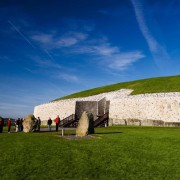
Dublin: Boyne Valley with Newgrange and Bru Na Boinne Entry
Free cancellation 848 traveller reviews Booked securely via partner
Check availability & prices →
From €85 per person
The Boyne Valley is where Irish civilisation began. Long before the Celts arrived, Neolithic farmers built massive passage tombs along this river valley that remain some of the most impressive prehistoric structures on earth. This day trip from Dublin takes you to the heart of it all, with skip-the-queue access to Newgrange - a 5,000-year-old chamber tomb that predates the Egyptian pyramids by five centuries.
Walking into Newgrange is one of those experiences that stays with you. You move along the narrow passage into the central chamber, where your guide explains how the builders aligned the entrance so precisely that the rising sun floods the inner chamber with light on the winter solstice - a feat of engineering that still works perfectly after five millennia. The Bru na Boinne visitor centre sets the scene beforehand, with an excellent exhibition on Neolithic life in the Boyne Valley.
Beyond Newgrange, you’ll visit the Hill of Tara, where Ireland’s High Kings were crowned for thousands of years, and the monastic ruins at Monasterboice, home to Muiredach’s High Cross - a masterpiece of early medieval sculpture covered in biblical scenes carved in stone over a thousand years ago. There’s also a photo stop at Trim Castle, the largest Anglo-Norman fortress in Ireland. If you want to understand the deep roots of Irish history, this day covers more ground than almost anything else you can do from Dublin.
The Bru na Boinne Visitor Centre is the only way in to Newgrange - access is by shuttle bus from the centre, not from the monument itself. Arrive with the tour group and let the guide handle the logistics; the shuttle timing is managed on your behalf, which is one of the real advantages of a guided day over trying to coordinate this independently.
The Hill of Tara is not signposted for what it really is. You’ll walk among earthen mounds and a standing stone called the Lia Fáil - the Stone of Destiny - on an open hilltop with long views in every direction. The interpretation board is light. Let your guide explain the layers: Bronze Age burials, Iron Age ringforts, and the later mythological associations with the High Kingship. It makes a visit to what looks like a grassy hill into something that earns the drive.
The photo stop at Trim is brief, but the view across the River Boyne to the keep earns it. Trim Castle is a three-storey cruciform keep on the south bank of the Boyne - the largest Anglo-Norman fortress in Ireland - and the classic photograph is from the far bank, looking across the water to where the Yellow Steeple rises behind it. If you’ve got fifteen minutes and want to stretch your legs, the walk from the castle around to that opposite bank is a two-kilometre return and takes you past the fragment of 14th-century abbey that the steeple came from.
Monasterboice’s high crosses are best photographed in overcast light, which Ireland provides reliably. Full sun creates harsh contrast on the stone relief panels. If you have a phone camera, overcast is your friend here - the carved biblical scenes on Muiredach’s Cross read much more clearly when the light is flat.
Monasterboice sits about eight kilometres from Drogheda - if you’re building a longer trip around the Boyne Valley, Drogheda makes a better overnight base than Dublin for this circuit. It’s a medieval walled town on the River Boyne with the best-preserved town gate in Ireland, St Laurence’s Gate, and Scholars Townhouse Hotel on King Street turns in the best dinner in the region. Newgrange and Knowth are fifteen minutes west; Monasterboice is a short drive north.
The day returns to Dublin in the late afternoon. If you’re staying in the city, the timing works well for a quiet early dinner rather than rushing into evening plans. You’ll have covered roughly 150 kilometres and five thousand years of Irish history, and you’ll want to sit down.