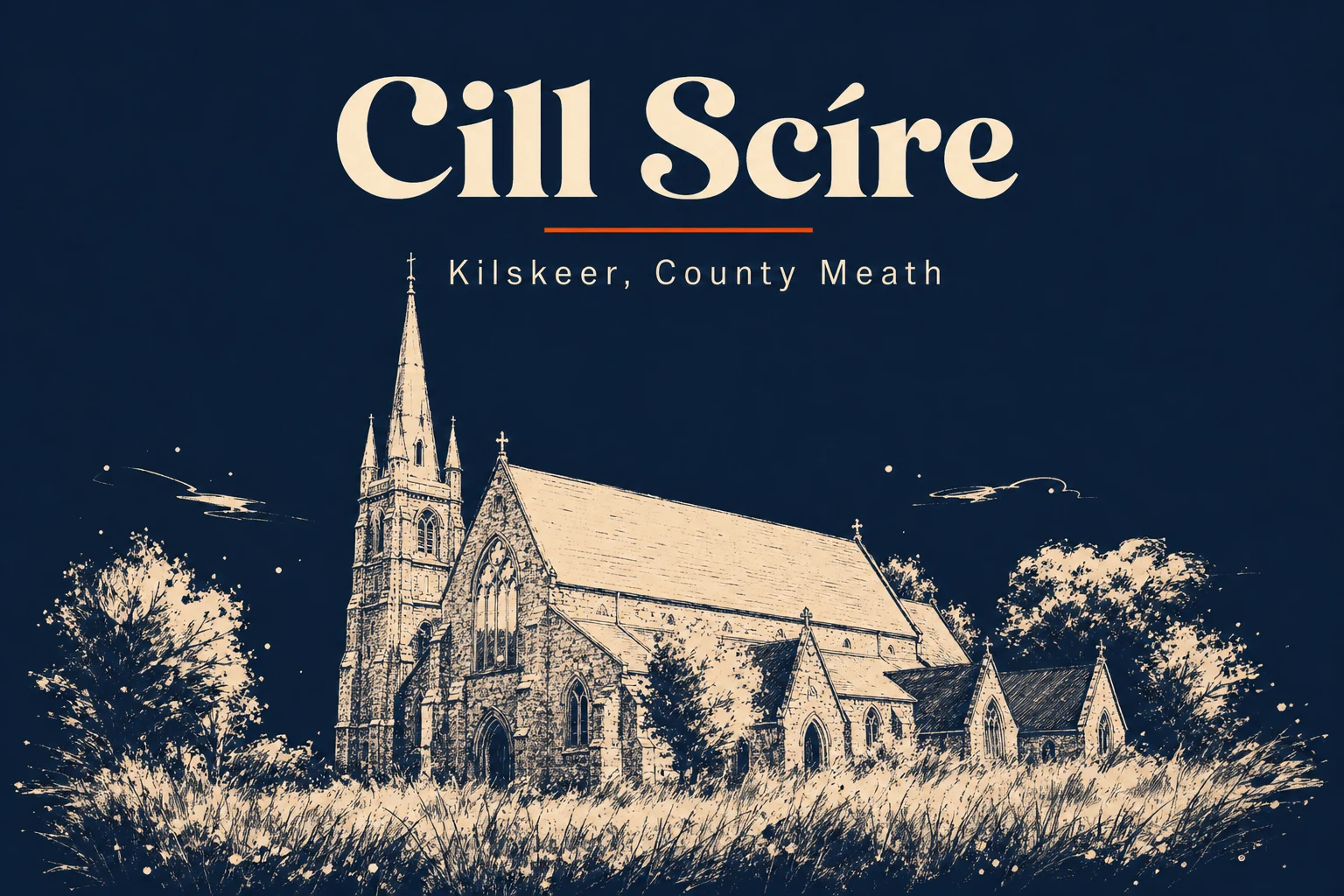
Cill Scíre · Co. Meath
A townland and a handful of houses on the road below Loughcrew - a sixth-century monastery, a round tower stump, and the parish that bred the man who wrote The Red Flag.
Kilskeer - the maps and the parish both spell it Kilskyre - is barely a village. It is a townland and a scatter of houses 10 kilometres southwest of Kells, in the high quiet country below the Loughcrew hills. The name is Cill Scíre, the church of Scíre, and the church she founded is why anyone ever stopped here at all.
St Scíre, the story goes, was a granddaughter of Laoghaire, the High King at Tara who fenced with St Patrick. She put a monastery on this ground in the sixth century and it grew into a place of learning, the way these early Irish foundations did. Then it was plundered and burned by the Danes in 949 and battered again in the centuries after, the way these places also did. What is left is a stump of round tower and a clutch of old tombs in the graveyard across from the present church.
That church - St Alphonsus, built between 1847 and 1854 through the work of Fr Kelly - was designed by James Joseph McCarthy, the Gothic Revival architect they called the Irish Pugin. It is a serious building for so small a place, and it is the one thing in the village a passing visitor would actually stop the car for.
The other reason to know Kilskyre has nothing to do with stone. Jim Connell, born in the townland of Rathniska in this parish in 1852, went to London, watched a stationmaster lower a red signal flag during the 1889 dock strike, and wrote The Red Flag - the anthem the labour movement has sung ever since. Crossakiel, the next village, keeps his memory with a monument and a festival. Brian O'Higgins, poet and Sinn Féin man, came from here too. A small parish with a long reach.