County Westmeath Ireland · Co. Westmeath · Clonmellon Save · Share
POSTED FROM
CLONMELLON
CO. WESTMEATH · IE

Clonmellon
Rathaird

The Ireland's Hidden Heartlands
STOP 04 / 04
Rathaird · Co. Westmeath

A planned village on the N52 with a ruined castle and an unlikely link to Lawrence of Arabia.

Clonmellon is a planned village on the N52, laid out around 1770 by Sir Benjamin Chapman of Killua Castle, two kilometres west. The Chapman family had been granted the land in 1667 as Cromwellian payment, and the town came as part of the long Anglo-Irish project of building a tenant population from scratch. The result is one long, broad, tree-lined main street with the houses lined up along it. Drive through and you'd be in and out in a minute.

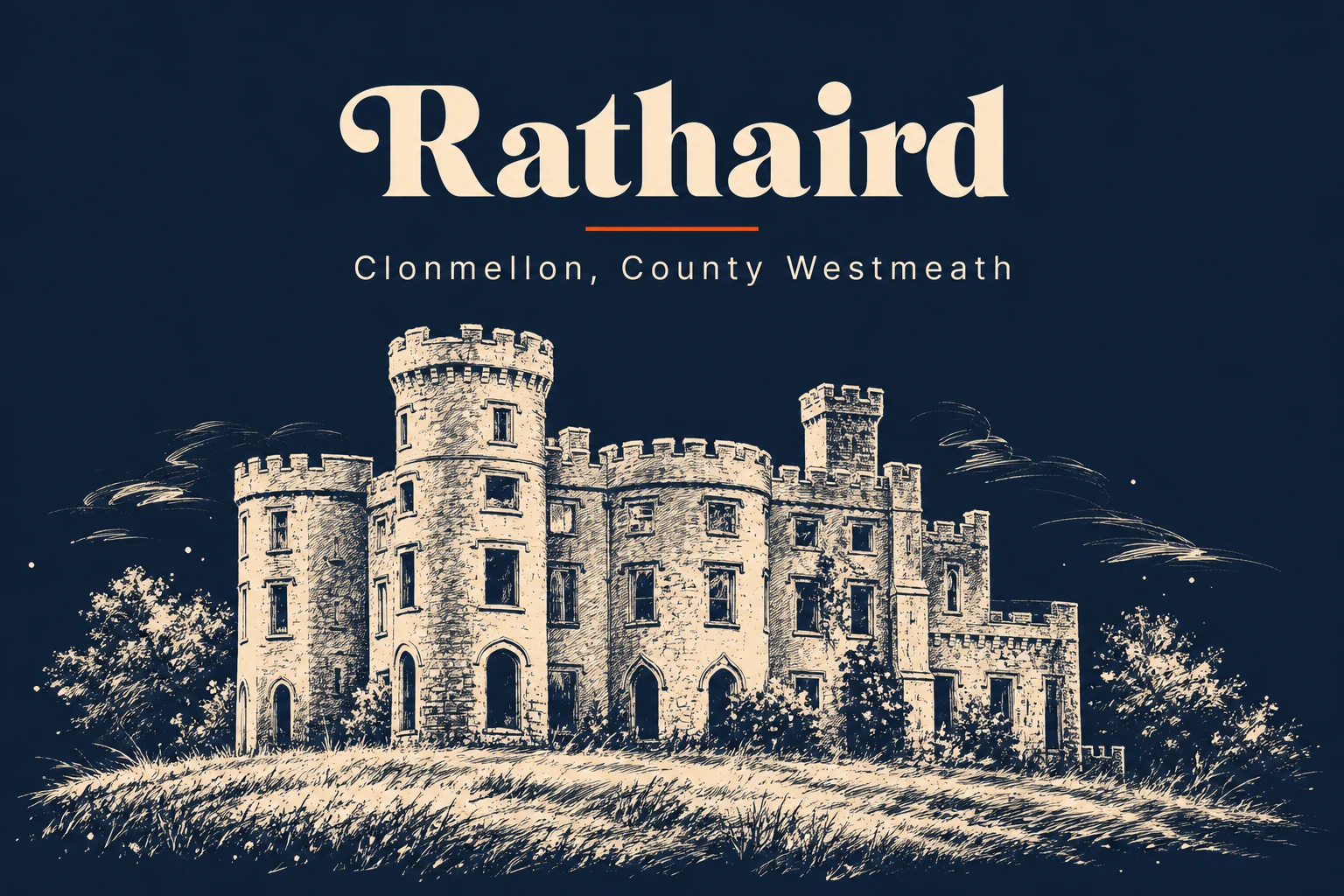
The reason to stop is Killua. The castle the Chapmans built was a serious Gothic Revival mansion — round towers, oval drawing room, the lot — and after the family sold up in 1949 it spent half a century as a roofless ruin in a field. A Mexican-Austrian banker bought it in 1999 and put twenty years of his own money into restoring it. It's a private house now, not open to visitors, but the gates and the grounds are visible from the road and the obelisk near the castle is a story in itself.

And then there's the Lawrence thing. Sir Thomas Chapman, the 7th Baronet, lived at Killua with a wife and four daughters. In the mid-1880s he ran off with the governess, Sarah Junner, took her surname (Lawrence), and started a second family in Wales. Their second son, Thomas Edward, grew up to become Lawrence of Arabia. He was illegitimate, the title died with his father, and the connection to a small Westmeath village is the kind of thing you only find out by stopping somewhere most people drive past.

The third local story — the one carved into the obelisk in Killua's grounds — is that Sir Walter Raleigh planted the first potato in Ireland here in 1586. It is, to be clear, almost certainly not true. Youghal in Cork makes the same claim with better paperwork. But the obelisk was built in 1810 by Sir Thomas Chapman to commemorate it, and it has stood there in a Westmeath field for two centuries insisting otherwise. Take it as the local legend it is.
Population
702 (2022)
Walk score
One long tree-lined street, ten minutes end to end
Founded
c. 1770 (planned town, Sir Benjamin Chapman)
Coords
53.6638° N, 7.0162° W
01 / 04

At a glance.

Three things every local will eventually mention. Read these and you've already understood more than most day-trippers do.

02 / 04

Stories & lore.

The reason to come back. The things every local will eventually tell you about, usually after the second pint.

From Cromwellian grant to twenty-year restoration

Killua Castle

Captain Benjamin Chapman, an officer in Cromwell's army, was granted around 1,163 acres at Killua in 1667 as payment for services rendered during the conquest. His descendant, also Sir Benjamin Chapman, built the present house around 1780 — hall, oval drawing room, dining room, the works. Sir Thomas Chapman added the round tower and the rest of the Gothic Revival drama in the 1820s. The Chapmans sold up in 1949 after the death of the 7th Baronet, the building was unroofed, and it sat as a romantic ruin for fifty years. In 1999 the Mexican-Austrian banker Allen Sangines-Krause bought the wreck and spent twenty-one years restoring it as a private home — geothermal heating, solar, wind turbine, the lot. Completed in 2020. Not open to the public. The gates and the grounds are off the L1413 west of the village.

Why a Westmeath baronet became a Welsh schoolmaster

Lawrence of Arabia

Sir Thomas Robert Tighe Chapman was born at Killua in 1846. He married Edith Hamilton in 1873, had four daughters, and settled into the life of an Anglo-Irish landlord. Around 1885 the household discovered he was in love with the daughters' Scottish governess, Sarah Junner. He left his wife, took Sarah's borrowed surname (Lawrence), and lived with her in Wales and then Oxford for the next thirty-four years. They had five surviving sons, the second of whom — Thomas Edward Lawrence, born 1888 — would later ride into Damascus. Thomas Senior succeeded as 7th Baronet in 1914 but, his sons being illegitimate, the title died with him in 1919. The Killua estate passed sideways and was eventually sold. T.E. Lawrence reportedly visited the place once.

A 200-year-old folklore claim, in stone

The Raleigh Obelisk

Standing in the grounds of Killua, near the castle, is an obelisk commissioned in 1810 by Sir Thomas Chapman (the same Sir Thomas who would later add the round tower). It commemorates the legend that Sir Walter Raleigh planted the first potato in Ireland on this estate in 1586. Take this with a grain of salt the size of a potato. Youghal, Co. Cork, claims the same thing with rather more historical evidence behind it; the truth is probably that the potato arrived in Ireland through several ports and several gardens around the same time. But Sir Thomas Chapman believed it enough to put up an obelisk, and the obelisk is still there, two centuries later, quietly arguing with Cork.

03 / 04

Things to do outside.

Wear waterproofs. Bring a sandwich. Tell someone where you're going if it's the mountain.

Killua Castle grounds (from the road) The castle is private and the gates are closed, but the L1413 west out of the village runs along the demesne wall and gives you views of the castle, the lake, and the Raleigh Obelisk. Park sensibly in the village and walk it. Do not climb the wall.
2 km returndistance
30 mintime
The Main Street Broad, tree-lined, designed in 1770 to look exactly like this. Sts. Peter and Paul Catholic church (c.1808) sits at the western end with a freestanding belltower added around 1830. The whole thing is the planned-village template, intact.
500 mdistance
10 mintime
+

Getting there.

By car

On the N52 between Athboy (10 minutes south) and Castlepollard (15 minutes north). Mullingar is 30 minutes south-west; Kells is 15 minutes east. Dublin is about 1h 15m via the M3 and N52.

By bus

Bus Éireann route 111 (Athlone–Mullingar–Cavan) stops in the village a handful of times a day. Slow but it works.

By train

Nearest station is Mullingar (30 minutes by road) on the Dublin–Sligo line.

By air

Dublin Airport is about 1h 15m by car.