County Westmeath Ireland · Co. Westmeath · Collinstown Save · Share
POSTED FROM
COLLINSTOWN
CO. WESTMEATH · IE

Collinstown
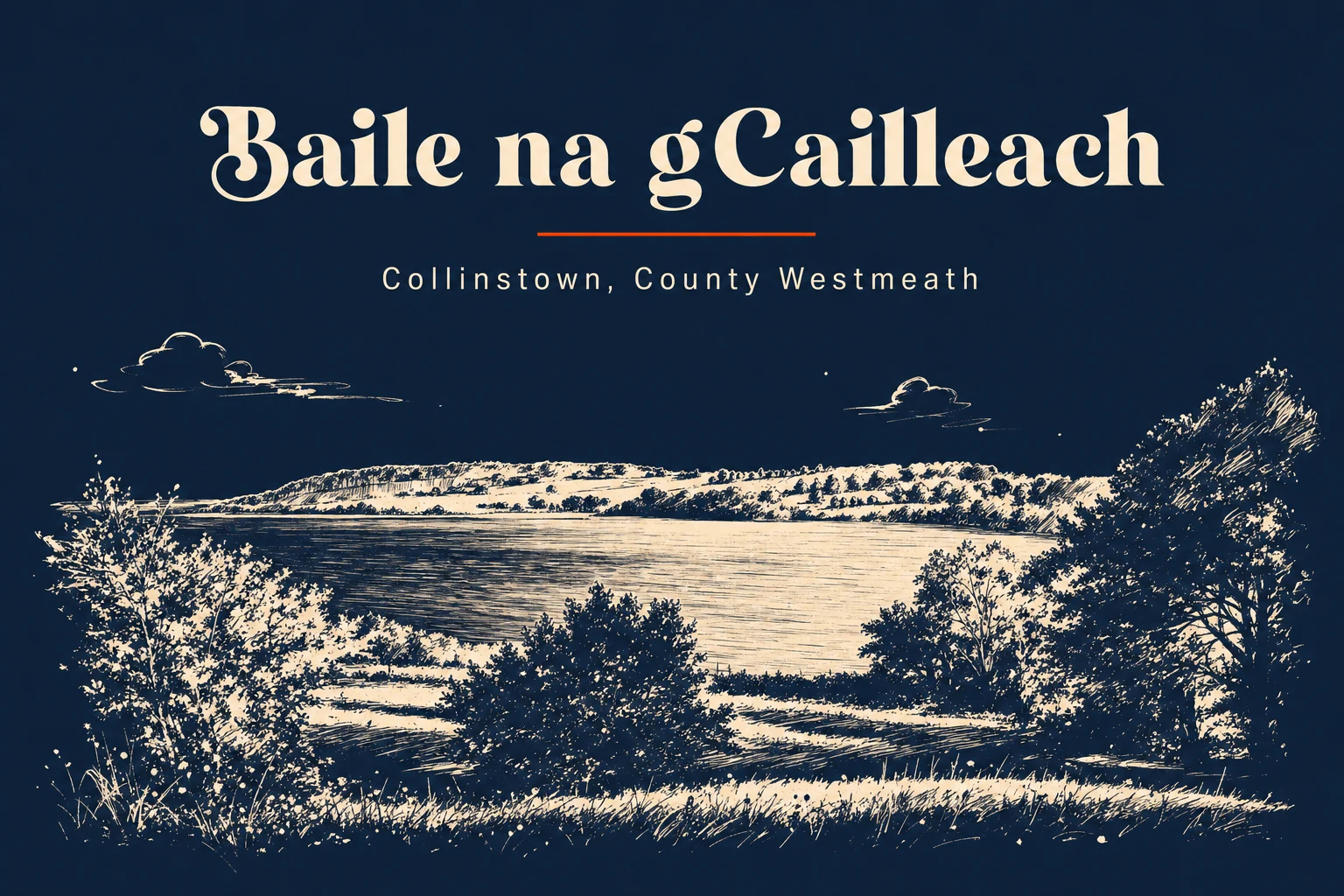
Baile na gCailleach

The Ireland's Hidden Heartlands
STOP 07 / 07
Baile na gCailleach · Co. Westmeath

A Lough Lene crossroads, seven kilometres from one of Ireland's strangest monastic ruins.

Collinstown is the service village for somewhere stranger than itself. Fore — the proper village, seven kilometres east in its bowl of bog and limestone — is where the monks were and the wonders are. Collinstown is where the people who tend Fore live, drink and post their letters from. The Irish name, Baile na gCailleach, means "town of the veiled women" or "town of the hags" — a convent stood on an island in Lough Lene a long time ago, and the village kept the name when the convent went.

The lake is the other reason to come. Lough Lene sits on the northern edge of the village, fed by springs, and was one of the first freshwater swims in Ireland to fly a Blue Flag. The locals call the swimming spot "the Cut". On a still evening you can see why monks chose to live on its islands — the water goes glass-flat and the hills around hold the light for an hour after the sun has gone.

Bring the day. Drive in, walk Fore in the morning with a sandwich, swim Lough Lene in the afternoon, eat in the village, and drive home. Or stay nearby in Castlepollard or Multyfarnham and treat Collinstown as the lunch stop. There are no hotels in the village. There is no need for one. Two pubs, a lake and one of the country's older ruins is the whole offer, and on the right Saturday it is plenty.
Population
356 (2016)
Coords
53.6694° N, 7.2333° W
01 / 07

At a glance.

Three things every local will eventually mention. Read these and you've already understood more than most day-trippers do.

02 / 07

The pubs.

None of these are themed Irish pubs, because they don't need to be. A few that earn the trip:

The Maypole Bar & Lounge

Old-style, three rooms
Village pub

Three small bars knocked together at the crossroads. Snug lounge with a pool table and a dartboard. The kind of pub that was here before the road was paved and will be here when it is dug up again.

The Lough Lene Inn

Sport on, music sometimes
Village pub

The other pub in the village, a hundred yards away. Sports on the telly, a pool room out the back, occasional live music. The Saturday-night option when The Maypole feels too quiet.

03 / 07

Stories & lore.

The reason to come back. The things every local will eventually tell you about, usually after the second pint.

And one stubborn lintel

The Seven Wonders of Fore

Seven kilometres east, in the valley of Fore, locals will list them off in the same order their grandparents did. The monastery built upon the bog. The mill without a race — water made to flow from dry ground. The water that flows uphill. The tree that will not burn. The water in the holy well that will not boil. The anchorite shut up in a stone cell on the slope above the church. And the great lintel over the door of St Féichín's church, which the workmen could not lift, until the saint went home from breakfast, prayed, and set it in place himself. You can stand at most of them in an afternoon. A few of them you have to take on faith.

Founded 630, died of plague 664

St Féichín

Féichín was born up in Sligo and came south to a clearing in the bog at Fore around 630, where he founded the monastery that drew, by the time of his death, around three hundred monks. His feast day is the 14th of January and he died in the great plague that swept Ireland in 664-665. The seven wonders are mostly his miracles, gathered up by later monks who needed the saint to be larger than the man. The Norman de Lacys built a Benedictine priory beside the older site around 1200 and the two ruins now sit a few hundred yards apart, a grey-stone reminder that Fore had two acts.

Lifted from the lake in 1968

The Lough Lene Boat

On the east side of Lough Lene, in 1968, divers raised an oak logboat from the lakebed. Radiocarbon dating put it at the Roman period at the latest — first century AD or earlier — not the Bronze Age, though the local accounts often blur the two. It was paddled, about eight metres long, and is now in the National Museum in Dublin. A second boat came out of the same waters in the same year. They are reminders that the lake was already a place people moved goods and people on, two thousand years ago, when Collinstown was still trees.

Why the village is named for them

The hags

Baile na gCailleach. "Town of the veiled women" — cailleach is the Irish for an old woman, a hag, or a nun, and the word does the work of all three. A small convent stood on an island in Lough Lene at some early date, long enough ago that the records are thin, and the village kept the name when the women were gone. It is the only Irish place name that comes with that particular shrug built in.

04 / 07

Things to do outside.

Wear waterproofs. Bring a sandwich. Tell someone where you're going if it's the mountain.

Fore Abbey loop Drive to Fore village, park at the visitor information point, and follow the marked trail past the seven wonders. The anchorite cell, St Féichín's church with the famous lintel, the de Lacy priory ruin, the mill, the holy well. A short walk that takes longer than you think because you keep stopping.
3 km loopdistance
1.5 hourstime
Lough Lene shore at the Cut A short walk from the village out to the swimming spot on the lake's south shore. Picnic tables, a changing area, the kind of clean cold water that stops your breath in May and rewards you in August. Bring a towel.
1–2 kmdistance
30 minutes plus a swimtime
Turgesius's ringforts at Ranaghan West of the village, in the townland of Ranaghan, the remains of several ringforts are signposted. One is locally attributed to Turgesius, the Viking leader who is supposed to have ruled Dublin in the 840s. The attribution is folkloric. The earthworks are real.
Short detourdistance
30 minutestime
05 / 07

When to go.

There is no bad time. There are different times.

Spring
Mar–May

Fore is at its best when the trees are bare and the wonders are easy to read. The lake is too cold for most. The pubs are quiet.

◉ Go
Summer
Jun–Aug

Swim at the Cut, walk Fore in the morning before the sun gets high, eat in Castlepollard. Long evenings make a single day stretch.

◉ Go
Autumn
Sep–Oct

The valley turns gold and the light is good for photographs of ruins. The lake holds its summer warmth into early October if you are brave.

◉ Go
Winter
Nov–Feb

Fore is exposed and the bog gets soft. The pubs are open. The lake is for hardier people than most of us.

◐ Mind yourself
06 / 07

What to skip.

Honestly? Don't bother.

If a local was sitting beside you, this is the bit where they'd lean in.

×
Treating Collinstown as the destination

It isn't. Fore is the destination, the lake is the swim, Collinstown is the village you eat and drink in between. Plan accordingly.

×
Looking for a hotel in the village

There isn't one. Castlepollard or Multyfarnham have rooms. Mullingar has more of them. The village has two pubs and that is the deal.

+

Getting there.

By car

Mullingar to Collinstown is 25 minutes on the R394 then the R395. Castlepollard is six minutes north. Dublin is 1h 30m on the M3 and N52.

By bus

Bus Éireann services run Mullingar–Castlepollard nearby; Collinstown itself is best reached by car. Check current timetables.

By train

Nearest station is Mullingar (Sligo line). Then a 25-minute drive.

By air

Dublin Airport is 1h 20m by car.