County Westmeath Ireland · Co. Westmeath · Multyfarnham Save · Share
POSTED FROM
MULTYFARNHAM
CO. WESTMEATH · IE

Multyfarnham
Muilte Farannáin

The Ireland's Hidden Heartlands
STOP 05 / 05
Muilte Farannáin · Co. Westmeath

A village, a Franciscan friary that won't quit, and the lake the Children of Lir spent 300 years on.

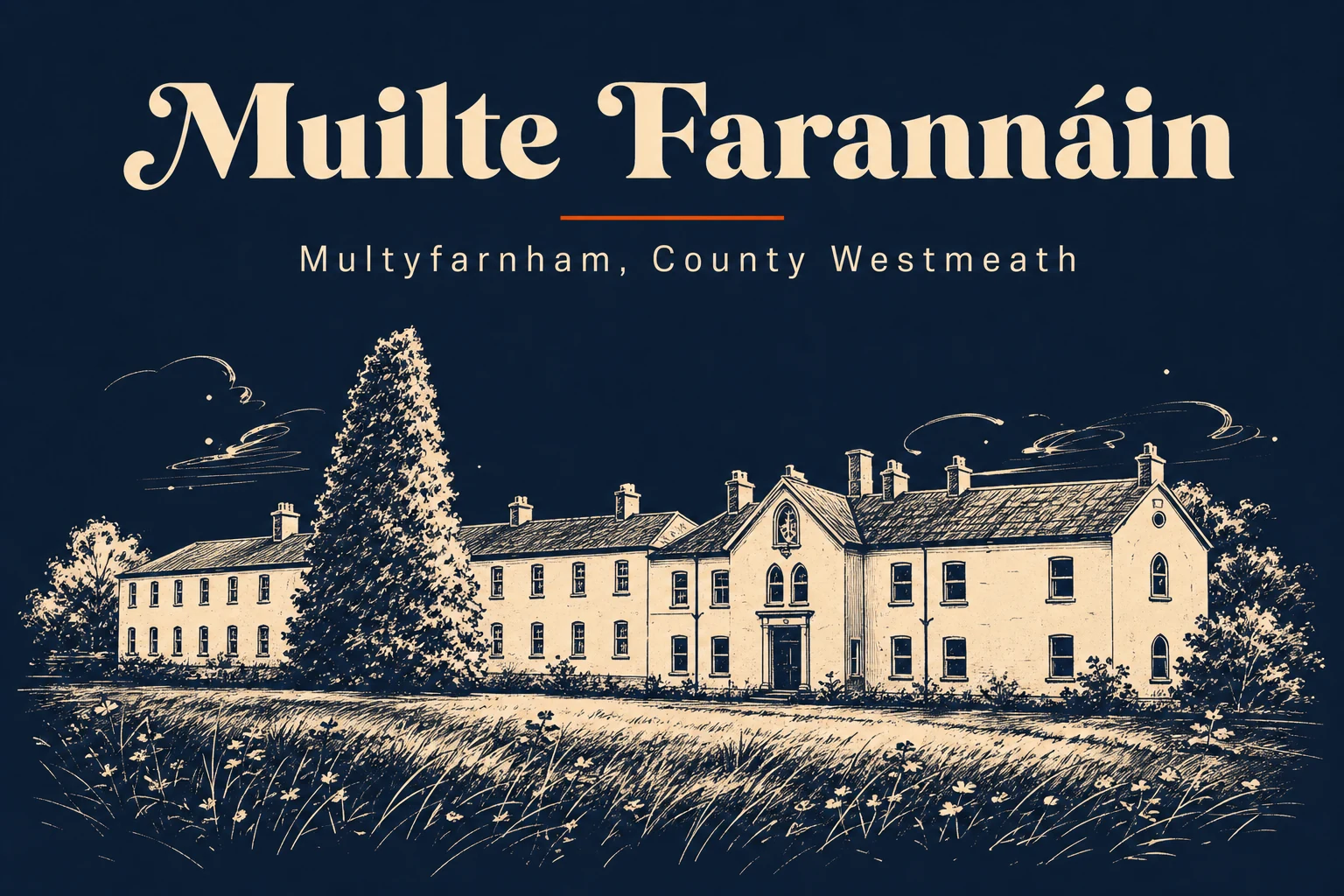
Multyfarnham is a single street in north Westmeath, half a mile from the southern end of Lough Derravaragh. Four hundred and sixty people, a friary, a pub, a GAA pitch, and a lake older than memory. That is the whole place. It is enough.

The friary is the reason the village exists. Franciscans came in around 1238 at the invitation of the Norman Delamer family, and William Delamer built them a stone church and house here by 1268. They have been at it, more or less, ever since. Suppressed by Henry VIII in 1540, scattered by Cromwell in 1651, in ruins by the 1820s, rebuilt in 1839, college opened 1899, college closed 2003. The friars are still here. Walk in. The Stations of the Cross in the grounds are life-sized and oddly affecting.

Then the lake. Lough Derravaragh is one of the great mythic places in Ireland and almost nobody outside Westmeath knows it. Aoife, Lir's second wife, brought the four children here in her chariot, told them to bathe, and turned them into swans for nine hundred years. The first three centuries they spent on this water. The Fate of the Children of Lir — Oidhe Chloinne Lir — is one of the Three Sorrows of Storytelling, and Westmeath gets the saddest sorrow.

Come for an afternoon. Walk the friary. Drive five minutes to the lake. Climb Knockeyon if the weather holds. Have a pint at Weir's. Do not expect more than that, and you will not be disappointed.
Population
460
Founded
Friary built c. 1268 by William Delamer
01 / 05

At a glance.

Three things every local will eventually mention. Read these and you've already understood more than most day-trippers do.

02 / 05

The pubs.

None of these are themed Irish pubs, because they don't need to be. A few that earn the trip:

Weir's Bar & Restaurant

Old-world, local
Pub & restaurant, family-run

On Main Street, run by the Weir family. Restaurant Wednesday to Sunday, bar most evenings. Home-cooked food, a fire in winter, the kind of place where the bar staff will know who you are by your second pint.

03 / 05

Stories & lore.

The reason to come back. The things every local will eventually tell you about, usually after the second pint.

Oidhe Chloinne Lir

The Children of Lir

Lir, a king of the Tuatha Dé Danann, lost his wife and married her sister Aoife. Aoife grew jealous of his four children — Fionnuala, Aodh, Fiachra and Conn. She brought them here to Lough Derravaragh in her chariot, told them to bathe, and struck them with a druid's wand. They became swans, sentenced to 300 years on this lake, 300 on the Sea of Moyle, 300 on the Bay of Erris. They kept their human voices and their singing was said to ease any sorrow that heard it. People camped on the shore for centuries to listen. It is one of the Three Sorrows of Storytelling. Stand by the water at Coolure point and the lake does not feel like it is arguing with the story.

Eight hundred years of being told to leave

The friary that would not stop

Built around 1268 by William Delamer for the Franciscans who had been in the area since about 1238. Suppressed by Henry VIII in 1540, when the friars went to ground in the surrounding farms and kept saying mass anyway. Queen Elizabeth's officials called them a nest of scorpions. Cromwell's men finally scattered them in 1651. The buildings fell into ruin. The Franciscans came back in 1827, built a new friary in 1839, opened the Seraphic College in 1899 — a school for boys destined for the order. The college eventually became a Franciscan-run secondary school and agricultural college; the agricultural college closed in 2003. The friars themselves are still here. The math on that is hard to take in.

What Multyfarnham used to mean

The agricultural college

Through the second half of the twentieth century, the Franciscan College of Agriculture was the village's other life. Farmers' sons came from all over the country to learn dairy, tillage, machinery. Eight hundred boys in the dormitories at the peak. It closed in 2003 on foot of the Teagasc-funded Kennedy report and the village felt it for years. The buildings now hold a nursing home, a cancer support centre, an autism charity, and the friars themselves. Multy used to be a place you came to learn farming. Now it is a place you come to think about the friary, the lake, and what time does to institutions.

04 / 05

Things to do outside.

Wear waterproofs. Bring a sandwich. Tell someone where you're going if it's the mountain.

Knockeyon Hill South-eastern shore of Lough Derravaragh, signposted from the R394 north of Mullingar via Crookedwood. The track is short and steep — 215m of hill that punches above its weight. Ruined chapel of Saint Eyon halfway up. Park sensibly; the access is across farmland and the right to walk it is a courtesy, not a guarantee.
1 km up, 1 km downdistance
30–40 mintime
Lough Derravaragh shore (Coolure / Donore) There is no single signposted lakeshore loop. The amenity area at Donore on the western shore gives the easiest access for a swim or a paddle. From Multyfarnham, the lane down to Coolure House on the southern shore puts you at the swans' end of the lake. Do not promise yourself a circuit — the lake is bigger than it looks, and most of the shoreline is private.
Variabledistance
Half hour to half daytime
The friary grounds The Stations of the Cross around the friary grounds are life-sized stone tableaux, weather-blackened and quietly powerful. Fifteen minutes if you walk through them, longer if you sit. Open during daylight, no charge.
500 mdistance
20 mintime
+

Getting there.

By car

Mullingar to Multyfarnham is 14 km on the R394 north — about 20 minutes. Castlepollard is another 12 km on. Dublin is 1h 30m via the M4 and N4.

By bus

Local Link Westmeath services run between Mullingar and Castlepollard via Multyfarnham, but timetables are sparse and Sunday is essentially nothing. Drive if you can.

By train

Nearest station is Mullingar (Sligo line from Dublin Connolly). Then a 20-minute drive or a long, lonely cycle.