1918, and the village burned the book
The Valley of the Squinting Windows
John Weldon was the schoolmaster's son at Ballinvalley. He took the pen name Brinsley MacNamara, moved to Dublin, joined the Abbey, and in 1918 published a first novel called The Valley of the Squinting Windows. The fictional village of Garradrimna — its drunks, its informers, its hypocrites, its illegitimate children — was Delvin with the names changed. The book was read aloud on the steps of Clonyn Castle so the whole village could place itself in it. Copies were burned. A libel suit followed and MacNamara was ordered to pay compensation. The bigger casualty was his father James, the principal of the local national school, who was boycotted by parents and eventually had to leave the parish. Brinsley never came back. The novel is still in print. A book fair was held in his honour in Delvin in 2010. The wound is old. It is not entirely closed.
Nugent's tower, 1181
Delvin Castle
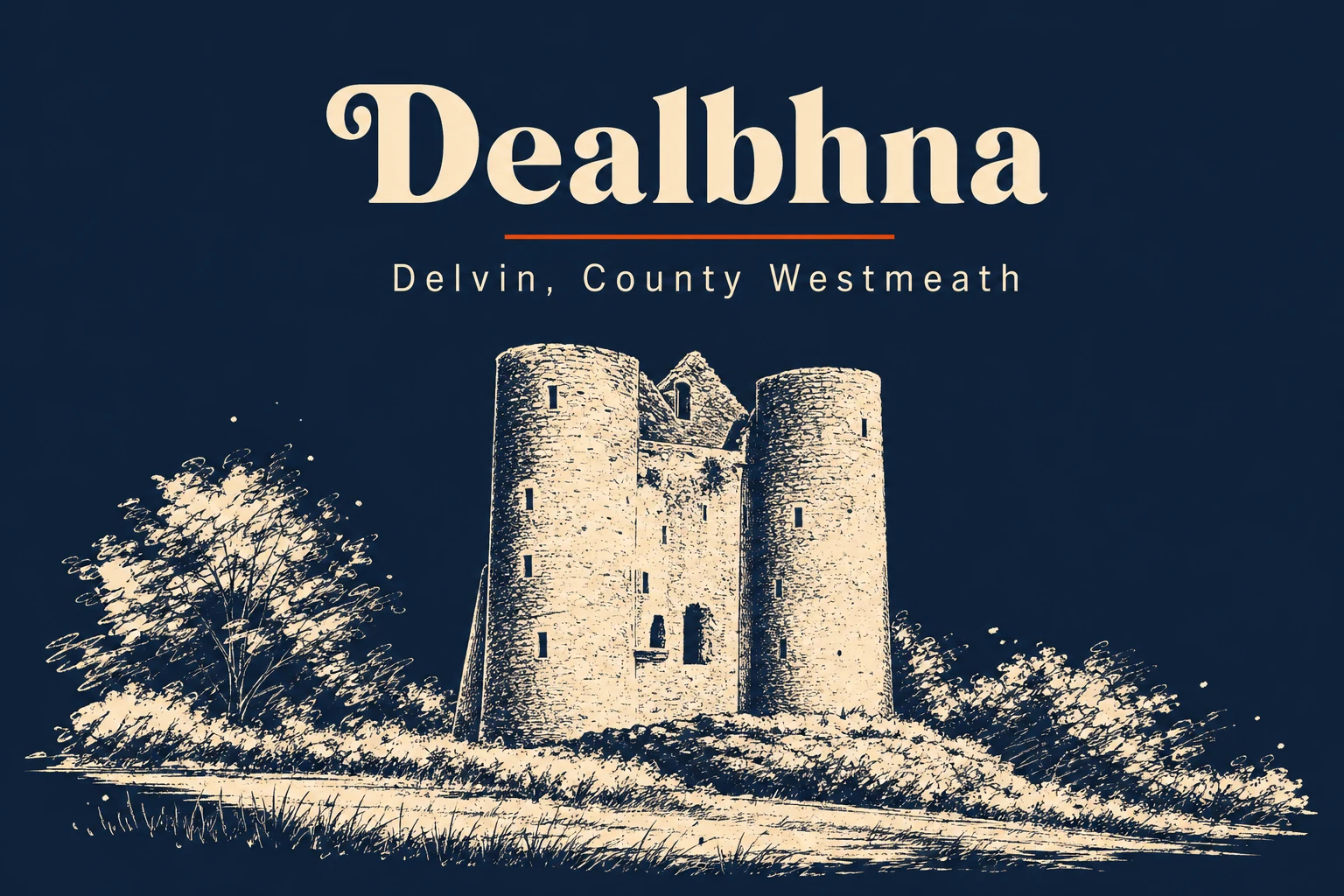
The four-towered ruin in the field beside the village is the original castle, built in 1181 by Hugh de Lacy — the first Norman lord of Meath — for his brother-in-law Gilbert de Nugent. It is one of the oldest stone castles in the midlands. The Nugents held it, more or less, for the next seven centuries, becoming Earls of Westmeath in 1621 and Catholic stalwarts through the worst of the penal years. The tower is roofless and the walls are gapped, but the shape of the keep is still legible. Climb the gate carefully. It is not a managed site.
Burned, rebuilt, burned again
Clonyn Castle, twice over
Up the hill from the village stands Clonyn Castle — also called the new Delvin Castle. The first version was thrown up by Richard Nugent, 1st Earl of Westmeath, in 1639. When Cromwell's army marched on Meath the Earl burned his own house rather than let it fall, and ran for Galway. His grandson rebuilt it, the family lived there until 1860, and Lord and Lady Greville replaced the lot with the Victorian baronial castle visible from the road today, completed in 1876. After the Second World War it was briefly home to a group of Jewish child Holocaust survivors known as the Clonyn Castle Boys. It is private property. Look from the road and let it be.
Seven hundred years of the same family
The Nugents
Few Irish villages can name the family that has stood over them for the entire span of recorded history. Delvin can. The Nugents arrived with the Normans in 1181, became barons of Delvin, then earls of Westmeath, kept their faith through the Reformation, kept their land through the penal laws, and produced soldiers, scholars and at least one cardinal. The barony of Delvin still exists on the map. The senior line eventually faded into other titles, but the name Nugent is on more headstones in this parish than any other. The story of Delvin is more or less the story of one family running out of money slowly.