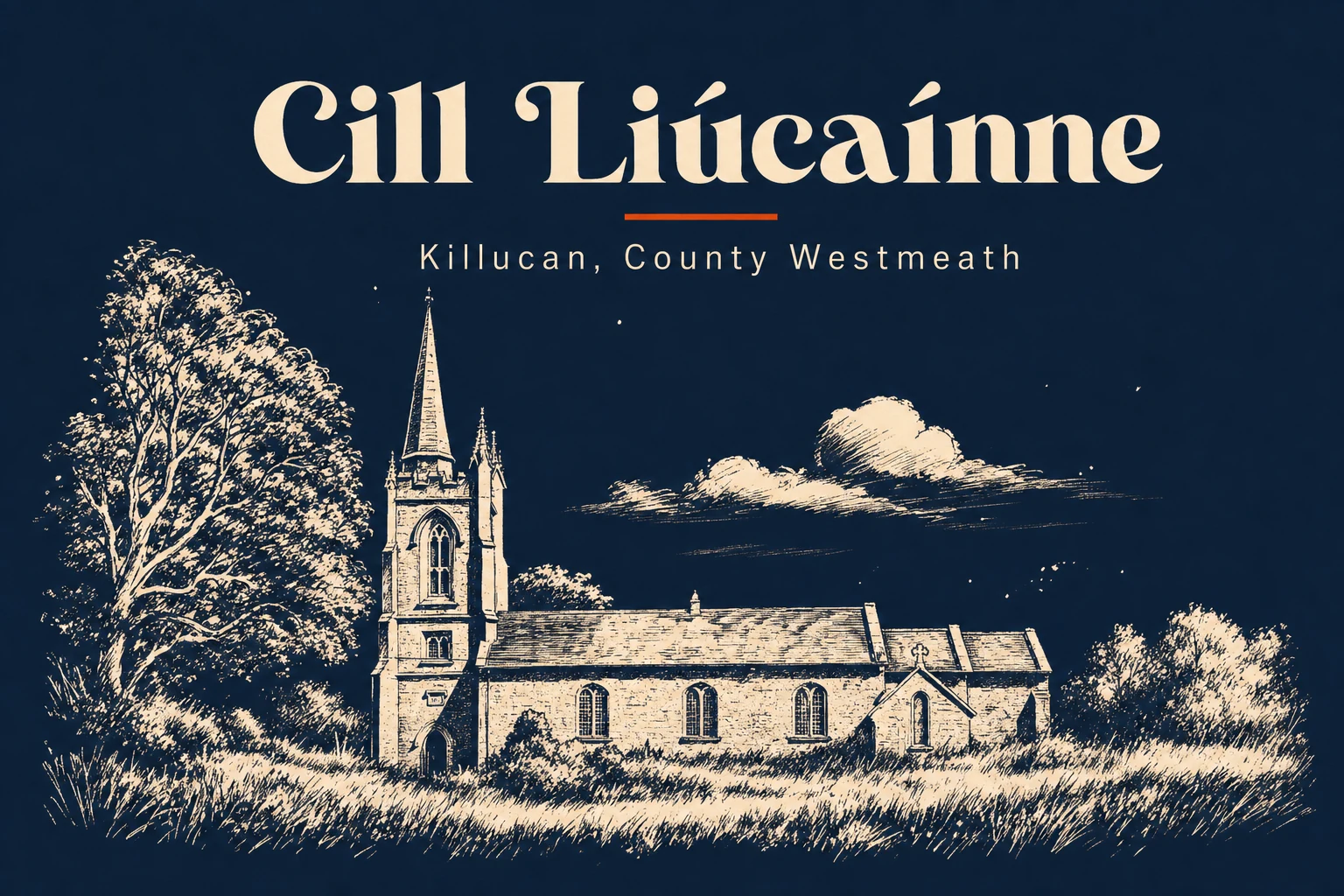
Cill Liúcainne · Co. Westmeath
Two villages on one hill, a Norman motte above them, the Royal Canal below.
Killucan is two villages pretending to be one. Killucan proper is the church-and-shop end. Rathwire is the half-mile up the road with the Norman motte on the hill above it. The CSO calls the joined-up census town Killucan-Rathwire. The GAA club, the school and the parish all just say Killucan. Walk between them in ten minutes and you have seen the place.
The history is older than it looks. Guaire built a ringfort on the hill - Ráth Guaire, the fort of Guaire - and Hugh de Lacy planted his motte on top of it in the 1170s after the Normans rolled in. King John came in person in 1210 to put manners on the de Lacys. The mound is still there. The Darcy family held it through the 1500s until the Silken Thomas rebellion burned the castle. The hill has watched a lot.
The Royal Canal arrived in the 1800s and gave the village its modern shape - bridges, locks, a station. The station shut in 1963 and the campaign to reopen it has been running, on and off, for more than twenty years. The canal stayed. The Royal Canal Greenway now runs the towpath all the way from the Meath border to Longford, and Killucan is one of the access villages, with three bridges within walking distance of the centre.
There is no hotel in the village. There is a pub at Cunningham's, another at Nanny Quinn's down at the Thomastown lock, a church with medieval ruins beside the rebuild, a motte on the hill, and a greenway along the canal. That is most of what is here. It is a place to stop on a cycle, eat a sandwich, climb the mound, and move on. Or stay for the GAA on a Sunday and find that there's more to it than the road suggests.