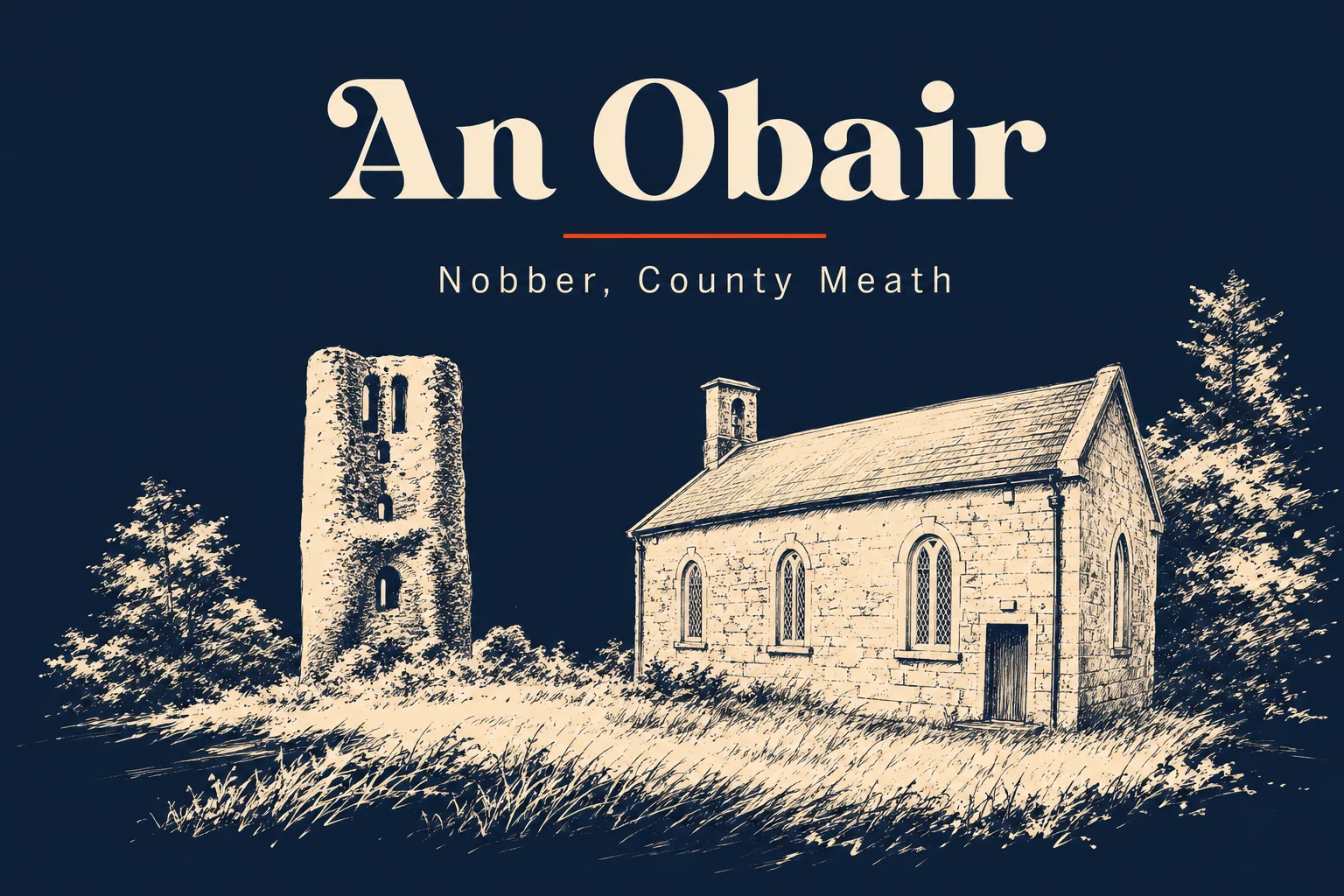
An Obair · Co. Meath
The birthplace of Ireland's last great harper, a clutch of early-medieval high crosses, and a greenway running through it. A small village that remembers.
Nobber is a quiet village in north Meath, on the R162 about nineteen kilometres above Navan, close to where the county runs up against Cavan and Monaghan. Four hundred people. The Irish name, An Obair, means 'the work' - thought to refer to the Norman earthworks thrown up here in the late twelfth century when Hugh de Lacy's man took the Barony of Morgallion and raised a motte.
It is remembered best for one person. Turlough O'Carolan was born near here in 1670 - the harper-composer who bridged the dying Gaelic tradition and the new European classical sound, wrote some 220 tunes, and died in 1738. Most of his music is still played. Some of it you have heard without knowing his name.
But the older layer is worth as much as the harper. In the old graveyard at St John's there is a small group of high and Latin crosses - the only real sign that an early Christian monastery once stood here. They were properly recognised only this century. The village also sits on the Boyne Valley to Lakelands Greenway, the old railway line turned cycle path, which is the main reason anyone outside Meath now stops at all.
Set your expectations to the size of the place. Nobber is one pub, one shop or two, a church, a graveyard with good stones, a greenway and a strong memory. That is the entry. Come for the crosses and the line, not for a day out.