County Offaly Ireland · Co. Offaly · Clonmacnoise Save · Share
POSTED FROM
CLONMACNOISE
CO. OFFALY · IE

Clonmacnoise
Cluain Mhic Nóis

The Ireland's Ancient East
STOP 06 / 06
Cluain Mhic Nóis · Co. Offaly

A monastery rising from the Shannon in fog. The stones are older than Europe knew the word.

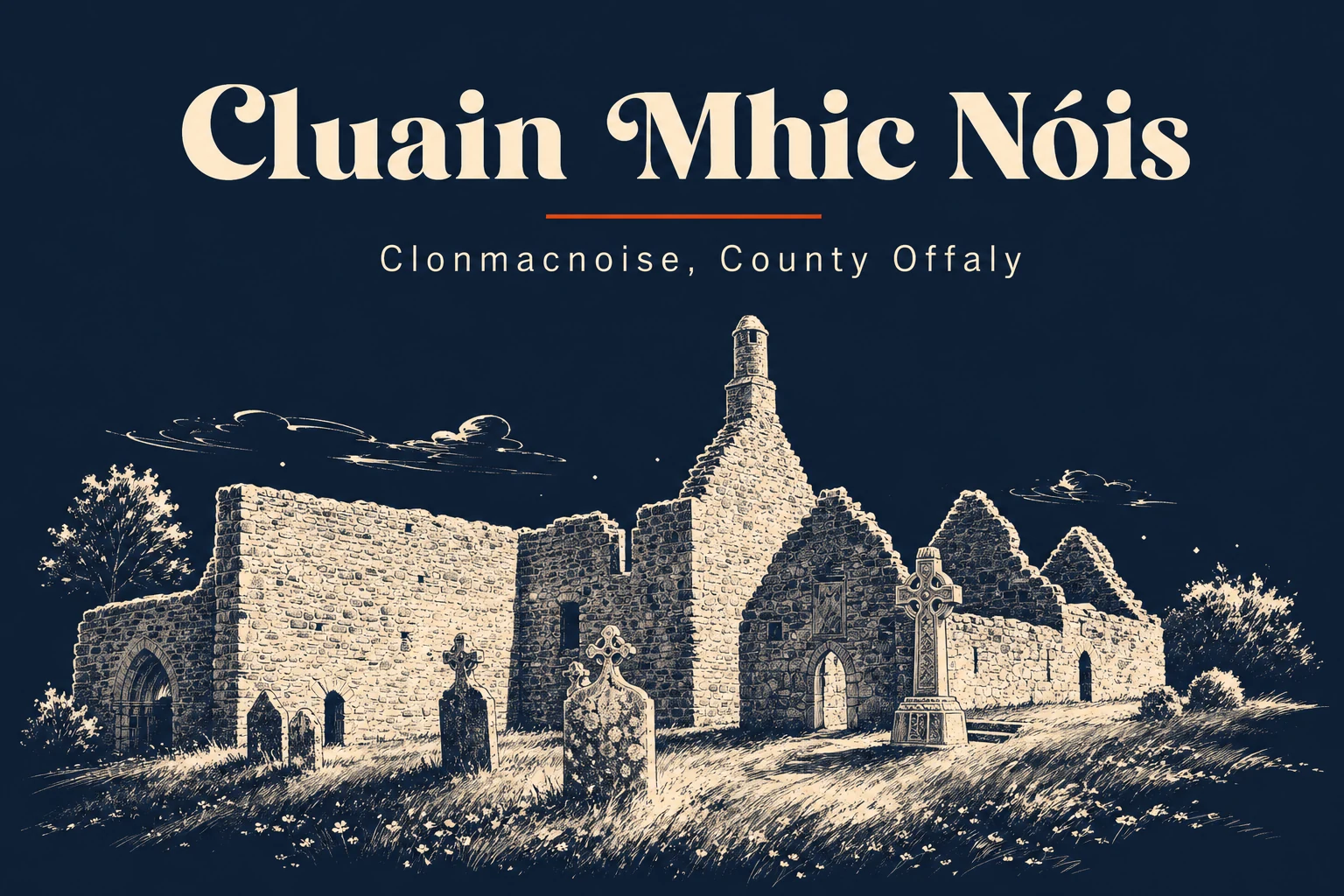
Clonmacnoise is not a village. It's a monastery—founded in 544 AD by St. Ciarán on the banks of the River Shannon, fifteen kilometers south of Athlone. What remains is a complex of stone churches, two round towers, three high crosses (one still with its ring intact), and the largest collection of early medieval grave slabs in Western Europe: over two hundred carved stones in the ground.

In the 6th and 7th centuries, monks came here from across Europe—Franks, Saxons, Angles—to study and copy manuscripts in a monastery that had become a centre of learning as important as anywhere else in the medieval Christian world. They were raided by Vikings at least six times. The Vikings came up the Shannon to plunder it. In 1552, the English garrison from Athlone finally did what the Vikings had tried: they ransacked it, drove out the monks, and left it to the weather.

What you need to know: it's an OPW site now, with admission, a visitor centre, and a car park. Walk the grounds for an hour and the tourists thin. Stand at the high crosses in November fog and you'll understand why monks sailed across Europe to study in a place like this. The stone doesn't lie about what it has witnessed.
0
Founded
544 AD
Coords
53.3658° N, 7.8700° W
01 / 06

At a glance.

Three things every local will eventually mention. Read these and you've already understood more than most day-trippers do.

02 / 06

Stories & lore.

The reason to come back. The things every local will eventually tell you about, usually after the second pint.

The founding, 544 AD

St. Ciarán's monastery

Ciarán mac an tSáir—Ciarán son of the carpenter—founded Clonmacnoise on the Shannon in the middle of the 6th century. No stone remains from his hands. What you see now was built in the centuries after him, but the place itself, on this particular riverbank, never moved. By the 7th century, monks were coming from Britain and the continent to learn and to copy books. The Abbey was one of the great scriptoria of early medieval Europe.

The age of manuscripts

A learning centre

For two centuries Clonmacnoise was a refuge for Christian scholarship at a time when much of Europe was in the dark. Monks copied manuscripts—gospels, theological works, poetry. Scribes came from France, Germany, and beyond. The Book of Dimma and the Leabhar Dimma were copied here. The monastery had a school. It had a library. It had a reputation that echoed across the Christian world. Then the Vikings came.

At least six times

The Viking raids

Between 836 and 1050 the monastery was raided, ransacked, and burned by Viking warriors who sailed up the Shannon to reach it. Each time it rebuilt. The round towers—the tall, perfectly cylindrical stone towers you see on the site—may have been built partly as defensive structures, partly as bell towers and treasuries where valuables could be locked away before the next raid. Six times was not the end.

1552 and the English garrison

The last plunder

The English garrison stationed at Athlone was tasked with subduing the region. In 1552 they marched on Clonmacnoise and did what the Vikings had tried for centuries: they finished it. They drove out the monks, ransacked the buildings, and desecrated the graves. The monastery never recovered. What remains now is what they left behind—stones too heavy to move and too sacred to destroy completely.

03 / 06

Things to do outside.

Wear waterproofs. Bring a sandwich. Tell someone where you're going if it's the mountain.

The site itself The monastery grounds are a walking circuit. Start at the cathedral (10th century). Move to the Round Tower of the Scribes. Stand at the Cross of the Scriptures and read the carved panels. Walk to Teampall Doirninnn and the second Round Tower. The grave slabs lie in the grass like a conversation in stone. There is a visitor centre at the entrance with a small café.
c. 1.5 kmdistance
1–2 hourstime
The Shannon's edge Walk the riverbank east and west of the site. In winter, when the callows flood, the water reaches far into the meadows. In summer the river is low and slow. Either way, the Shannon at Clonmacnoise is the reason the monastery was here—this is the main transport route through Ireland. The monks chose their location with precision.
c. 2–3 kmdistance
1 hourtime
Tochar Phádraig (Pilgrim Road) The Pilgrim Road connects several sacred sites across the midlands. Clonmacnoise is one waypoint. The full route is a multiday pilgrimage walk. Sections near the site are signposted. It's an ancient trackway that predates Christianity.
Variabledistance
Multiple daystime
04 / 06

When to go.

There is no bad time. There are different times.

Spring
Mar–May

Lambs in the meadows. The site is quiet and the light on the stone is pale. The River Shannon is clear and fast with snowmelt.

◉ Go
Summer
Jun–Aug

The site gets busy with coach tours. Come early in the morning (before 10am) or go in the late afternoon (after 4pm). The summer light is strong and can be harsh on the grey stone.

◐ Mind yourself
Autumn
Sep–Oct

The water begins to rise. The light changes. Tourists thin. This is when the place begins to feel the way the Vikings would have seen it: approaching from the water.

◉ Go
Winter
Nov–Feb

The Shannon floods the callows and turns the monastery into an island. The fog comes in off the water. The stone becomes ancient again. This is the season to understand what it meant to be a monk here, waiting for the Vikings, copying by candlelight.

◉ Go
05 / 06

What to skip.

Honestly? Don't bother.

If a local was sitting beside you, this is the bit where they'd lean in.

×
A coach tour

The site is overwhelmed by coaches during summer. You don't need a guide to read the stones. Book the visitor centre but walk the grounds alone. Come in November if you can.

×
Skipping the visitor centre interior and the 'history' film

The stones themselves are the museum. The grave slabs are better than any explanation. The crosses speak. Walk the site first, in silence. The visitor centre café is useful if you need shelter or a cup of tea.

×
Trying to find a pub or restaurant nearby

There are none. The site is isolated on the Shannon. Bring food or eat in Athlone (15km north). The emptiness is the point. The monastery was built to be quiet.

+

Getting there.

By car

From Dublin: N5 south to Longford, then R392 east towards Athlone, then local roads to Clonmacnoise. c. 2 hours. From Cork: N8 north to Mallow, N20 north towards Dublin, then R392. c. 2.5 hours. The site is signposted once you reach Athlone.

By bus

No direct bus service to Clonmacnoise. Bus Éireann operates from Athlone (15km away). Bus to Athlone from Dublin, Cork, Galway, or Limerick, then local taxi. Not efficient.

By train

Irish Rail to Athlone, then taxi or hire a car. The railway station at Athlone is the nearest rail connection.

By air

Fly to Shannon Airport (c. 90km), Dublin (c. 130km), or Cork (c. 180km). Rent a car. Public transport does not serve this site well.