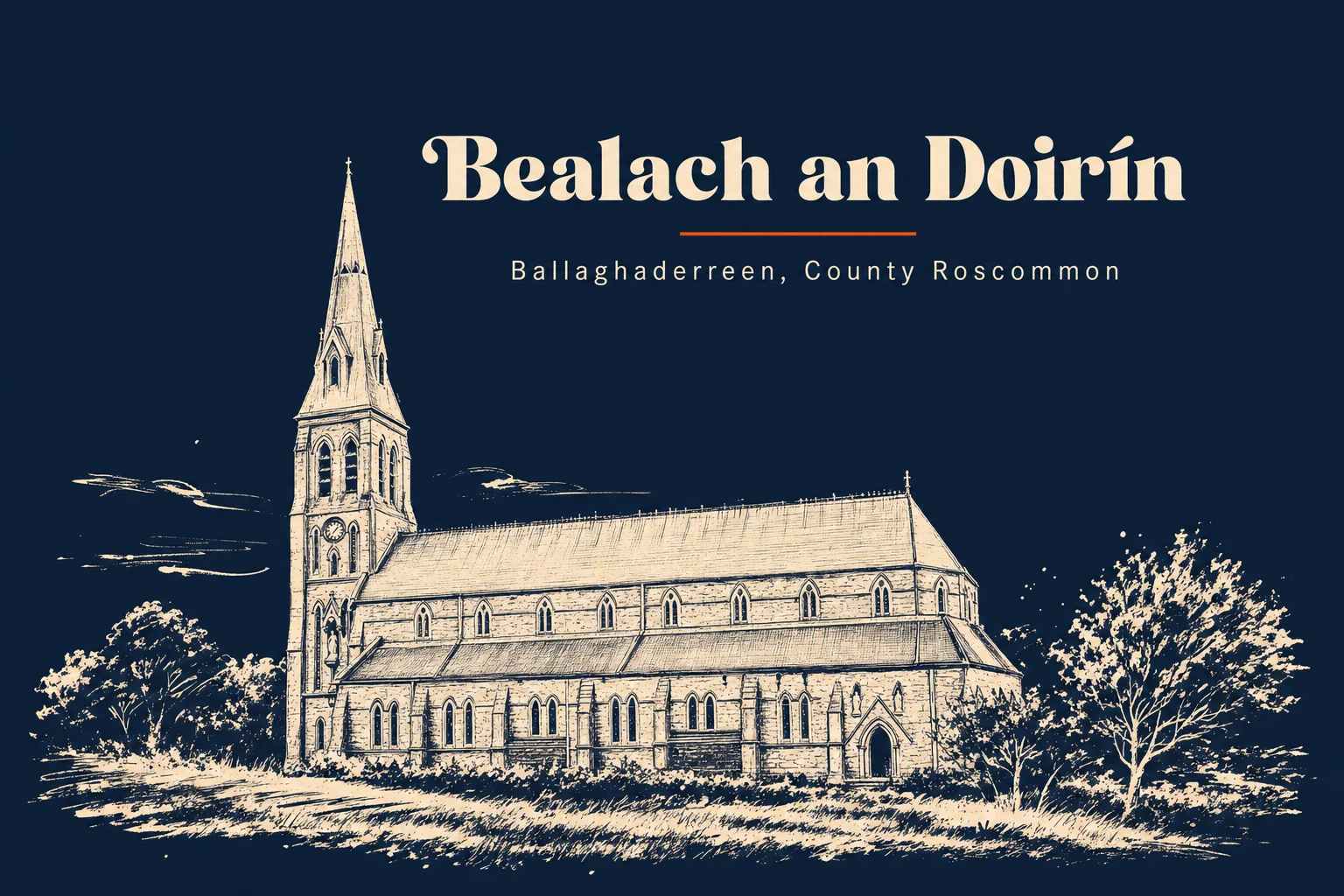
Bealach an Doirín · Co. Roscommon
A cathedral town that used to be in Mayo, with a tower you can see for miles and a county line that the football club refuses to recognise.
Ballaghaderreen is a market town of a little under two and a half thousand people in the far north-west corner of Roscommon, where the county meets both Mayo and Sligo. Except it was not always Roscommon. Until 1899 the town and the parish of Edmondstown were part of County Mayo, in the barony of Costello. The Local Government (Ireland) Act 1898 moved the line and put Ballaghaderreen into Roscommon. That is a century and a quarter ago now. The town is administratively Roscommon. The Gaelic football club still plays in the Mayo championship, and nobody here thinks that needs explaining.
The town you see grew under one family. When Luke Dillon brought his people to Ballaghaderreen in 1812 he began the most interesting chapter the place has. Dillon House on the Market Square was where John Blake Dillon was born in 1814 - the man who, with Thomas Davis and Charles Gavan Duffy, founded The Nation newspaper in 1842. His son John Dillon, the Irish Parliamentary Party leader, called the same house his home in the West. The square is still the shape of the town, and the house is still on it.
Then there is the cathedral, which is the thing you actually see. The Cathedral of the Annunciation and St Nathy was begun in 1855 under Bishop Patrick Durcan, finished and opened in 1860, built in the Gothic Revival style. In 1912 the architect W.H. Byrne added the bell tower, the carillon and a new sacristy. The tower is close to sixty metres, far too big for the town around it, and that is the point. It is the cathedral of the Diocese of Achonry, which reaches across three counties, and Ballaghaderreen was chosen to hold it.
Do not come for a resort. The N5 bypass took the through-traffic away from the square in 2014, which is good for the town and means you have to choose to stop. When you do, there is one substantial pub-restaurant-guesthouse on the square, a cathedral worth the neck-craning, a heritage walk that takes in Dillon House and the old Convent of Mercy, and Lough Gara and its iron-age crannogs a few kilometres south. It is a quiet town that produced loud people. That is most of its character.