County Sligo Ireland · Co. Sligo · Ballymote Save · Share
POSTED FROM
BALLYMOTE
CO. SLIGO · IE

Ballymote
Baile an Mhóta

The Ireland's Ancient East
STOP 06 / 06
Baile an Mhóta · Co. Sligo

A market town with a ruined castle and a manuscript that taught the world to read Ogham.

Ballymote is a south Sligo market town that has carried more history than the size of the square suggests. The Dublin–Sligo trains still call here. The Friday morning still has farmers in town. The castle at the edge of the village has been a ruin for longer than it was ever a castle.

The thing worth knowing is the Book. The Book of Ballymote was compiled in the town in or around 1391 — a Gaelic manuscript of pedigrees, place-name lore, biblical history, and, almost as an aside, a treatise on Ogham script. It is one of the few keys scholars had to decoding the carved stones of early Ireland. The book is in the Royal Irish Academy in Dublin now. The town stays where it was made.

There is no coast here. The Atlantic is up the road in Strandhill and the lakes are over in Leitrim. Ballymote is for the train pause, the castle walk, the pilgrimage stop on the way to Knock, and the quiet evening that south Sligo is rather good at. Don't come for a checklist. Come for an hour, walk to the castle, look at the four towers still leaning into each other, and let the town do its slow work.
Population
~1,500
Walk score
Square to station in ten minutes
Founded
Castle built c. 1300
Coords
54.0903° N, 8.5181° W
01 / 06

At a glance.

Three things every local will eventually mention. Read these and you've already understood more than most day-trippers do.

02 / 06

Stories & lore.

The reason to come back. The things every local will eventually tell you about, usually after the second pint.

Built c. 1300, taken by O'Donnell in 1598

Ballymote Castle

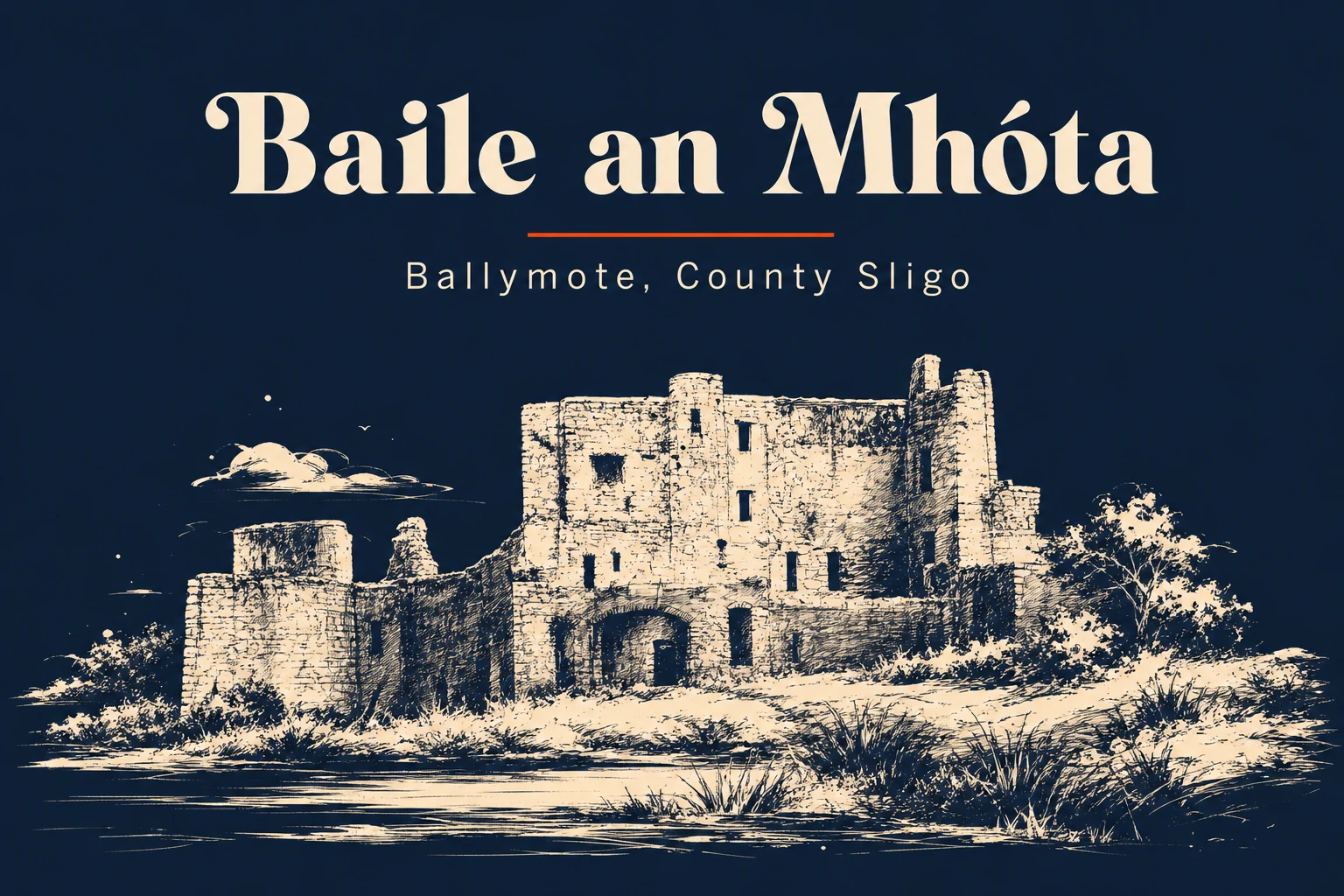
Richard de Burgo, the Red Earl of Ulster, built Ballymote Castle around 1300 as the strongest of the de Burgo castles in Connacht — a square keep with a tower at each corner and twin gate-towers. It changed hands often through the late medieval centuries. Red Hugh O'Donnell took it in 1598, the year before the Battle of the Yellow Ford, and used it as a forward base. The castle has been a ruin since the Williamite wars. The walls and four corner towers are still standing. You can walk in off the lane and stand in the middle of it.

A 1391 manuscript that decoded a script

The Book of Ballymote

Around 1391 a group of scribes working in or near the town compiled what came to be called the Book of Ballymote — Leabhar Bhaile an Mhóta. It is a large vellum manuscript of Irish genealogies, hagiography, world history, and translations from Latin. Tucked inside it is the Auraicept na nÉces, a treatise that explains the Ogham alphabet. Centuries later, when antiquarians tried to read the carved Ogham stones standing in fields across the south and west, the Book of Ballymote was the Rosetta they had. The manuscript is now in the Royal Irish Academy in Dublin. The town it was written in is the one you are standing in.

Composer of Maritana, born nearby in 1812

Vincent Wallace

William Vincent Wallace was born in 1812, the composer of the opera Maritana that played London, Dublin and Vienna in the middle of the nineteenth century. He is usually listed as a Waterford man — his family lived there for much of his childhood — but the Sligo connection is local and persistent, and Ballymote claims a corner of him. The opera is rarely staged now. The tunes are still sung in country houses if you know who to ask.

03 / 06

Things to do outside.

Wear waterproofs. Bring a sandwich. Tell someone where you're going if it's the mountain.

Castle and Square loop From the square out to Ballymote Castle, around the field-edge of the ruin, and back the long way through the lanes. The corner towers look different from each side. Do it in evening light.
1.5 kmdistance
25 mintime
Ballymote Station walk A short loop down to the Dublin–Sligo line and back. The station building is Victorian, plain, still working. The Connolly train comes through and everyone on the platform watches it.
1 kmdistance
15 mintime
04 / 06

When to go.

There is no bad time. There are different times.

Spring
Mar–May

Long light, hedges coming up, the castle field dries out. Knock pilgrimage buses start running through.

◉ Go
Summer
Jun–Aug

The Heritage Weekend in August opens the castle for tours and the town puts on a programme. Trains busier in both directions.

◉ Go
Autumn
Sep–Oct

The honest season. Quiet in town, the harvest in around it, the castle in low gold light. The best of the year for a walk-and-train day.

◉ Go
Winter
Nov–Feb

Short days and the wind off the bog goes through you. The pubs stay open and the train still runs. Bring a coat that means it.

◐ Mind yourself
05 / 06

What to skip.

Honestly? Don't bother.

If a local was sitting beside you, this is the bit where they'd lean in.

×
Trying to see the Book of Ballymote in Ballymote

It isn't here. The manuscript is in the Royal Irish Academy on Dawson Street in Dublin. Read about it in the town if you like, but the page-turn is in Dublin.

×
Driving past for Sligo without stopping at the castle

It is five minutes off the N4 and the gate is open. Twenty minutes in the field is twenty minutes well spent.

×
Booking a hotel in town for a Knock pilgrimage day

The buses pause here, then push on. The accommodation is in Knock or Sligo town. Use Ballymote for the stop, not the bed.

+

Getting there.

By car

Sligo town is 25 minutes north on the N4. Boyle is 25 minutes south. Knock is 35 minutes west via Charlestown. The town sits a few minutes off the main road.

By bus

Bus Éireann routes through south Sligo call here. Local Link buses run to Sligo, Tubbercurry and Boyle through the week.

By train

Ballymote is on the Dublin Connolly–Sligo line. Several services daily in each direction. Dublin in just under three hours; Sligo in twenty minutes.

By air

Ireland West Airport Knock (NOC) is 40 minutes by road. Sligo Airport is closer but mostly serves general aviation now.