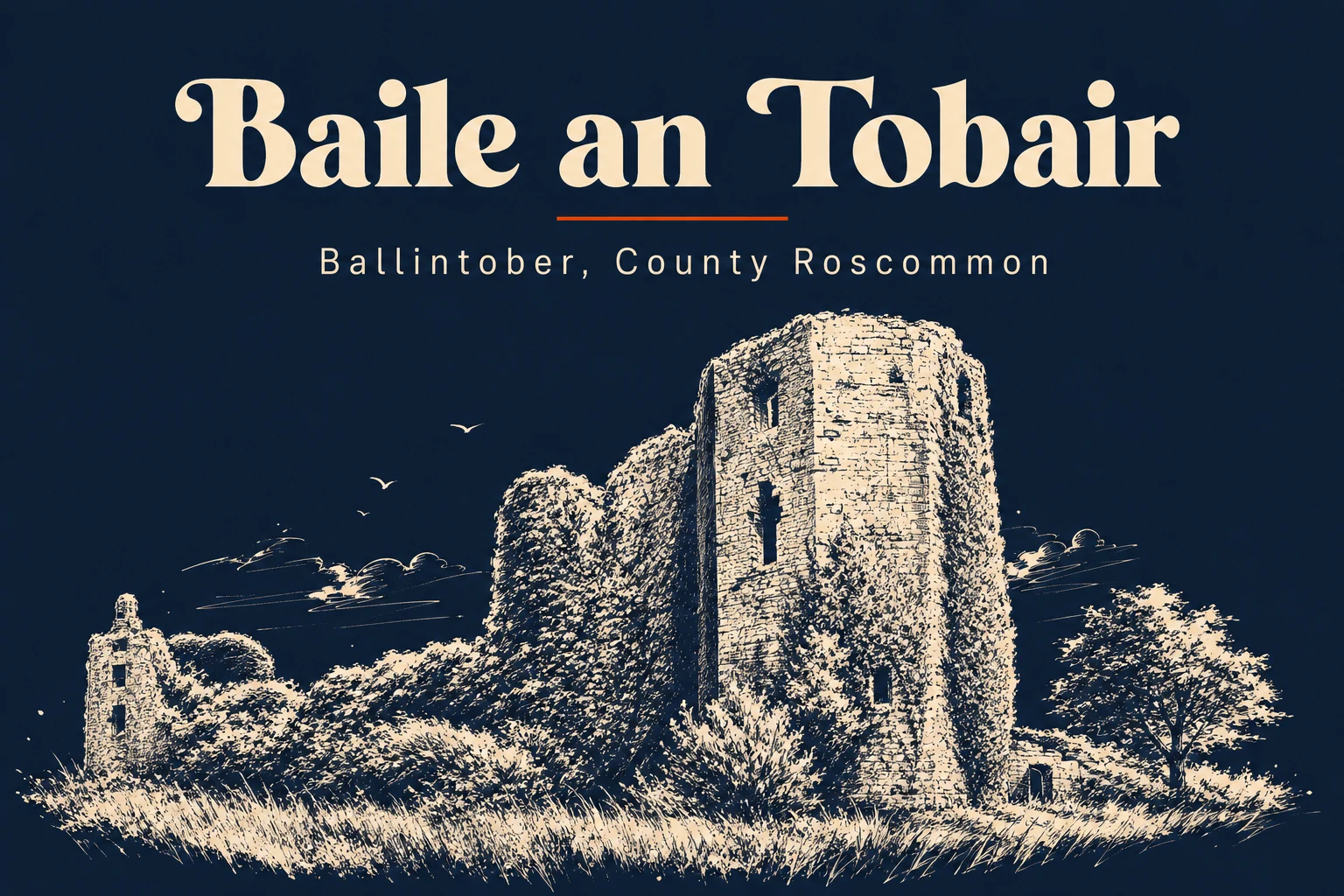
Baile an Tobair · Co. Roscommon
The largest keepless castle in Ireland, the seat of the O'Conor kings, and a village of two hundred people built around the well it is named for.
Ballintober is a village of about two hundred people that exists, more or less, because of one enormous ruin. The castle is the largest keepless castle in Ireland - 73.8 metres by 80.5 metres, a tower at each of the four corners, two more flanking the eastern gate, and no great central keep at all. The outer walls were the defence. It is more than twice the size of Roscommon Castle despite Roscommon having royal patronage, and standing in the field below it you feel that size before you read the numbers.
Richard de Burgh, Earl of Ulster, built it in the early 1300s; it is first mentioned in writing in 1311. By 1381 the O'Conors had taken it, and the O'Conor Don line ruled Connacht from here for the better part of three centuries. They were not conquered invaders living in a Norman shell - they were native Irish aristocracy who took the Norman fortress and made it the caput, the principal seat, of a kingdom. Excavations have found a deserted medieval town spread east across what is now the village, roughly twice the size of the place today.
After a near-attack in 1642 the castle was abandoned as a residence, and in the 1700s the family moved to Clonalis House near Castlerea, where the O'Conor archive, Carolan's harp and the inauguration stone of the kings still sit. Ballintober Castle is still owned by the O'Conors. Since 2015 an American-led fieldschool has been digging and surveying it every July with the family and the local Tidy Towns. The ruin is dilapidated enough that formal access is prohibited - you see it from the road and the field edge, not from inside the walls.
Past the castle there is a church, a holy well, a pub, and the Suck Valley Way going through. That is the village, honestly stated. It is not a day out on its own. It is a half-hour stop with a serious ruin at the centre of it, best paired with Castlerea and Clonalis House six kilometres west.