County Roscommon Ireland · Co. Roscommon · Athleague Save · Share
POSTED FROM
ATHLEAGUE
CO. ROSCOMMON · IE

Athleague
Áth Liag (na Sioca), Co. Roscommon

The Ireland's Hidden Heartlands
STOP 09 / 09
Áth Liag (na Sioca) · Co. Roscommon

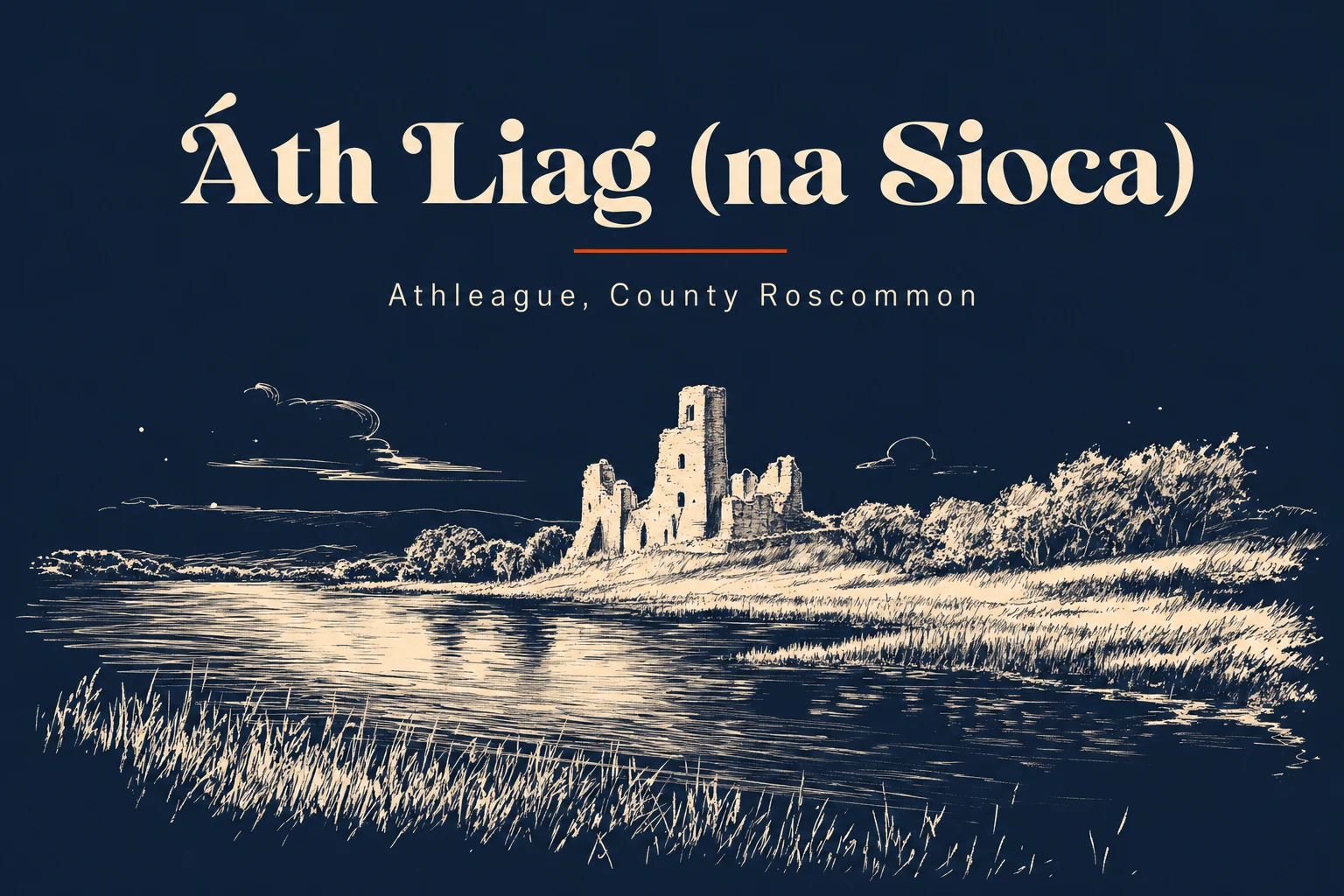
A ford with a castle ruin. The River Suck keeps moving; the tower watches.

Athleague is a small village on the River Suck, about eight kilometres south-west of Roscommon town where the N63 meets the R362. Two hundred and ninety-six people at the last count. It exists because of the river crossing - that is what the name says, Áth Liag, the ford of the flagstones - and the village strung itself along the road that uses the ford.

The history runs deeper than the size suggests. A monk called Maenucán founded a church here around the year 500, and the place turns up in the Annals of Connacht, the Annals of Loch Cé and the Four Masters. By the medieval period this was O'Kelly country, the lordship of Uí Maine, and three O'Kelly castles stood in the parish. One tower house still stands on the bank of the Suck beside the village - the kind of ruin you walk up to, not the kind with a ticket office. The Earl of Kildare captured it in 1499.

The river is the other reason to stop. The Suck through Athleague is well-known coarse-fishing water - roach, bream, perch, pike - and the old Church of Ireland building now works as the Athleague Angling Centre. The Suck Valley Way, a hundred-kilometre looped trail, runs its seventh and eighth stages through here: in from Castlecoote, out toward Ballygar. Quiet walking, river on one side, very few other boots.

Do not arrive expecting a day out. This is a one-pub village with a shop, a butcher and a café, the river, and a tower. That is the entry, and it is honest. Use it as a quiet half-hour on the way between Roscommon town and Ballinasloe, or as a base for a morning on the Suck.
Population
296 (2022)
Pubs
1and counting
Walk score
The whole village is a five-minute stroll; the river is the walk
Founded
Church founded c. 500 by Maenucán; tower house on the Suck, 14th-15th century
Coords
53.5667° N, 8.2531° W
01 / 09

At a glance.

Three things every local will eventually mention. Read these and you've already understood more than most day-trippers do.

02 / 09

The pubs.

None of these are themed Irish pubs, because they don't need to be. A few that earn the trip:

The Bridge House

Family-run village local
Pub & guesthouse, Main Street

The pub in Athleague, in a townhouse dating to around 1863 by the bridge. Family-run, open fire, pool and darts, a big screen for the matches, and rooms upstairs if you are basing yourself on the river. It also doubles as the village hall in practice - dinner dances, craft fairs, club meetings all end up here. If you want one pint in Athleague, this is where you have it.

03 / 09

Where to eat.

PlaceTypeLocal note
Hamrock's Village pub serving food Family-run local pub that puts out a home-cooked lunch through the day. The honest, unfussy midday plate in a village this size - check it is serving before you build a day around it.
Keane's Centra Shop & deli, Main Street The busy village shop, with a well-stocked hot and cold deli, its own coffee dock and a sit-down area. The practical stop for a roll, a coffee and the makings of a riverside picnic before you walk the Suck.
04 / 09

Where to sleep.

PlaceTypeLocal note
The Bridge House Guesthouse rooms above the pub, Main Street Athleague does not have a hotel. The Bridge House offers bed-and-breakfast rooms over the bar, which is the one place to stay in the village itself. For a wider choice of beds, Roscommon town is eight kilometres north and Ballinasloe fifteen south.
05 / 09

Stories & lore.

The reason to come back. The things every local will eventually tell you about, usually after the second pint.

Áth Liag, a crossing between two kingdoms

The ford of the flagstones

The Irish name, Áth Liag, means the ford of the flagstones - a stone-bottomed crossing of the River Suck. The Suck marked the boundary between the old kingdoms of Uí Maine and Uí Briúin, so the ford was a frontier as much as a convenience. A tenth-century account in the annals even has Brian Boru bringing a naval raid up this stretch of water. The ten-arch causeway bridge that carries the road across today dates from the early 19th century, but it is doing the same job the flagstones did fifteen hundred years ago.

Three towers, one ruin left

The O'Kelly castle

Athleague was inside the lordship of Uí Maine, the country of the O'Kellys, and three of their castles once stood in the parish. The tower house on the bank of the Suck beside the village is the one that survives - a fragment of the original gatehouse and a partially visible vaulted chamber still readable in the stone. Garrett Mór Fitzgerald, the Great Earl of Kildare and Justiciar of Ireland, captured it in 1499. Older accounts also tie the site to the O'Conors and put a tower here in the 14th century; the dating is argued, the stone is not.

A monastic site from c. 500

Maenucán's church and the friars

Christian worship at Athleague goes back to about the year 500, when the monk Maenucán Atha Liacc founded a church on the site. Records also remember a medieval house of Grey Friars in the parish; Maylesa O'Hanayn, abbot of Roscommon, is recorded dying at it in 1266. Little of the friary is left to see, but the layering is the point - an early-Christian foundation, a medieval friary, and a tower-house lordship all packed into one small bend of the river.

06 / 09

Things to do outside.

Wear waterproofs. Bring a sandwich. Tell someone where you're going if it's the mountain.

Suck Valley Way through the village Athleague sits between two stages of the 100 km Suck Valley Way looped trail. Stage 7 comes in the 7 km from Castlecoote; Stage 8 runs the 13 km out toward Ballygar. Riverside and quiet-road walking, well waymarked, almost no crowds. Pick up one stage as an out-and-back if you do not want to commit to the whole loop.
Stage 7 (7 km from Castlecoote) and Stage 8 (13 km to Ballygar)distance
Half a day for either stagetime
The bridge, the tower and the riverbank The short village walk: out onto the ten-arch causeway bridge for the view up and down the Suck, then along the bank to the O'Kelly tower-house ruin. Boggy after rain and the tower is an unfenced ruin, so mind your footing. This is the whole heritage of the place in a twenty-minute stroll.
Under 1 kmdistance
20-30 minutestime
Coarse fishing on the Suck The Suck here is well-regarded coarse-fishing water - roach, bream, perch and pike. Pike run best in spring and autumn; perch take well on a warm summer evening. The Athleague Angling Centre, in the former Church of Ireland building, has an information desk, a craft shop and coffee for anglers working the river.
River stretch at the villagedistance
A morningtime
07 / 09

When to go.

There is no bad time. There are different times.

Spring
Mar-May

Best for the pike fishing and for walking the Suck Valley Way before the grass gets heavy on the riverbank. The river is high and the tower stands clear of summer growth.

◉ Go
Summer
Jun-Aug

Long evenings on the river, perch taking well on warm nights, and the easiest walking conditions on the waymarked stages. The quietest season for crowds, which here is the appeal.

◉ Go
Autumn
Sep-Oct

Pike on the move again and good colour along the Suck. A fine time for the bridge-and-tower stroll before the ground turns soft.

◉ Go
Winter
Nov-Feb

Short days, soft ground and a swollen river. The riverbank walk to the tower gets muddy and slippery. The pub keeps going; the walking does not, much.

◐ Mind yourself
08 / 09

What to skip.

Honestly? Don't bother.

If a local was sitting beside you, this is the bit where they'd lean in.

×
Expecting a visitor attraction at the castle

The O'Kelly tower house is an unfenced ruin on a riverbank, not a managed heritage site. No car park, no signage, no ticket. That is the charm, but go in boots and do not expect interpretation panels.

×
A big day out

Athleague is a 296-person village with one pub, a shop and a café. It is a half-hour stop or a fishing base, not a day-trip destination. Pair it with Roscommon town or Ballinasloe if you need more.

×
Driving over the bridge without stopping

Most people cross the ten-arch causeway at speed on the N63 and never see the tower forty metres away. Pull in, walk the bridge, look at the river. It takes ten minutes and it is the whole point of the place.

+

Getting there.

By car

Roscommon town is 8 km north on the N63; Ballinasloe (Co. Galway) is about 15 km south. The R362 also meets the village. Easy parking in the village itself.

By bus

Bus Éireann route 65 (Galway-Athlone-Monaghan) passes through, with public bus stops in the village. Most visitors drive.

By train

No station in Athleague. Nearest is Roscommon railway station (8 km), on the Dublin Heuston-Westport line. Athlone station is the other rail option to the south.