County Roscommon Ireland · Co. Roscommon · Ballyforan Save · Share
POSTED FROM
BALLYFORAN
CO. ROSCOMMON · IE

Ballyforan
Béal Átha Feorainne, Co. Roscommon

The Ireland's Hidden Heartlands
STOP 07 / 07
Béal Átha Feorainne · Co. Roscommon

A ferry crossing turned bridge village on the Roscommon-Galway border, where the River Suck does most of the talking.

Ballyforan is a crossing, not a town. It sits where the road from Ballygar to Dysart meets the River Suck, and the river here is the border - the far bank is County Galway. Two hundred and twenty-seven people at the last count. A pub, a shop, a post office, a church, a national school, and a thirteen-arch bridge that is the most handsome thing for miles.

The Irish name, Béal Átha Feorainne, means the approach to the ford at the grassy riverside, which tells you what the place was before anyone built anything: a place you waded across. In 1601 Colla O'Kelly, who had backed the English at the Battle of Kinsale, was rewarded with the right to run a ferry over the Suck between here and Muckloon on the Galway side. The village grew up around that ferry. The bridge, built around 1820, made the boat redundant and the village permanent.

Do not come expecting a destination. Come because you are passing between Roscommon and Galway, or because you fish, or because the new bog greenway gives you a reason to stretch your legs off the road. The water and the bridge are the draw. The village is what supports them.
Population
227 (2022)
Pubs
1and counting
Walk score
A 3.1 km bog loop and a thirteen-arch bridge to lean on
Founded
Settlement granted to Colla O'Kelly in 1601 for a ferry over the Suck
Coords
53.4236° N, 8.6092° W
01 / 07

At a glance.

Three things every local will eventually mention. Read these and you've already understood more than most day-trippers do.

02 / 07

The pubs.

None of these are themed Irish pubs, because they don't need to be. A few that earn the trip:

The Big Apple

The local, and the only one
Village pub

Ballyforan has one pub, and this is it. A traditional village bar in the middle of the village - the social hub for a place this size, where the GAA and snooker-club crowd end up and where any music session that happens, happens. Do not expect a gastro menu or a craft list. Expect a pint and a conversation. That is the whole offer, and in a village of 227 people it is enough.

03 / 07

Stories & lore.

The reason to come back. The things every local will eventually tell you about, usually after the second pint.

Colla O'Kelly, 1601

The ferry that became a village

Ballyforan owes its existence to a reward for picking the winning side. Colla O'Kelly, 7th Lord of Screen, sided with the English at the Battle of Kinsale in 1601 - the battle that ended the Gaelic order in Ireland - and was granted the right to operate a ferry over the River Suck between Ballyforan and its sister village of Muckloon on the Galway bank. The crossing had been strategically useful far longer than that, a taxing point for traffic moving east to west across the Suck. The ferry made the spot a settlement. The bridge, two centuries later, made it a village.

Ballyforan Bridge, c. 1820

Thirteen arches over the county line

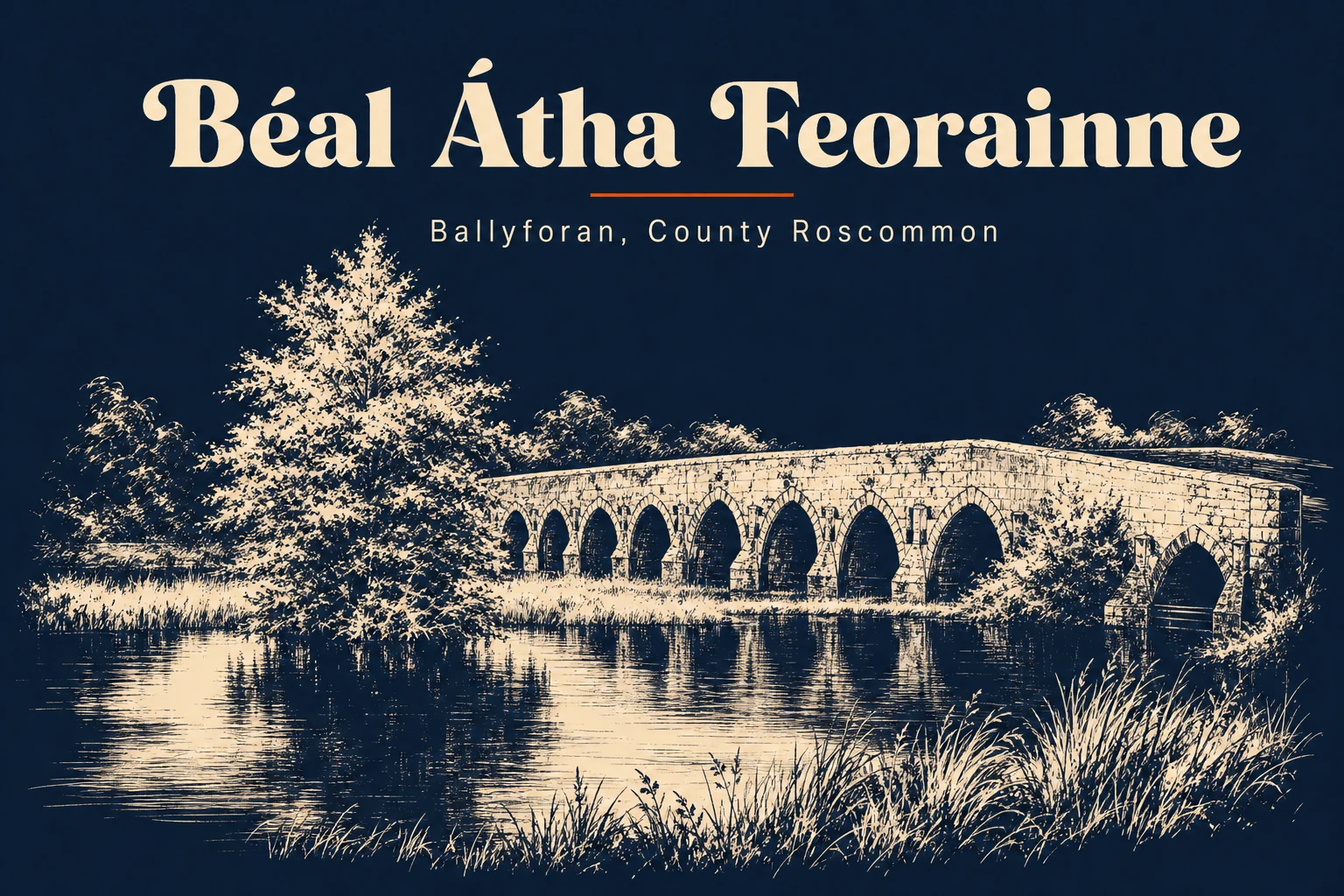
The bridge that replaced the ferry is the set piece here. Built around 1820, it carries the road over the Suck on thirteen segmental arches of random coursed stone with cut-limestone arch-rings and V-shaped cutwaters fore and aft. The National Inventory calls it a robust and handsome masonry viaduct and a credit to the local craftsmen of the time. It is also a county boundary in stone: drive across it and you leave Roscommon for Galway midway over the water.

Born in Ballyforan

Jack McQuillan, footballer and TD

The village's best-known son is Jack McQuillan, born here and a man who managed two careers at once. He won the All-Ireland Senior Football Championship twice with Roscommon and then represented the county in Dáil Éireann from 1948 to 1965, an independent voice in a parliament that did not always know what to do with him. A small village, a long shadow.

The parish church

St Joseph's, 1857

The Roman Catholic church of St Joseph was built in 1857, a decade after the Famine, and still serves the parish. It is the kind of mid-nineteenth-century rural church you find at the centre of a hundred Irish villages - not a cathedral, not a ruin, just the building the place was organised around. Worth a look if you are passing and the door is open.

04 / 07

Things to do outside.

Wear waterproofs. Bring a sandwich. Tell someone where you're going if it's the mountain.

Derryfada Bog greenway The one built-for-walking route in Ballyforan. A 3.1 km gravel loop through 250 acres of cutaway bog that opened in May 2025, an EU-funded reclaim of former peat-extraction land. Flat, compact surface, fine for buggies and bikes. There is a free twenty-space car park at the trailhead. Watch for curlew, snipe and red grouse over the recovering sedge and heather. Open year-round in daylight, no booking, no charge.
3.1 km loopdistance
45 minutestime
The bridge and the riverbank Walk out onto the thirteen-arch bridge for the view up and down the Suck, then follow the informal paths along the bank. No managed walkway, no stands - just willow, reed and slow water, with picnic spots if the ground is dry. This is also the coarse-fishing water: pike and perch for anyone who has brought a rod. Wet underfoot after rain.
Short, on footdistance
20-30 minutestime
05 / 07

When to go.

There is no bad time. There are different times.

Spring
Mar-May

The bog greenway is at its best as the sedge greens up and the curlew come back to breed. Drier underfoot than winter, and the bridge view is clear before the bankside willow leafs out fully.

◉ Go
Summer
Jun-Aug

Long evenings on the river, coarse fishing, and a Heritage Week ecology and heritage walk on the bog in August. The pub keeps later hours. The best window for the place.

◉ Go
Autumn
Sep-Oct

Quiet, golden, and good for the greenway before the ground turns. Pike fishing holds up. Few people about, which here is the point.

◉ Go
Winter
Nov-Feb

Short days and a high water table - the bog loop and the riverbank both go soft and grey. The pub and the church carry on. Bring boots or stay in the car.

◐ Mind yourself
06 / 07

What to skip.

Honestly? Don't bother.

If a local was sitting beside you, this is the bit where they'd lean in.

×
Expecting a village centre to wander

There is a pub, a shop, a post office, a church and a school strung along the road. That is the village. Plan your visit around the river, the bridge and the bog, not around streets to stroll - there are none.

×
Managed fishing facilities

The Suck here is good coarse water for pike and perch, but the access is informal - no stands, no signage, no tackle shop on the corner. Come self-sufficient or ask in the pub. Treat the riverbank as the working farmland it borders.

×
A search for the old ferry

The 1601 ferry to Muckloon is the founding story, but there is nothing to see of it - the bridge replaced it two centuries ago. The history is real; the artefact is gone. Stand on the bridge and picture the boat.

+

Getting there.

By car

Ballyforan is on the R363 between Ballygar and Dysart, on the Roscommon-Galway border. From Roscommon town it is roughly 25 km south; from Ballinasloe it is about 12 km north over the bridge. Easy to drive straight through if you are not watching for it.

By bus

No regular scheduled service through the village. Local Link Roscommon covers parts of south Roscommon on limited rural routes - check timetables in advance, and assume a car is the realistic way in.

By train

Nearest mainline station is Ballinasloe (Dublin-Galway line), about 12 km south. Athlone, a larger hub on the same line, is around 30 km east.