County Roscommon Ireland · Co. Roscommon · Dysart Save · Share
POSTED FROM
DYSART
CO. ROSCOMMON · IE

Dysart
An Díseart, Co. Roscommon

The Ireland's Hidden Heartlands
STOP 07 / 07
An Díseart · Co. Roscommon

A crossroads parish village in south Roscommon whose name means hermitage, with two pubs, a shop, and not much that asks you to stop - which is rather the point.

Dysart is a small parish village in south County Roscommon, sitting at the crossroads where the R363 and R357 meet, about twenty kilometres north of Athlone. For most of its life it was known plainly as Thomas Street. It is not a place you go to. It is a place people are from - a crossroads with two pubs, a grocery shop, a community centre, a football pitch and a church, holding the middle of a scattered farming parish.

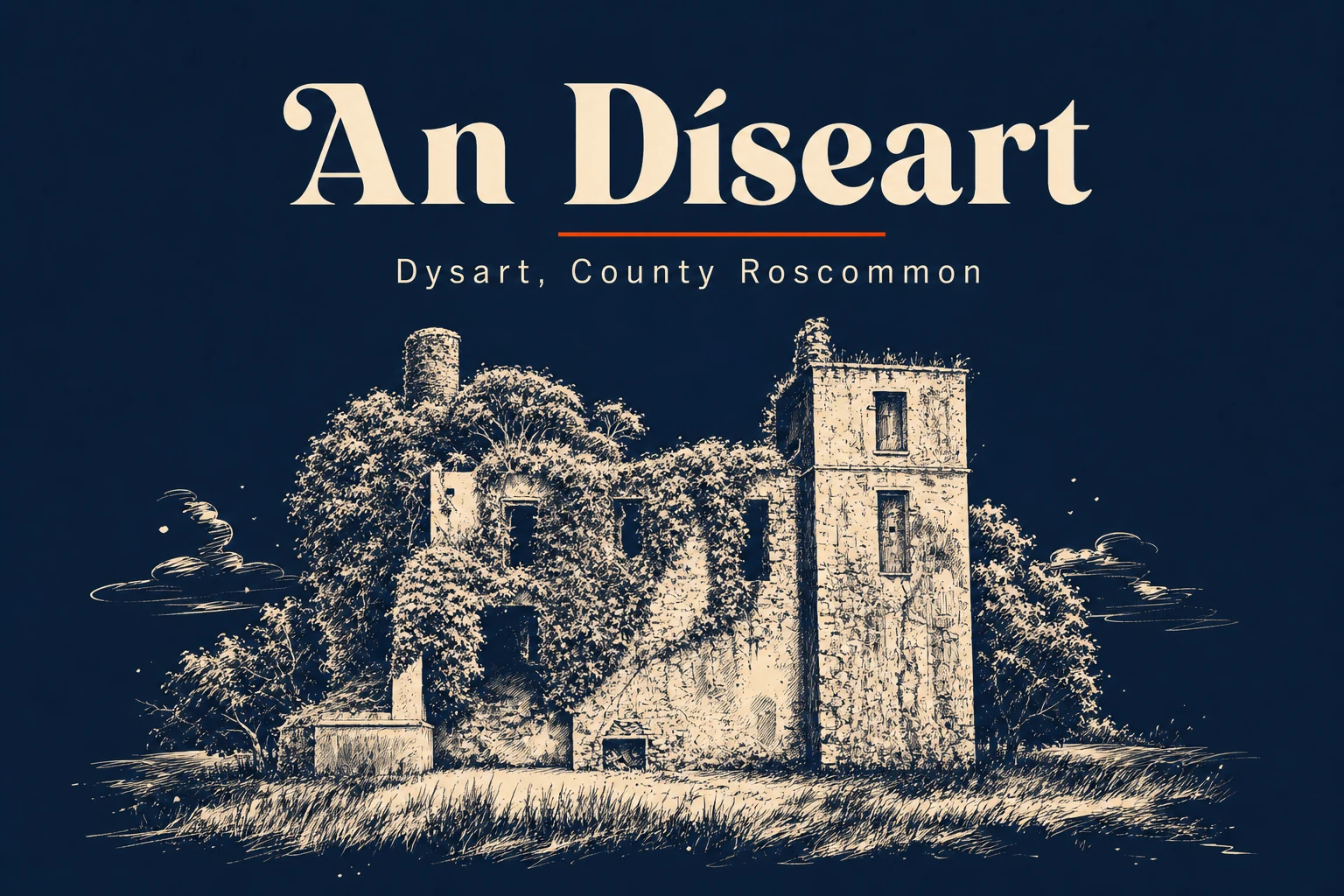
The name is the interesting thing. An Díseart comes from díseart, the Irish for a hermitage, a place set apart for prayer and solitude. That word marks early Christian sites the length of Ireland, and it tells you that fifteen centuries ago someone chose this spot to withdraw from the world. Nothing of that hermitage stands now. The name outlived the building, the monk and the memory of why. It is the longest thread you can pull in the place.

What you can actually see is more recent. St Patrick's Roman Catholic church was built in 1825, replacing a penal chapel from the harder days when Mass was a furtive thing, and it was worked on again in 1901 and 1958. There is a graveyard with it, and older church ground in the parish with headstones going back to the early 1700s. The living centre of the village is the parish, the pitch and the pub - the ordinary anchors of a Roscommon community that does not perform for anyone.

Be honest with yourself about why you would come. This is the quiet farmland of Ireland's Hidden Heartlands, off the tourist trail by a good margin. If you have roots here, or you are working your way along the back roads between Athlone and Roscommon town and want a genuine country pub rather than a curated one, Dysart is worth the few minutes. If you are chasing sights, keep driving.
Population
A small parish village - no separate census town figure
Founded
Name from an early Christian díseart (hermitage); present church built 1825
Coords
53.4642° N, 8.2156° W
01 / 07

At a glance.

Three things every local will eventually mention. Read these and you've already understood more than most day-trippers do.

02 / 07

The pubs.

None of these are themed Irish pubs, because they don't need to be. A few that earn the trip:

The village pubs

Genuine country locals
Two local public houses at the crossroads

Dysart has two public houses, the ordinary kind that hold a rural parish together rather than the kind with a brochure. Opening can follow the rhythm of the place rather than the clock, so a quiet weekday afternoon may find them shut. These are locals' pubs first. Go in, say hello, and take the pint at the pace it is poured.

03 / 07

Stories & lore.

The reason to come back. The things every local will eventually tell you about, usually after the second pint.

Early Christian Ireland

Díseart - the hermitage in the name

The Irish word díseart, from the Latin desertum, meant a place withdrawn from the world, the cell of a hermit or a small monastic foundation. It scatters across the Irish map - Dysart, Dysert, Disert - wherever the early church chose solitude. Dysart in Roscommon is one of these. The actual hermitage left no standing trace, and the records are thin: a medieval vicarage in the diocese of Elphin turns up in old royal taxation rolls, and that is close to the whole of it. What you are left with is the name itself, doing the work that a ruin would do elsewhere - pointing back fifteen hundred years to a choice nobody recorded.

A scrap of paper, a real building

The 1762 oak from Dysart

George Ensor, the architect of the courthouse in Roscommon town, kept correspondence dated 1762 in which the use of the best Irish oak timber from Dysart was recommended for the building. It is a small thing and it is real: somebody in or around this parish had timber of a quality worth naming to an architect, and that timber, by the recommendation, went into a building that still stands in the county town. The note matters now only as proof that this quiet crossroads once had a voice in making something that lasted.

Parish sport since the 1950s

Dysart F.C. and St Aidans

Dysart Football Club was formed in June 1971 and bought its present ground the following year. Its first outing was a challenge eight-a-side against Four Roads that finished two-all, and a three-team parish league ran that same summer between Dysart, Ballintleva and Feevagh. On the Gaelic side, St Aidans GAA was founded in 1956 and draws from the joined parishes of Ballyforan, Dysart, Four Roads and Mount Talbot. This is the real life of the village - small-parish football where the team and the community are the same set of people, and turning out for the match is turning out for the place.

04 / 07

Things to do outside.

Wear waterproofs. Bring a sandwich. Tell someone where you're going if it's the mountain.

Church, graveyard and crossroads There is no waymarked loop here - this is working farmland, not a trail village. The honest walk is around the crossroads itself: St Patrick's church of 1825 and its graveyard, the older parish burial ground with its early-1700s headstones, and the quiet lanes off the R363 and R357. Bring sensible shoes for verge and gateway. It is a parish to read slowly, not a place to clock up distance.
Short, around the villagedistance
20-30 minutestime
05 / 07

When to go.

There is no bad time. There are different times.

Spring
Mar-May

The Hidden Heartlands farmland greens up and the back roads are at their best. Quiet and dry-ish.

◉ Go
Summer
Jun-Aug

Long evenings, the football pitch in use, the easiest time to find a pub open and a bit of life at the crossroads.

◉ Go
Autumn
Sep-Oct

Soft light over flat country and few cars on the regional roads. A good time for a slow drive through.

◉ Go
Winter
Nov-Feb

Short days and not much open by day. The church and the pubs keep going, but there is little reason to make a special trip.

◐ Mind yourself
06 / 07

What to skip.

Honestly? Don't bother.

If a local was sitting beside you, this is the bit where they'd lean in.

×
Expecting a visitor village

Dysart has no heritage centre, no marked trail and nothing ticketed. It is a living parish, not an attraction. Come for the genuine country crossroads or do not come at all - both are fine answers.

×
A guaranteed open pub midweek

Two rural pubs in a small parish keep rural hours. Do not build an afternoon around a pint here without accepting one or both may be closed. Evenings and weekends are the safer bet.

×
Hunting for the hermitage

The díseart that named the place is gone - no ruin, no marker, no signposted site. The name is the monument. Read it and move on, rather than searching a field for a wall that is not there.

+

Getting there.

By car

Dysart sits at the R363 and R357 crossroads, about 20 km north of Athlone and roughly 25 km south of Roscommon town. From the M6 leave at Athlone and take the R363 north. Strokestown lies further north on the same route. A car is effectively the only practical way in.

By bus

No direct service stops in the village. The nearest scheduled buses run through Athlone and Roscommon town; Bus Éireann and TFI Local Link cover the wider county, so check current routes for the closest pickup and plan to be collected at the crossroads.

By train

No railway in the village. The nearest stations are Roscommon and Athlone, both on the Dublin Heuston to Westport and Galway lines. From either you would continue by car or local bus.