County Sligo Ireland · Co. Sligo · Ballintogher Save · Share
POSTED FROM
BALLINTOGHER
CO. SLIGO · IE

Ballintogher
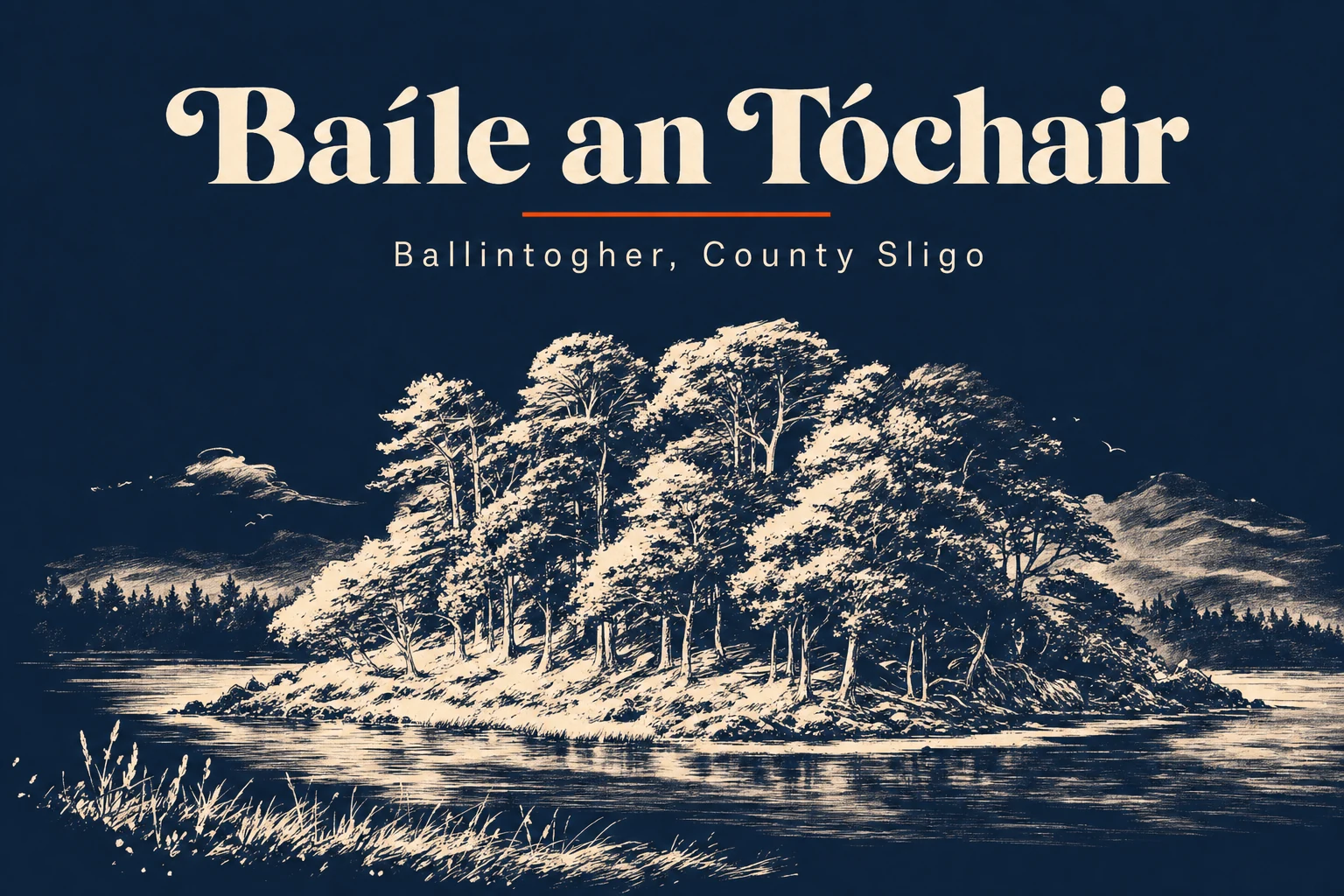
Baile an Tóchair

The Wild Atlantic Way
STOP 12 / 12
Baile an Tóchair · Co. Sligo

The town of the causeway — six kilometres from Yeats's Lake Isle.

Ballintogher is a small village in the south-east corner of Sligo, eight kilometres from the town centre and a few short kilometres from the western shore of Lough Gill. The 2022 census recorded 351 people. The Irish name — Baile an Tóchair, the town of the causeway — points at the old crossing that gave the village its place on the road.

What's here is what's around. The Isle of Innisfree, the small wooded crannóg-ish island in Lough Gill that Yeats turned into the great longing-poem of the language, is about six kilometres east. You cannot get out to the island — there is no public boat and no bridge — but you can drive to Innisfree View on the south shore of the lake and stand at the spot Yeats had in mind. Hazelwood, the old demesne and sculpture trail on the north shore, is the place he was thinking of when he wrote The Song of Wandering Aengus. The Lough Gill drive — the loop road around the lake taking in Parke's Castle on the Leitrim side and the Glencar Waterfall — is a half-day from Sligo and Ballintogher sits at its western end.

The village itself is small. A pub or two, a school, a community hall, the cut of an old railway. Treat it as a base for the lake rather than a destination. Sleep in Sligo or Dromahair; come here for a walk and a quiet pint.
Population
351
Walk score
Crossroads village in five minutes — drive to Innisfree
Coords
54.2381° N, 8.3503° W
01 / 06

At a glance.

Three things every local will eventually mention. Read these and you've already understood more than most day-trippers do.

02 / 06

Stories & lore.

The reason to come back. The things every local will eventually tell you about, usually after the second pint.

Yeats, 1888 in London

The Lake Isle of Innisfree

Yeats wrote The Lake Isle of Innisfree in London in 1888 — homesick for Sligo, hearing the lap of water in a Fleet Street fountain, putting it down. The island itself is a small wooded outcrop in Lough Gill, just off the south shore between Ballintogher and Dromahair. It is private and not landable. The poem is one of the most-anthologised in English. Yeats said in old age it was the first lyric of his with anything resembling his own music in it.

1870s to 1957

The Sligo, Leitrim and Northern Counties Railway

A small narrow-gauge railway built through south-east Sligo and west Cavan from the 1870s, intended to link Sligo with Enniskillen and onward to Belfast. Ballintogher had a station on the line. The route was never a commercial success and it shut in 1957 when the cross-border traffic dried up after partition. The old station house and a length of cut survive at Ballintogher; the line is talked about as a future greenway.

And the name

The causeway

Baile an Tóchair — the village of the causeway. The tóchar was an early raised road across the soft ground south of Lough Gill, of the kind built across boggy parts of Ireland from at least the early medieval period. The village grew up around the road, then around the railway, then around the modern R290.

03 / 06

Things to do outside.

Wear waterproofs. Bring a sandwich. Tell someone where you're going if it's the mountain.

Innisfree View Drive to the signposted Innisfree View car park on the south shore of Lough Gill, walk down the path. The island is offshore. Take the poem with you.
3 km / drive then walkdistance
1 hourtime
Hazelwood sculpture trail A few kilometres north, on the lake's other shore. Mature woodland and an open-air sculpture trail. Park at the gate. The Half Moon Bay viewpoint is the angle.
2.5 km loopdistance
1 hourtime
Lough Gill Drive Loop the lake — south shore from Ballintogher through Dromahair, Parke's Castle on the Leitrim side, the Glencar Waterfall on the north loop, back into Sligo. Stop often.
40 km loopdistance
Half day by cartime
04 / 06

When to go.

There is no bad time. There are different times.

Spring
Mar–May

The lake quiet, wildflowers along the south shore, Hazelwood at its best.

◉ Go
Summer
Jun–Aug

Long evenings over the water. The Lough Gill drive is at its most rewarding in the long light of July.

◉ Go
Autumn
Sep–Oct

The locals' season. Colour around the lake, mist on the island in the early morning. The Yeats lines start to make full sense in this weather.

◉ Go
Winter
Nov–Feb

Short days, often wet. The Lough Gill drive is still drivable but the viewpoints lose their pull in heavy weather.

◐ Mind yourself
05 / 06

What to skip.

Honestly? Don't bother.

If a local was sitting beside you, this is the bit where they'd lean in.

×
Trying to land on Innisfree

The island is private. There is no public boat, no bridge, no path. You stand on the south shore and look. That is the assignment. That is also the poem.

×
Driving the Lough Gill loop in a rush

It is forty kilometres and worth a half-day. Parke's Castle, Glencar, the Hazelwood walk — each needs an hour. Allow it.

×
Expecting a Lake District in the village

Ballintogher is a small commuter crossroads, not a lakeshore town. The water is six kilometres away. Sleep in Dromahair or Sligo if you want to be on the lake.

+

Getting there.

By car

Sligo to Ballintogher is 15 minutes on the R290. Dromahair (Co. Leitrim) is 10 minutes east. Manorhamilton is 30 minutes.

By bus

Local Link 472 runs Sligo–Dromahair via Ballintogher most days. No direct Bus Éireann route.

By train

No station — the SLNCR line closed in 1957. Nearest active station is Sligo MacDiarmada (15 min).

By air

Ireland West Airport Knock (NOC) is 1h 15m. Dublin is 2h 45m.