County Sligo Ireland · Co. Sligo · Ballysadare Save · Share
POSTED FROM
BALLYSADARE
CO. SLIGO · IE

Ballysadare
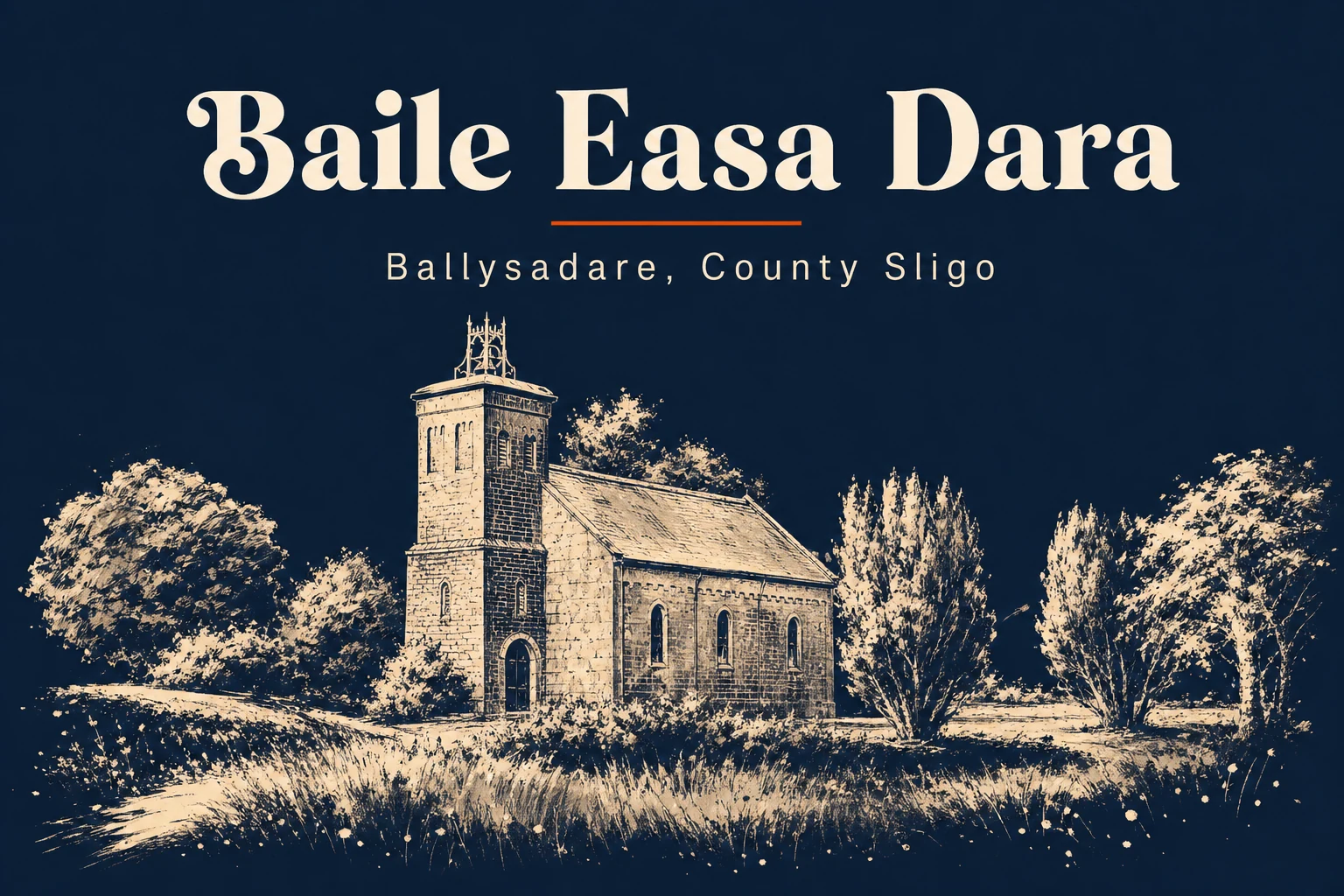
Baile Easa Dara

The Wild Atlantic Way
STOP 09 / 12
Baile Easa Dara · Co. Sligo

The falls Yeats's family ran a mill on, and a saint had a monastery beside.

Ballysadare is eight kilometres south of Sligo town, where the Owenmore River and the Unshin meet and drop to the sea over a long staircase of falls. The name says it — Baile Easa Dara, the town of the cascade of the oak. There is a village core on the main street and an older parish around the church on the rise above. The population almost trebled between 1996 and 2022 — Celtic Tiger commuter belt for Sligo, more than anything else.

What there is to do here is read the falls. The Owenmore is a working salmon river — one of the better short rivers on the west coast — and the weir was the engine of a mill complex that ran from the 17th century through to the late 20th. The Pollexfens and the Middletons, the families W.B. and Jack Yeats's mother came from, ran the flour business through the 19th century. The poet came on summer holidays to his uncle William Middleton at Avena House. The Salley Gardens — Down by the salley gardens, my love and I did meet — Yeats's lyric was set on this riverbank.

The other long story is St Féchín. Around AD 650 he founded an abbey here before moving east to Fore in Westmeath, where he made his name. The ruined church, the holy well and the truncated round tower are above the village, on a slope you can walk to in five minutes. It is not a Glendalough — it is a small site that has been a place of worship for fourteen hundred years.

The mill is silent. The village is a commuter belt. The falls are still the falls. Stop on the bridge for ten minutes and you will hear the case for coming back.
Population
1,747
Walk score
Falls, mill, weir — twenty minutes end to end
Founded
St Féchín, c. AD 650
Coords
54.2117° N, 8.5117° W
01 / 06

At a glance.

Three things every local will eventually mention. Read these and you've already understood more than most day-trippers do.

02 / 06

Stories & lore.

The reason to come back. The things every local will eventually tell you about, usually after the second pint.

Yeats's lyric, on this bank

Down by the salley gardens

The Salley Gardens were said to be along the banks of the Ballisodare River at the foot of the village. Yeats heard the lines from an old woman in Ballysadare during his Pollexfen-uncle summers and wrote them up in 1889. Salley is the local word for willow — sally trees grow along the river still.

Yeats's mother's family

The Pollexfen mill

Susan Pollexfen was W.B. and Jack Yeats's mother. The Pollexfen and Middleton families, in business together, ran the Ballisodare flour mill from the 1850s and built much of what stood by the river through the 19th century. The mill complex changed hands more than once in the 20th century and ground its last in the late 1980s. The big stone buildings on the river have since been partly converted to apartments.

Around AD 650

St Féchín's monastery

Féchín — also written Fechin, Féchín of Fore — is said to have been born in this parish at Bile, probably Billa. He founded a monastery at Ballysadare around the middle of the 7th century, then moved on to Fore in Westmeath where his name endures more strongly. The Ballysadare site holds the lower courses of a round tower, a small church and a holy well still walked to. Féchín died in 664 in the Yellow Plague.

An Atlantic salmon and sea trout river

The salmon weir

The Ballisodare River is a recognised Atlantic salmon and sea trout fishery — short, fast, fed by Lough Arrow and Templehouse Lake. The weir at the falls is part fish-pass, part historical mill structure. The Ballisodare Fishery is privately managed; day tickets are limited and bookable through Markree-area outfits.

03 / 06

Things to do outside.

Wear waterproofs. Bring a sandwich. Tell someone where you're going if it's the mountain.

The falls walk Down from the main street to the lower bridge, across, back up past the weir to the old mill. The roar of the river does most of the talking.
1.5 km loopdistance
30 mintime
St Féchín's monastic site Up from the village to the old church and round-tower stub above the river. The holy well is signposted. The view back down over the falls is the reason.
2 km returndistance
40 mintime
Coney Island via Strandhill Drive to Strandhill, walk the strand at low tide if conditions allow. The Cúil Irra peninsula is the south side of the bay you are at the head of here.
Day tripdistance
half daytime
04 / 06

When to go.

There is no bad time. There are different times.

Spring
Mar–May

Salmon up the river, falls in full voice after a wet March. Monastery site is dry and clear of nettles.

◉ Go
Summer
Jun–Aug

Long evenings on the riverbank. Sligo is a short drive — base here if Sligo is full.

◉ Go
Autumn
Sep–Oct

Sea trout late August into September. The river runs high after the first autumn rain. The light through the mill ruins is the kind Jack Yeats painted.

◉ Go
Winter
Nov–Feb

Cold, wet, dark. The falls are at their loudest. There is nothing to do here in January that you could not do better in Sligo town.

◐ Mind yourself
05 / 06

What to skip.

Honestly? Don't bother.

If a local was sitting beside you, this is the bit where they'd lean in.

×
Expecting a tourist village

Ballysadare is a working commuter town with one heritage core and a serious river. It is not Westport. Treat it as a half-day stop or a quieter base for Sligo.

×
Driving the bypass without taking the exit

The N4 lifts the traffic off the village. The old route through the falls is the one worth the detour. Five minutes.

×
Fishing without a permit

The Ballisodare Fishery is privately managed. Day tickets are limited and need booking. Walking in with a rod is not the move.

+

Getting there.

By car

Sligo to Ballysadare is 10 minutes on the N4. From Galway, 1h 40m. From Boyle, 35 minutes.

By bus

Bus Éireann Expressway 23 (Dublin–Sligo) stops at Ballysadare. Local Link 473 also serves the village.

By train

No station — closed in the 1960s. Nearest is Sligo MacDiarmada, 12 minutes north, or Collooney, four minutes south.

By air

Ireland West Airport Knock (NOC) is 50 minutes. Dublin is 2h 45m.