County Tipperary Ireland · Co. Tipperary · Clonmel Save · Share
POSTED FROM
CLONMEL
CO. TIPPERARY · IE

Clonmel
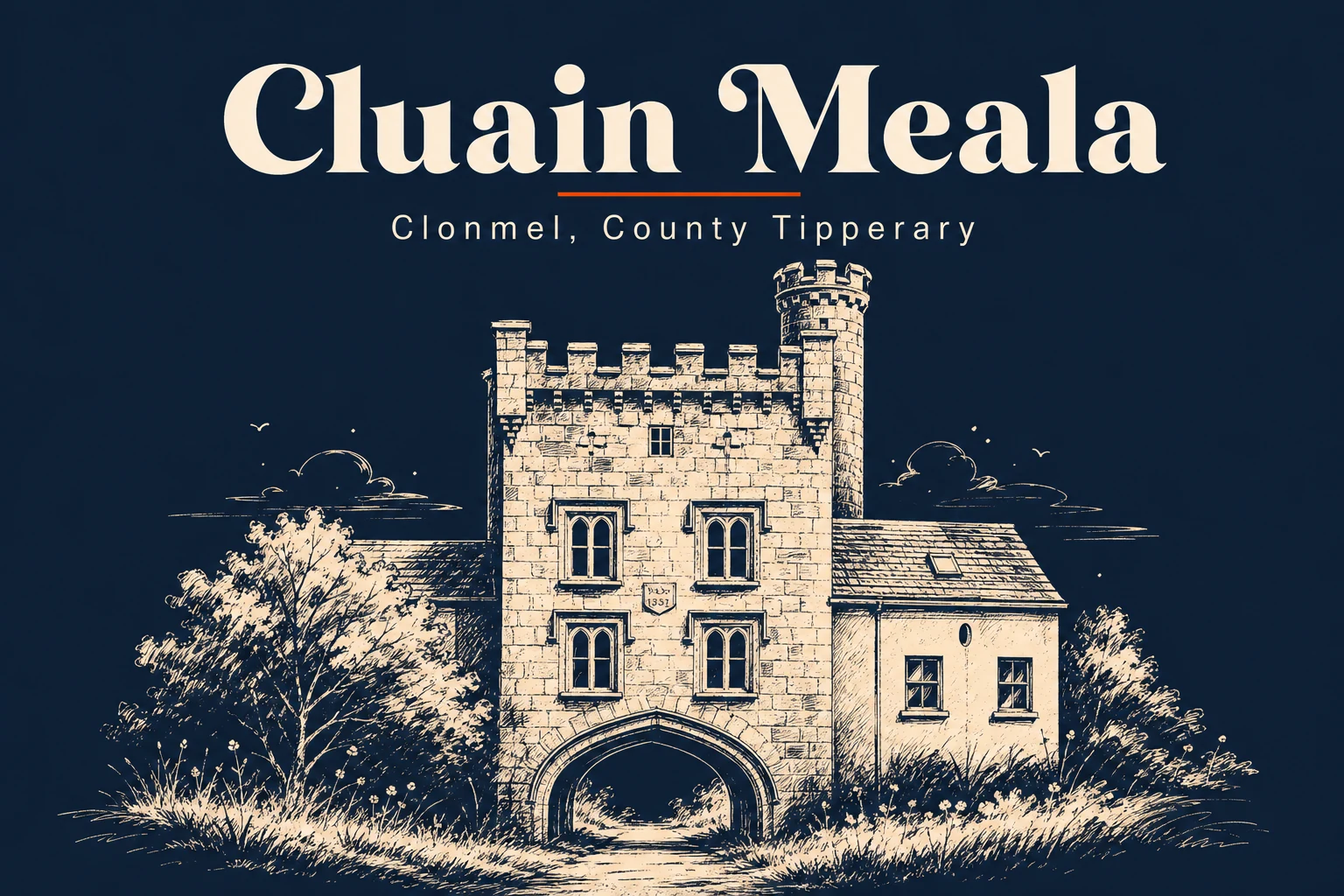
Cluain Meala

The Ireland's Ancient East
STOP 10 / 10
Cluain Meala · Co. Tipperary

The town that put Ireland on wheels — and still makes Ireland's cider.

Clonmel sits in a bend of the River Suir with the Comeragh Mountains rising to the south and the Slievenamon plain opening to the north. It's the largest town in Tipperary, which makes it the market town, the hospital town, the court town, and the place people from smaller Tipperary towns mean when they say 'going into town'. It has a functional weight that tourist towns don't.

On 6 July 1815, an Italian immigrant named Carlo Bianconi — he went by Charles — sent an open-sided horse-drawn car out of what is now Hearn's Hotel on Parnell Street, bound for Cahir, sixteen kilometres up the Suir. That was the first scheduled public transport service in Ireland. Within thirty years, Bianconi had 1,400 horses covering over 6,000 kilometres a day across 123 Irish towns. He became mayor of Clonmel twice. His portrait is everywhere.

The town also makes cider. William Magner started pressing apples at Dowd's Lane in 1935. The English firm H.P. Bulmer bought in two years later, lent their name to the Irish market product, and moved the whole operation to a new plant at Annerville — five kilometres east — in 1965. Bulmers is what they call it here. Magners is what they call it everywhere else. The apples are still Tipperary apples.

What Clonmel doesn't have is a tourist identity with edges around it. It has a medieval core — the Main Guard, the West Gate, the remnants of the town walls, Old St Mary's Church with its 25-metre octagonal tower — and it has the kind of town-centre life that comes from being the place where actual county business gets done. Come for the history. Stay because the river walk is good and nobody's trying to sell you a leprechaun.
Population
18,369
Walk score
Town centre on foot in twenty minutes
Founded
Medieval; town walls from c. 1298
Coords
52.3556° N, 7.7039° W
01 / 10

At a glance.

Three things every local will eventually mention. Read these and you've already understood more than most day-trippers do.

02 / 10

The pubs.

None of these are themed Irish pubs, because they don't need to be. A few that earn the trip:

Sean Tierney's

Award-winning local institution
Bar & restaurant

Open since 1991. Fourteen-times winner of Tipperary Pub of the Year, four-times best Munster pub. The kind of record that either means the judges are wrong or the pub is genuinely that good. The judges aren't wrong.

Mulcahy's

Town-centre, everything-to-everyone
Late bar, live venue & hotel

A family business for over 35 years, right in the middle of town. Late bar, live music, hotel rooms upstairs. The restaurant does solid food. If something is happening in Clonmel on a Saturday, it's probably happening here.

Eldon's

Cosy, local, unhurried
Family bar

A family-run bar since 1926. Comfortable lounge with an open fire, a modern bar with a mezzanine, a beer garden. The kind of pub that doesn't need to try.

03 / 10

Where to eat.

PlaceTypeLocal note
Befani's Mediterranean & tapas €€ 6 Sarsfield Street, in a restored listed building. Husband and wife Fulvio and Caroline Bonfiglio have been running it since 2005. Mediterranean and tapas, open Thursday to Sunday evenings. The sort of place that fills up with people who actually live in Clonmel.
Darcy's at Raheen House Fine dining in a Georgian hotel €€€ The drawing room restaurant at Raheen House Hotel, five minutes from the town centre on the Waterford Road. The hotel dates to 1832. Fine dining for groups, and the Buffalo Bar for something less formal.
Mulcahy's Restaurant Bar food & restaurant €€ The restaurant arm of the bar and hotel on the main strip. Solid all-rounder — useful for a meal before or after the Junction Festival or any Saturday evening when everything else is booked.
04 / 10

Where to sleep.

PlaceTypeLocal note
Hotel Minella 4-star hotel On Coleville Road, right on the River Suir with a garden running to the water. Ninety rooms, indoor pool, spa. Peaceful end compared to the town centre. The riverside location is the reason to stay here.
Raheen House Hotel Georgian country house hotel 3.5 acres of gardens, a Georgian house dating to 1832, five minutes' walk from the town centre. Darcy's Restaurant in the drawing room. Quieter and older-feeling than the town-centre options. Book ahead at weekends.
Talbot Hotel Clonmel 4-star hotel Modern hotel on the Cahir Road, five minutes from the centre by car. 99 rooms, 20-metre indoor pool, Howard's Restaurant. The conference-and-leisure end of the market, but well-run.
Befani's Townhouse Guesthouse Rooms above the restaurant at 6 Sarsfield Street. Small, central, and run by the same people who do the food downstairs — which is a reliable sign.
05 / 10

Stories & lore.

The reason to come back. The things every local will eventually tell you about, usually after the second pint.

Carlo Bianconi, 1815

The man who put Ireland on wheels

Charles Bianconi was born in northern Italy in 1786 and arrived in Ireland in 1802 as a travelling print seller. He ended up in Clonmel, read the roads correctly — the Napoleonic wars had ended, horses were cheap, there was no public transport in rural Ireland — and on 6 July 1815 sent his first two-wheeled car from what is now Hearn's Hotel on Parnell Street to Cahir. Within a generation his network connected 123 towns. He was twice elected mayor of Clonmel, became a friend of Daniel O'Connell, and died in 1875 having spent most of seventy years making Ireland smaller.

The Siege of Clonmel, 1650

Hugh Dubh outwits Cromwell

Oliver Cromwell laid siege to Clonmel in late April 1650 with 8,000 New Model Army soldiers and was in a hurry: Parliament needed him back in England. The town was defended by Hugh Dubh O'Neill with 1,200 Ulstermen and very little ammunition. When Cromwell finally breached the walls on 17 May, he sent his men through a gap that O'Neill had prepared as a killing ground — a V-shaped coupure lined with cannon loaded with chain-shot. The slaughter was severe. That night, O'Neill slipped the garrison out of town toward Waterford and left the mayor to negotiate terms. Cromwell, furious at the deception, nonetheless kept his word. It was his worst Irish defeat. The town was spared.

Laurence Sterne, 24 November 1713

Born here, barely

Laurence Sterne — the author of Tristram Shandy, one of the stranger novels in the English language — was born in Clonmel to a soldier's family while his father's regiment was quartered there. He spent only his first months in the town before the regiment moved on, and he grew up in poverty following the troops around Ireland. He never returned. The novel, published in 1759, would eventually be called the first postmodern novel, the most chaotic masterpiece in English prose, and various other things. Clonmel's connection to it amounts to: he was born here. That's enough.

Bulmers / Magners, 1935

Ireland's cider, twice-named

William Magner started making cider at Dowd's Lane in Clonmel in 1935 with a press and twelve oak barrels. Two years later the English firm H.P. Bulmer bought in and lent their name to the Irish market — which is why the cider is called Bulmers in Ireland and Magners everywhere else. The Annerville plant, five kilometres east of the town, was opened in 1965 by Taoiseach Seán Lemass. It still runs. The C&C Group, which now owns the whole operation, is one of Tipperary's larger employers.

06 / 10

Things to do outside.

Wear waterproofs. Bring a sandwich. Tell someone where you're going if it's the mountain.

Suir Blueway — Clonmel to Carrick-on-Suir The walking and cycling trail follows the river bank east all the way to Carrick-on-Suir. Flat, well-surfaced for most of the route. Bike hire is available in town. Do it one way and get the bus back, or hire two bikes and sort it between yourselves.
21 km one waydistance
5–6 hours on foot / 2.5 hours by biketime
Mahon Falls Drive south from Clonmel into the Comeraghs — about 20 minutes — to the car park above Mahon Bridge. A short, easy gravel path leads to one of the most dramatic waterfalls in Munster. Especially good after rain. The longer Coum Tay loop (11 km) adds serious mountain terrain if you want it.
3.2 km returndistance
40–50 minutestime
Clonmel Town Walls Walk The medieval town walls survive in fragments around the centre. Start at the West Gate (rebuilt 1831), walk east past the Main Guard, find the surviving sections of the original wall. Good signage. Useful if you want to understand how the town sat before Cromwell.
2 kmdistance
30–40 minutestime
Suir Blueway — Cahir to Clonmel (by paddle) The upper Blueway from Cahir is river paddling — calmer near Cahir, with faster sections as you approach Clonmel. Kayak hire operators work along the route. Clonmel is the takeout point. The river does most of the work going east.
32 km by waterdistance
Full day by kayak / canoetime
07 / 10

Tours, if you want one.

The ones below are bookable through our partners — pick one that suits, or skip the lot and just turn up.

We earn a small commission when you book through our tour pages. It costs you nothing extra and keeps the village hubs free. All Co. Tipperary tours →

08 / 10

When to go.

There is no bad time. There are different times.

Spring
Mar–May

The Comeraghs are at their greenest and the river is full. Town life is at normal pitch — not a tourist circuit, so there's no off-season slump to recover from. Mahon Falls is excellent after the winter rains.

◉ Go
Summer
Jun–Aug

The Junction Festival runs in early July — book accommodation in advance that week. Otherwise, summer is busy but not overwhelmed. This is a working town, not a resort.

◉ Go
Autumn
Sep–Oct

The best walking season for the Comeraghs. The light is good, the crowds from the festival are gone, and Befani's is easier to get into. The Suir is often in good paddling condition through October.

◉ Go
Winter
Nov–Feb

Nothing closes the way it does in a coastal village, but the Comeraghs are proper winter mountains and the Blueway is quieter. The town carries on. Bring waterproofs.

◐ Mind yourself
09 / 10

What to skip.

Honestly? Don't bother.

If a local was sitting beside you, this is the bit where they'd lean in.

×
Driving to Mahon Falls on a bank holiday Sunday without checking the car park

The car park is small, the road is narrow, and the falls are not a secret. Go on a weekday morning or accept a long walk-in from the road.

×
The Cromwell narrative tour that makes him a villain and O'Neill a hero without the nuance

O'Neill was brilliant. Cromwell was brutal. The siege was also complicated — the townspeople were somewhere in the middle, negotiating their own survival. The real story is more interesting than the simplified version.

×
Expecting trad sessions on a Tuesday in a random pub

Clonmel is not a trad-circuit town. The Junction Festival brings live music in July. Otherwise, check what's on before you go out expecting music.

×
The Annerville plant tour

There isn't one. The cider plant is not open to visitors. You can drink the result in any pub in Ireland.

+

Getting there.

By car

Clonmel is 160km from Dublin on the M8/N24 via Cahir — about 2 hours. Waterford is 40km east on the N24, 40 minutes. Cork is 110km on the N8/M8, about 1h 20m.

By bus

Bus Éireann routes connect Clonmel to Waterford, Cahir, Tipperary town and Cork. Several services daily. The bus stop is on the quays.

By train

Clonmel has a train station on the Waterford–Limerick Junction line. Trains to Waterford take about 55 minutes. Limerick Junction connects onward to Cork and Dublin.

By air

Waterford Airport (WAT) is 35km east but has limited scheduled services. Cork (ORK) is 110km and the more useful option for international arrivals. Dublin (DUB) is the long way round.