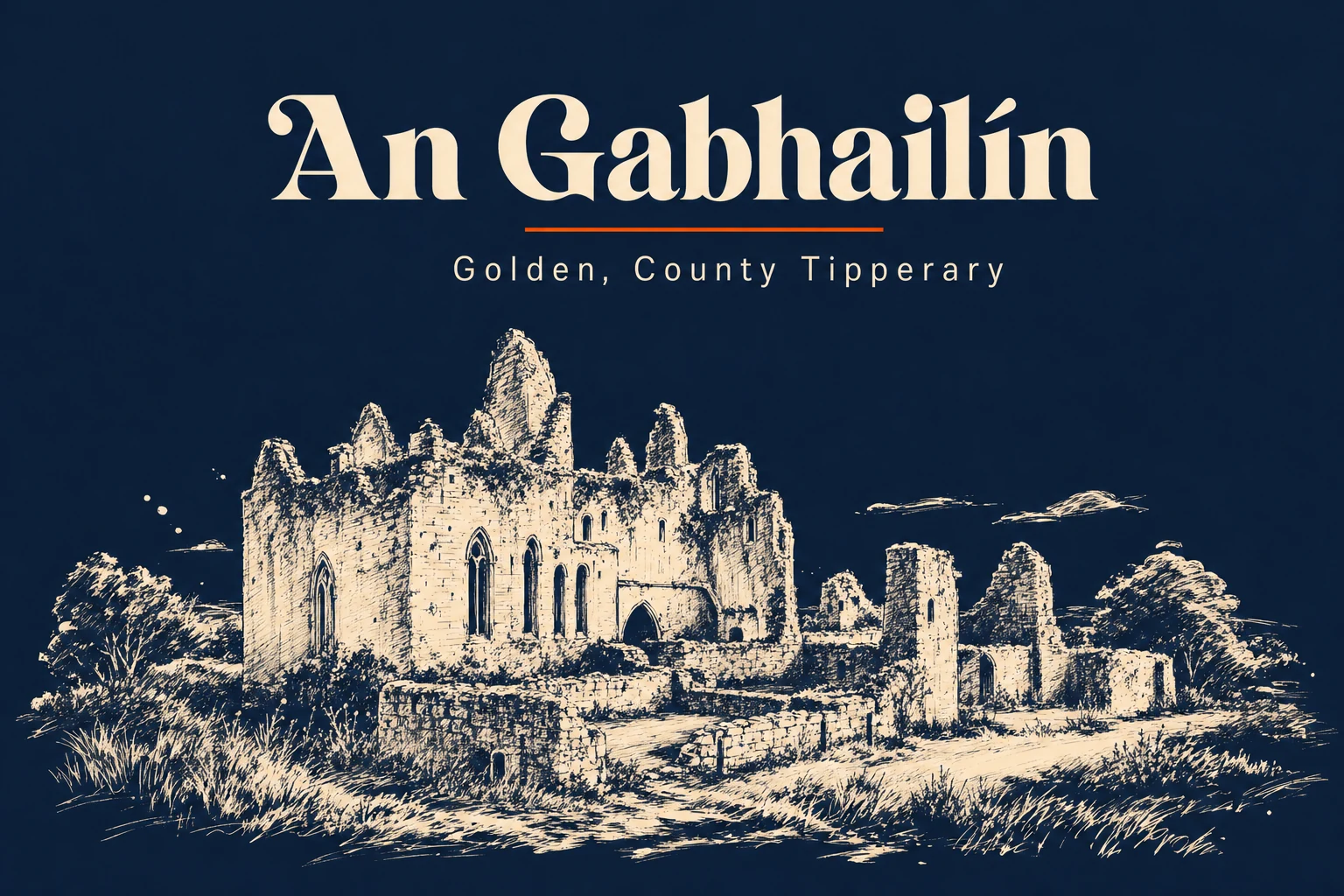
An Gabhailín · Co. Tipperary
Two pubs, one ruined priory, and a river that remembers everything.
Golden is a village that doesn't announce itself. You're on the N74 between Cashel and Tipperary town, the River Suir appears on your left, and then there's a bridge, a tower on an island, a handful of houses, and that's Golden. The name isn't boastful - it comes from the golden vale, the flat fertile farmland the Suir runs through on its way east.
The reason to stop is two kilometres south, in a field beside the river: Athassel Priory. Founded around 1200 by William de Burgh and dedicated to St Edmund, it grew into the largest medieval priory in Ireland by area - four acres of church, cloister, gatehouse and walls. A town of roughly two thousand people once sat outside its gates. Burned twice in the fourteenth century, dissolved in 1537, handed to the Earl of Ormond who let it fall to pieces. What's left is extraordinary - roofless but standing, open to walk through, and free.
Back in the village, the twelve-arch bridge sits where it has since around 1500. On the small island between the bridge's two channels, a tower house ruin keeps watch. Beside those ruins stands a memorial bust of Thomas MacDonagh - born in Cloughjordan, hanged in 1916, the only Tipperary signatory of the Proclamation. The connection between MacDonagh and Golden isn't birthplace but county - the monument is a claim of ownership by a county proud of its dead.
The Suir here is one of the finest trout rivers in Munster. Fishermen have named every pool: the Priest's Pool below the abbey, Jackman's Weir, the Moat where the River Multeen joins. The names are the parish memory - as specific and as local as the people who gave them.