Why a town grew here at all
St Cronan and the Slighe Dála
St Cronan's first monastery was at Corville, a couple of miles away, in the kind of quiet remove that early Christian monks favoured. Then he moved it. According to the annals, he relocated the foundation to the junction of the Slighe Dála — one of the five great ancient roads of Ireland, running southwest from Tara through the midlands — specifically so that travellers would find shelter. A monk who chose a busy crossroads over solitude is an unusual thing. It explains Roscrea. Every town starts with a decision; his was practical and deliberate. He died in 640. The town has been at the crossroads ever since.
Forty days and the sun that would not set
The Book of Dimma
In the 8th century, a monk called Dimma made a copy of the Gospels at Roscrea monastery. The manuscript is a pocket-sized book, small enough to carry — 17.5 by 14.2 centimetres — meant for a priest administering last rites in the field. The legend attached to it says Cronan asked Dimma to copy it in a single day; the sun refused to set until the work was done, and what felt like one day was forty. The book was later encased in a 12th-century bronze and silver reliquary shrine. Both book and shrine are now in the Long Room of Trinity College Dublin, MS 59. The town has a copy. Trinity has the original. That's how these things usually end.
Why it is 6 metres shorter than it should be
The round tower and 1798
The round tower at Roscrea was built in the 12th century — it is first mentioned in the annals in 1131 when lightning struck it. It originally stood around 26 metres. During the 1798 rebellion, United Irishmen used the height of the tower to snipe at the castle garrison below. After the rebellion was suppressed, the authorities had the top section removed. It now stands at 20 metres. The truncation is visible if you know what you are looking at: the cap is not tapered the way a finished round tower would be. A monument shortened as punishment is a rare thing.
A Queen Anne staircase in a Norman courtyard
Damer House inside the castle
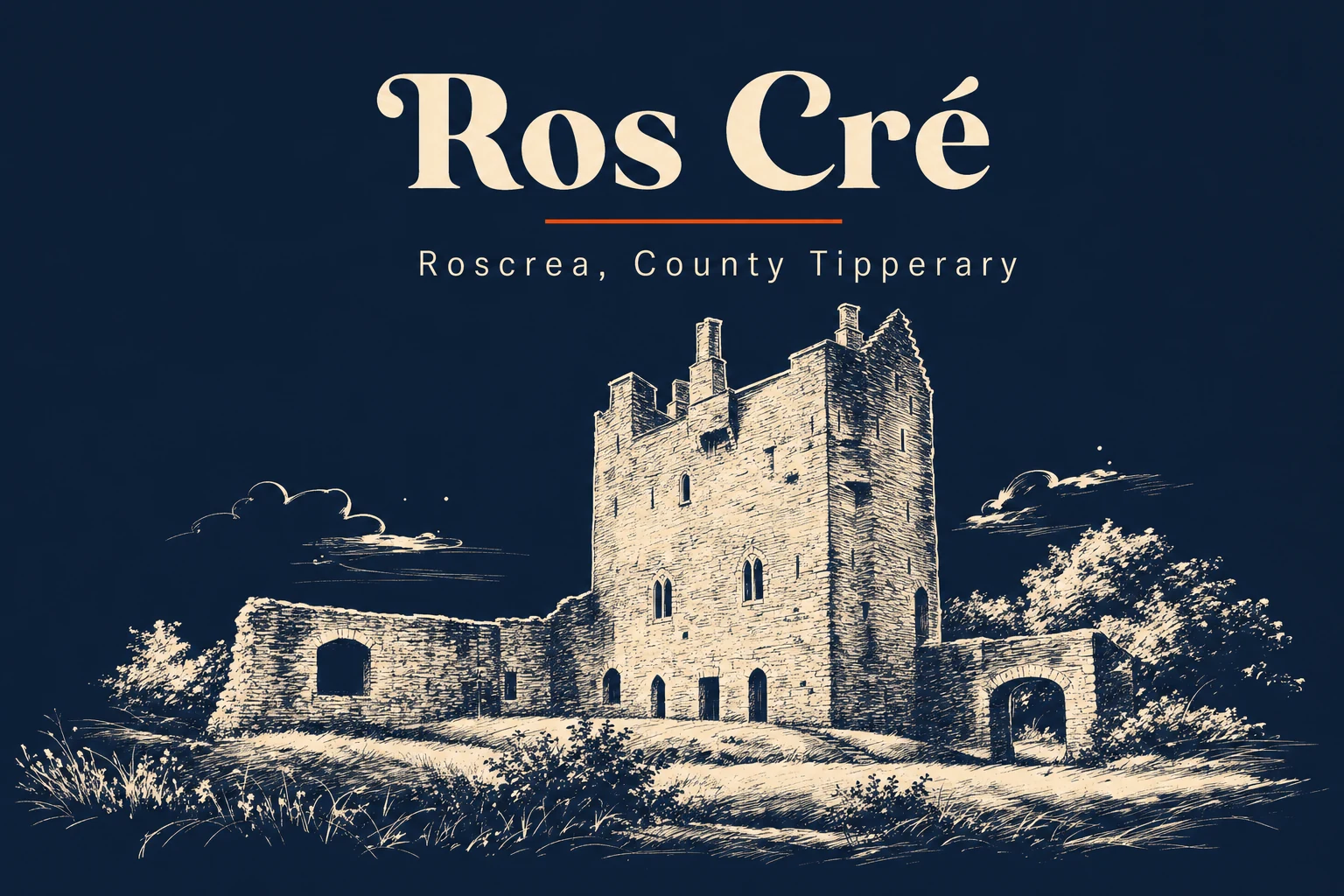
In 1728, a merchant named John Damer built a substantial Georgian townhouse inside the courtyard of a 13th-century Anglo-Norman castle. It is a strange arrangement — a pre-Palladian three-storey house with nine bay windows sitting in the middle of defensive walls built 450 years earlier. The house fell out of use and was threatened with demolition in the 1960s. Desmond Guinness and the Irish Georgian Society took a lease in 1973 and restored it; OPW completed further restoration work in the 1990s and again in 2023–24. Inside is one of only two Queen Anne-style staircases surviving in Ireland.
December 2010
The M7 bypass
The motorway opened on 22 December 2010. Before that, the N7 — the main Dublin to Limerick road — ran straight through Roscrea town centre, and every car, truck and coach stopped or slowed. Roadhouses, pubs, petrol stations and hotels on the Main Street had been running on that traffic for generations. The bypass drained it in a day. Empty shopfronts appeared along some stretches. The town has adapted — the heritage centre is genuinely good, the abbey still takes guests — but the wound is visible. When the motorway closes for maintenance and traffic is diverted back through the town, the pubs notice within hours.