County Laois Ireland · Co. Laois · Borris-in-Ossory Save · Share
POSTED FROM
BORRIS-IN-OSSORY
CO. LAOIS · IE

Borris-in-Ossory
Buiríos Mór Osraí, Co. Laois

The Ireland's Ancient East
STOP 07 / 07
Buiríos Mór Osraí · Co. Laois

The old pass to Munster, where the Fitzpatricks put a castle to hold the road. The M7 took the through-traffic in 2010, and the village got its quiet back.

Borris-in-Ossory is a small village in the west of Laois, hard against the Tipperary border, 629 people at the last count. The Irish name, Buiríos Mór Osraí, means the great borough of Ossory, which tells you the place once mattered more than its size now suggests. It sat on the great pass to Munster - the river Nore on one side, bog on the others, the road threading through the middle - and whoever held the road held the village.

The Fitzpatricks held it. Lords of Upper Ossory, they built a castle here to guard the pass, and Sir Barnaby Fitzpatrick was in possession in 1582. For centuries everything heading west into Munster came through Borris-in-Ossory, which is why the place grew a borough, a courthouse, churches, and later a row of pubs and tea-rooms for the coach trade. It was a refreshment stop on the long haul south long before anyone called it that.

Then in 2010 the M7 motorway opened its bypass and the through-traffic vanished overnight. What is left is an honest single-street village on the old R445: St Mark's Church of Ireland with its unusual round-tower bell tower from around 1870, St Canice's Catholic church on the main street, a pub, a school, a GAA club. The real heritage sits just west - Ballaghmore Castle, a restored 15th-century Fitzpatrick tower house with a sheela-na-gig built into its outer wall.

Do not come here for a weekend. Come for an hour: the church, the tower house, a pint, and the slightly melancholy pleasure of a village that was built around a road that no longer needs it. Then drive on to Roscrea or Mountrath, both of which have more to detain you.
Population
629 (2022)
Founded
Fitzpatrick castle and borough guarding the pass to Munster; chartered borough under the lords of Upper Ossory
Coords
52.9389° N, 7.6311° W
01 / 07

At a glance.

Three things every local will eventually mention. Read these and you've already understood more than most day-trippers do.

02 / 07

The pubs.

None of these are themed Irish pubs, because they don't need to be. A few that earn the trip:

Kelly's Bar

Locals, traditional
Village pub, Main Street

The pub on the main street. A traditional village bar of the unhurried kind - regulars, a pint, the sort of place where the bypass took the passing trade but not the local one. The one reliable stop in Borris-in-Ossory itself.

03 / 07

Stories & lore.

The reason to come back. The things every local will eventually tell you about, usually after the second pint.

Lords of Upper Ossory

The Fitzpatricks and the pass to Munster

The village exists because of the road. Bounded by the river Nore to the north and bog on every other side, Borris-in-Ossory formed the great pass west into Munster, and the Fitzpatricks - the Mac Giolla Phádraig family, lords of Upper Ossory - built a castle to defend it. Sir Barnaby Fitzpatrick, second baron of Upper Ossory, held the castle in 1582. In 1600 Queen Elizabeth granted the place to Florence Fitzpatrick and his son, a grant confirmed by James I in 1611. The borough, the courthouse and the churches all grew up around a road that mattered to anyone moving an army, a coach or a herd between Leinster and Munster.

A 1480 tower house, restored

Ballaghmore Castle and the sheela-na-gig

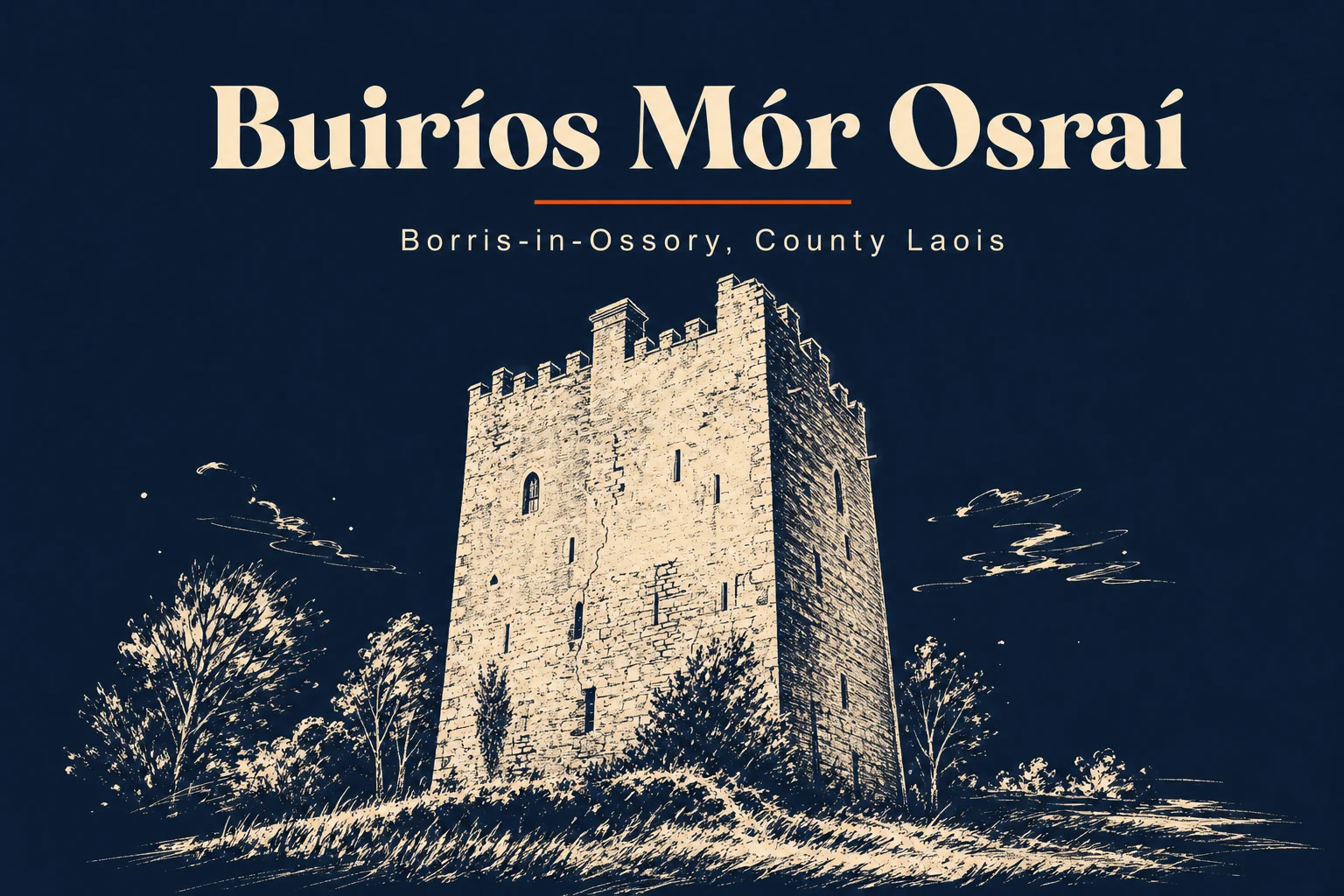
Six kilometres west of the village on the way to Roscrea stands Ballaghmore Castle, a tower house built in 1480 by the Mac Giolla Phádraig (Fitzpatrick) chieftains. The name comes from the Bealach Mor, the ancient great road to Munster - the same pass the village guarded. Cromwellian forces knocked it about in 1647 during the Laois-Offaly plantation, and it sat neglected for centuries before a sympathetic restoration from the 1990s left it, in the words of one survey, the only castle of Upper Ossory still habitable. Look for the sheela-na-gig carved into a cornerstone of the outer front wall. It is open for tours, run by a historian owner, and can be rented for overnight stays and events.

Hiberno-Romanesque, c. 1870

St Mark's and the round tower

The Church of Ireland church of St Mark, built around 1870, is the building you notice in the village. It is done in a Hiberno-Romanesque style with a bell tower built in the form of an Irish round tower - an unusual flourish for a small parish church, and a Victorian nod to the early monastic Ireland the style imitates. The Roman Catholic church of St Canice sits on the main street nearby. Between them and the former courthouse they are the bones of the old borough that the coach trade once supported.

04 / 07

Things to do outside.

Wear waterproofs. Bring a sandwich. Tell someone where you're going if it's the mountain.

Village and churches stroll Up and down the main street: St Mark's Church of Ireland with its round-tower bell tower, St Canice's Catholic church, the former courthouse. It is a short, honest walk through a village that was built around a road. Twenty minutes if you do not stop, an hour if you fall into conversation, which here you might.
1.5 kmdistance
30 minutestime
Ballaghmore Castle grounds Six kilometres west toward Roscrea. The grounds have mature gardens, ponds and woodland around the restored tower house. Phone ahead - tours are run by the owner and are not on fixed hours. The sheela-na-gig on the outer wall is the thing to find. Boots if it has rained.
2 km returndistance
1 hour with the tourtime
05 / 07

When to go.

There is no bad time. There are different times.

Spring
Mar-May

Quiet roads, the castle grounds greening up, easy driving on the R445. A fine time to combine it with Roscrea.

◉ Go
Summer
Jun-Aug

Ballaghmore Castle is most likely to be running tours; ring ahead. Long evenings make the drive between Mountrath and Roscrea a pleasure.

◉ Go
Autumn
Sep-Oct

Good light on the round tower and the castle stone, traffic light, weather usually still kind.

◉ Go
Winter
Nov-Feb

Short days and not much open. The castle tours wind down. Fine as a quick stop on the M7 run, less so as a destination in itself.

◐ Mind yourself
06 / 07

What to skip.

Honestly? Don't bother.

If a local was sitting beside you, this is the bit where they'd lean in.

×
Expecting a busy town

It is a single-street village of about 600 people that lost its through-traffic to the M7 in 2010. That quiet is the point now, but it is genuinely quiet. Manage your expectations and you will enjoy it.

×
Confusing it with Borris in Carlow

There are two places called Borris in Leinster. The big house tours and the McMorrough Kavanagh history belong to Borris, Co. Carlow - a different village entirely. Borris-in-Ossory is the Laois one on the old Munster road. Do not arrive expecting Borris House.

×
Turning up at Ballaghmore Castle unannounced

It is a privately run tower house, not a state heritage site with a ticket desk. Tours run by arrangement with the owner. Phone first or you may find the gate shut.

+

Getting there.

By car

On the R445, the old main road between Mountrath (13 km east) and Roscrea (12 km west). The M7 motorway bypasses the village - junction 21, which opened on 28 May 2010, is the exit. About 1h 30m from Dublin, 1 hour from Limerick.

By bus

Inter-urban coaches on the M7 corridor link the area with Dublin, Limerick, Galway, Cork and Carlow. Check current Bus Éireann and private operator timetables, as services use the motorway rather than the old village street.

By train

Ballybrophy station, about 5 km south, is on the Dublin-Cork line and is the junction for the Nenagh branch line to Limerick. It is the nearest rail option.