County Tyrone Ireland · Co. Tyrone · Clogher Save · Share
POSTED FROM
CLOGHER
CO. TYRONE · IE

Clogher
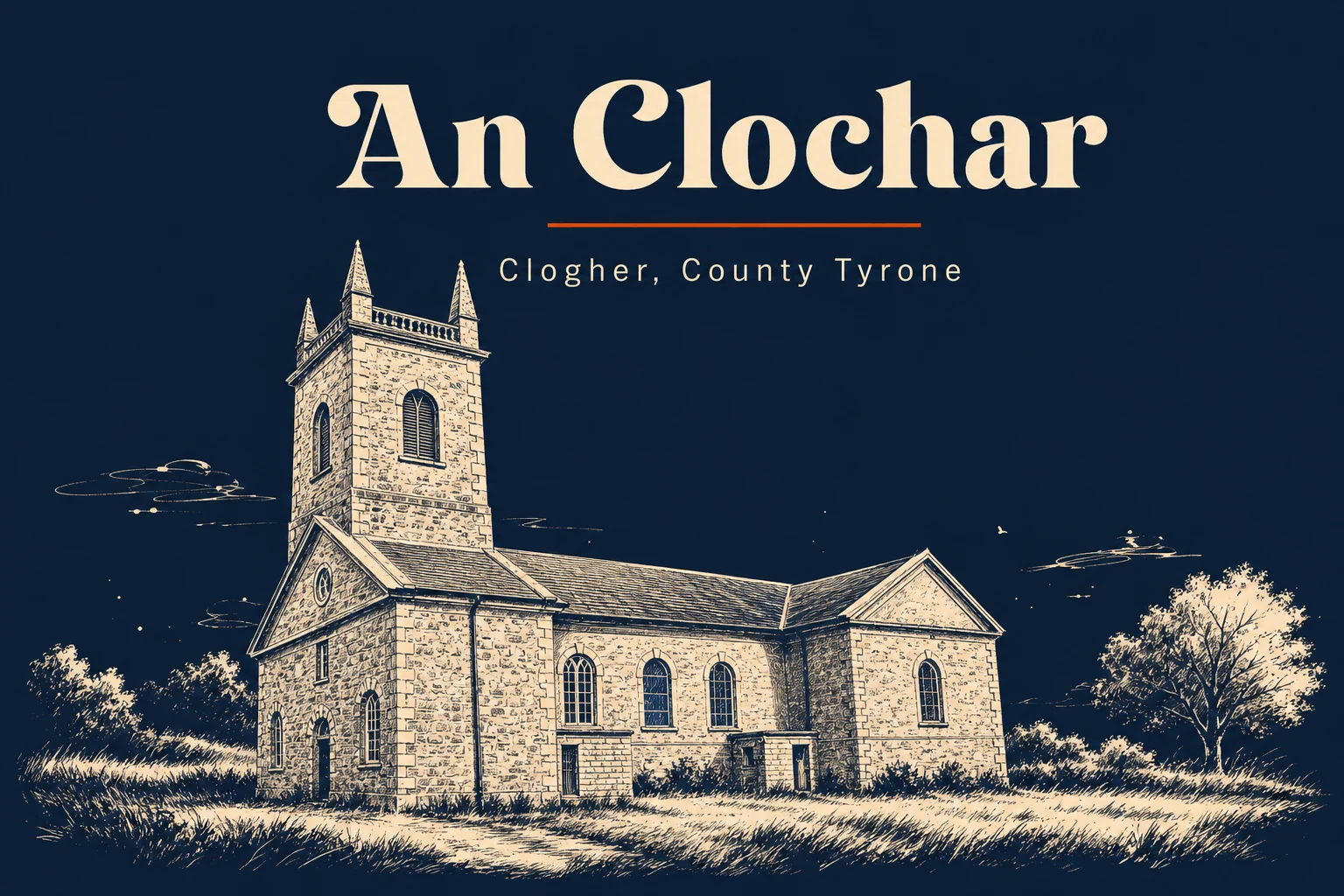
An Clochar

The Clogher Valley
STOP 04 / 04
An Clochar · Co. Tyrone

A cathedral in a village of three hundred. The Diocese of Clogher - older than the Norman tower, older than the written county - has its seat here, where St Macartan placed a bishop sixteen centuries ago.

Clogher is a village of roughly three hundred people in the Clogher Valley, six miles north of the Monaghan border. There is a main street, a Church of Ireland cathedral on the hill, a Catholic church below it, a bishop's palace behind a gate, and not much else. What makes the place worth understanding is not its size but its age.

St Macartan - Aedh Mac Cairthinn - came to this hill around 454 AD, appointed by Patrick as the first Bishop of Clogher. He was Patrick's companion on the road, known in hagiography as the "strong man" of Patrick, and when Patrick placed him here he was placing the church in one of the most significant pre-Christian sites in Ulster. Clogher was already a place of consequence: a hillfort, a royal seat, and the location of the Clogh-Oir - the golden stone, a pagan oracle said to have been consulted by the High Kings of Ulster. The name Clochar, stone place, came before the monastery; the monastery came before the diocese; the diocese came before the county.

The present cathedral is eighteenth century, much rebuilt, but the continuity underneath it is genuine. The Diocese of Clogher covers much of south Ulster - Fermanagh, Monaghan, parts of Tyrone, Cavan, Leitrim, Donegal - and its bishops have been consecrated in this valley since before the Norman conquest of England. That is the thing about Clogher: the village is small and the ambition of the place stopped a long time ago, but the foundation is one of the oldest in Irish Christianity. Come for the cathedral, stay for the weight of the ground.
Population
~300 (est. 2021)
Walk score
Cathedral to bishopric site in under two minutes
Founded
c. 454 AD (monastic foundation)
Coords
54.4122° N, 7.1817° W
01 / 04

At a glance.

Three things every local will eventually mention. Read these and you've already understood more than most day-trippers do.

01 St Macartan's Cathedral

Church of Ireland, on a site that predates it by twelve centuries.

The present building went up in 1744 - designed by architect James Martin for Bishop John Stearne in a neo-classical style - but the ground it stands on was an episcopal seat from at least the fifth century. The site has been burned, sacked, rebuilt and reconsecrated across a documented history stretching back to 1041. Inside: a collection of episcopal portraits, quality stained glass, and the Clogh-Oir, a carved stone that carries its own legend. The cathedral occupies the hill that gave Clogher its name.

Stories & lore →
02 The Ancient Episcopal Seat

Seat of the Diocese of Clogher since the Synod of Rathbreasail, 1111.

The Diocese of Clogher was formalised at the Synod of Rathbreasail in 1111, but the see is traced to St Macartan's foundation in the mid-fifth century - making this one of the oldest continuously referenced episcopal sites in Ulster. After the Reformation the Church of Ireland took the cathedral. The Roman Catholic diocese, restored in the nineteenth century, now has its cathedral in Monaghan. Both traditions trace their line to the same hillside in this small valley village.

Stories & lore →
03 The Clogher Valley

South Tyrone's quiet corridor to Monaghan.

Clogher sits in the valley of the River Blackwater, about six miles from the Monaghan border. The valley runs south-west toward Fivemiletown and Clones; the hills above it are low and green. It is agricultural country - small farms, roadside hedges, the occasional standing stone. The landscape earns no adjectives. It suits the place.

Getting here →
02 / 04

Stories & lore.

The reason to come back. The things every local will eventually tell you about, usually after the second pint.

Foundation c. 454 AD

St Macartan and the First See

Aedh Mac Cairthinn - latinised as Macartan - was born in Ulster and went south to hear Patrick preach, meeting him first at Drumlease near Dromahair in County Leitrim. Baptised and taken on as a companion, he became known as Patrick's "strong man" (treinfhear) for his physical strength and his loyalty. Patrick appointed him first Bishop of Clogher, placing him on a hill in south Tyrone that was already a site of royal and spiritual significance. According to tradition he died around 505 AD, having established the monastery that would become the longest-running episcopal see in Ulster. His feast day is 24 March. The Diocese of Clogher celebrates his memory still.

A golden stone and a pagan oracle

The Clogh-Oir

The name Clogher derives from An Clochar - the stone place - and specifically from the Clogh-Oir, the golden stone. This was a pagan oracle stone, said to have been covered in gold and consulted by the kings of Ulster, among them Concobar MacNessa, High King of Ulster. The Clogh-Oir was counted as one of the three great sacred stones of Ireland, alongside the Stone of Destiny and the Crom Cruach. Early Christian tradition holds that Macartan destroyed or neutralised the oracle stone when he established the see - a standard act of supersession in the conversion of Ireland. What is less standard is that a carved stone still sits inside the cathedral today, identified by some antiquarians as the original. Whether or not that is so, the hill at Clogher carries the older name.

Synod of Rathbreasail, 1111

The Diocese Across Sixteen Centuries

The monastic church at Clogher was organised into a formal diocese at the Synod of Rathbreasail in 1111 - part of the broader reform of the Irish church under the influence of the continental model. The Diocese of Clogher was defined as the see for the Kingdom of Uí Chremthainn, covering a broad stretch of south-west Ulster. After the Reformation, Henry VIII confiscated the cathedral for the Church of Ireland; the Roman Catholic bishops of Clogher continued in a precarious existence through the penal period, holding the ancient title without a seat. A decision was made in 1851 to move the Catholic episcopal presence to the larger town of Monaghan, where the RC cathedral now stands. The Church of Ireland diocese remains based in Clogher, with its cathedral on the original fifth-century hill. In 2005 the Church of Ireland Diocese of Clogher was united with Armagh; the title survives.

03 / 04

What to skip.

Honestly? Don't bother.

If a local was sitting beside you, this is the bit where they'd lean in.

×
Looking for village amenities

Clogher is very small - a cathedral, a church, a handful of houses. There are no verified restaurants, hotels or pubs within the village itself. Augher is two miles west; Fivemiletown is six miles south-west. Plan accordingly.

×
Coming for a half-day of activities

The cathedral is the visit. It will take you thirty minutes to an hour. The valley is pleasant to drive through. This is a detour on the way to somewhere else, not a destination for a full day.

×
Expecting two cathedrals in the village

The Roman Catholic cathedral for the Diocese of Clogher is in Monaghan, not here. The village has St Macartan's (Church of Ireland) and St Patrick's Catholic Church below it - the latter a parish church, not a cathedral. The diocese has two traditions but only one cathedral building in Clogher.

+

Getting there.

By car

Clogher sits on the A4, the main Dungannon-to-Enniskillen road, in the Clogher Valley. From Dungannon: 25 km south-west, about 25 minutes. From Enniskillen: 40 km east, about 35 minutes. From Armagh: 30 km south-west via the A28 and A4, about 35 minutes.

By bus

Translink Ulsterbus route 261 (Dungannon to Enniskillen) passes through Clogher. Services are infrequent - check Translink timetables before travelling.

By train

No rail service. Nearest stations are Portadown (about 45 minutes by car, on the Dublin-Belfast Enterprise line) and Newry (about 50 minutes).

By air

Belfast International Airport is approximately 85 km north-east (about 1 hour 10 minutes by car). Dublin Airport is approximately 130 km south (about 1 hour 40 minutes via the A4 and M2/M1).