County County Tyrone Ireland · Co. County Tyrone · Newtownstewart Save · Share
POSTED FROM
NEWTOWNSTEWART
CO. COUNTY TYRONE · IE

Newtownstewart
An Baile Nua

The Northwest Tyrone / Sperrin foothills
STOP 07 / 07
An Baile Nua · Co. County Tyrone

A Plantation town on the River Strule where a ruined O'Neill castle stands on a hill above the fields, and Gortin Glen is twenty minutes south.

Newtownstewart sits in a bend of the River Strule where the Owenkillew comes in from the south. The town itself is compact - a main street, a square, the ruined walls of a 17th-century Plantation castle rising above the river. It was called Lislas before the Plantation, then renamed by Sir William Stewart, who took the land in the 1620s after the original grantee forfeited it. That is the shape of northwest Tyrone: layers of ownership, each one stamped over the last.

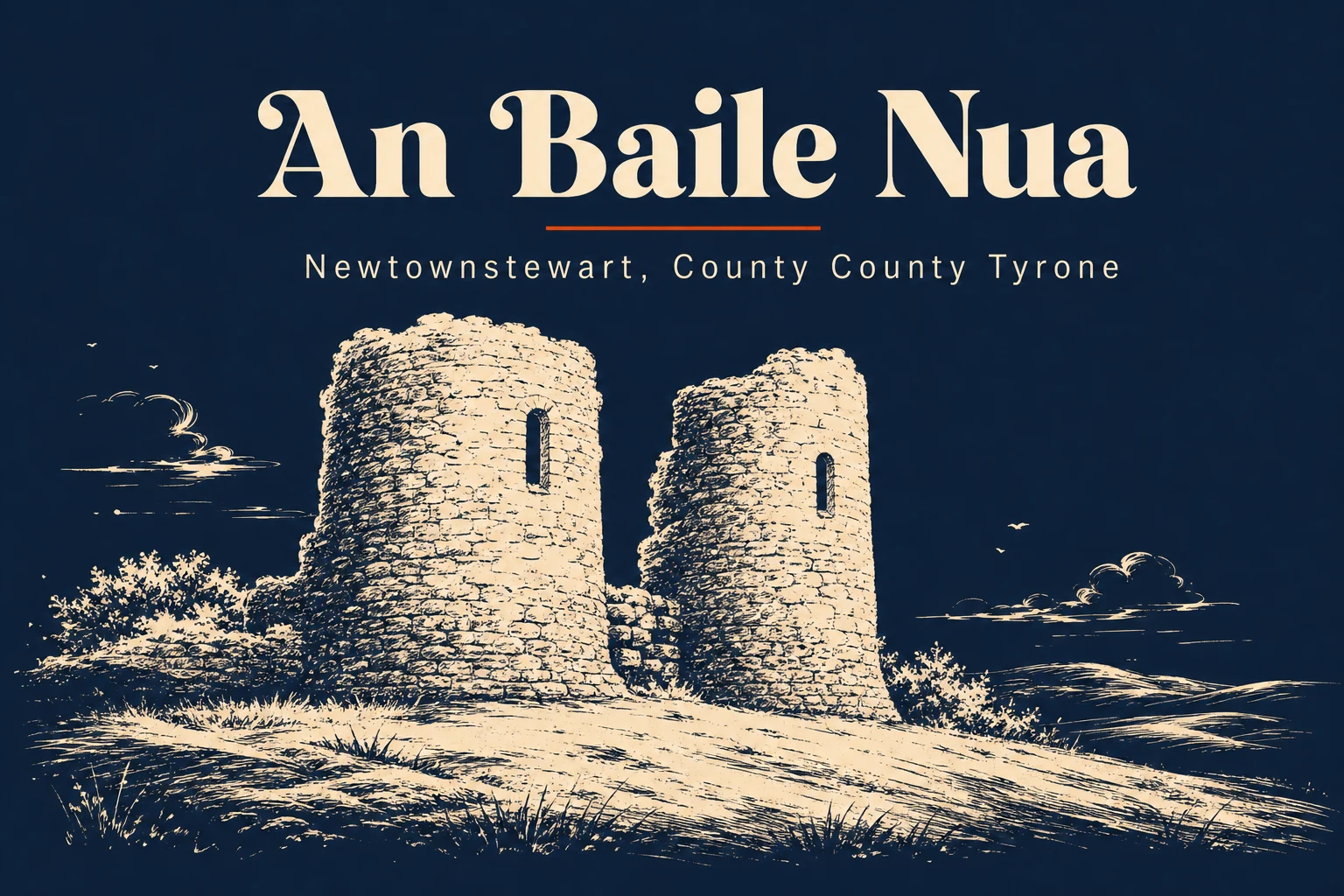
The reason most people stop here - if they stop at all - is Harry Avery's Castle, half a mile south-west on a hill above the A5. It is not a ruin in the romantic sense: two D-shaped towers of rough stone, roofless for four centuries, looking out over farmland and river valley. But what it is matters. Almost every medieval stone castle in Ireland was built by the Anglo-Normans. This one was built by the O'Neill family - Gaelic, Irish, the clan that held Tír Eoghain before the Plantation ended it. Named for Henry Aimhréidh O'Neill, who died in 1392, it is a statement in stone that the chieftains here were building to last, in a tradition not their own. The English seized it in 1609. Then it became a quarry.

The town has a working, unpretentious character. The Cedar Country Hotel, a few minutes' drive in the Baronscourt estate forests, is the food and accommodation story for the area - it won Best Hotel and Guesthouse Restaurant at the Irish Restaurant Awards in 2023, which is more than most towns this size can say. The town centre itself is quiet, the kind of place that does its business without performing it.

Use it as a base - for Harry Avery's Castle in the afternoon, for Gortin Glen the next morning, for the Bessy Bell hill walk if the weather is right. The Sperrin hinterland here is wide and largely empty of other visitors. That is either the problem or the point, depending on what you came for.
Population
1,414 (NISRA 2021)
Walk score
Compact town centre, Main Street and river within ten minutes of each other
Founded
Plantation town; castle built c. 1619 by Sir Robert Newcomen
Coords
54.7197° N, 7.3859° W
01 / 07

At a glance.

Three things every local will eventually mention. Read these and you've already understood more than most day-trippers do.

02 / 07

Where to sleep.

PlaceTypeLocal note
The Cedar Country Hotel Country hotel, restaurant and bar Set in the forests of the Baronscourt estate a short drive from Newtownstewart. Family-run by three sisters, newly renovated. The Sika 1888 restaurant champions local suppliers and holds the Best Hotel and Guesthouse Restaurant award from the Irish Restaurant Awards 2023. Bar on site (The Thirsty Duck). Book direct via thecedarcountryhotel.com.
Castle Inn Guesthouse with bar 3 Townhall Street, Newtownstewart BT78 4AX. Small guesthouse in the town centre with en-suite rooms and an on-site bar. Straightforward, local, no frills. Listed on booking.com and the property's own site at castleinnguesthouse.com.
03 / 07

Stories & lore.

The reason to come back. The things every local will eventually tell you about, usually after the second pint.

The O'Neill who built in stone

Harry Avery's Castle

Henry Aimhréidh O'Neill - anglicised as Harry Avery - died in 1392. He belonged to the O'Neill clan that dominated Tír Eoghain for centuries, but unlike most Gaelic lords of the period, he or someone in his family built in stone. The castle half a mile south-west of Newtownstewart is a rare survivor: a tower house with two massive D-shaped towers at the front, built c. 1320 according to tradition, though the origins remain uncertain. The structure copies the form of Anglo-Norman architecture but was built by a Gaelic chieftain - evidence of the two cultures watching and borrowing from each other across the centuries before the Plantation ended that ambiguity. The English occupied the castle in 1609 and by the 18th century it was being used as a quarry for building stone. What stands now is the tower front: roofless, accessible freely, signed off the A5. The Department for Communities maintains the site.

Two castles, two overlapping colonisations

The Stewart Plantation and the town castle

The townland here was called Lislas and was originally granted by James I to Sir John Clapham under the Plantation of Ulster. It passed to Sir William Stewart after Clapham's patent was forfeited, and Stewart built his castle on a bend in the Strule around 1619 - his son-in-law Sir Robert Newcomen is the named builder in the records, and Stewart modified it after 1628. The town took the name Newtownstewart. The castle was burned by Sir Phelim O'Neill in 1641 during the Ulster rebellion, and burned again in 1689 by the retreating army of James II. The roofless walls and 19th-century arcade that stands over the old market square are what remain. The arcade belonged to a corn exchange, part of a row of market buildings that once included a town hall and an inn.

The river that watched everything change

The Strule valley and the Flight of the Earls

The River Strule runs through one of the corridors of northwest Tyrone that mattered enormously in 1607, when the Flight of the Earls ended Gaelic Ulster. The O'Neills of Tír Eoghain had held these lands for centuries. After the Nine Years' War ended in 1603, the earls - Hugh O'Neill among them - left Lough Swilly for the continent and never returned. The Plantation that followed turned the land over to English and Scottish settlers. Newtownstewart is a physical record of that transfer: the Gaelic tower house on the hill, the Plantation town castle on the river bend, the Scots-Irish town that grew between them. Three layers in one small landscape.

04 / 07

Things to do outside.

Wear waterproofs. Bring a sandwich. Tell someone where you're going if it's the mountain.

Harry Avery's Castle Park at the lay-by off the minor road south-west of town (signed from the A5). Walk up through a field to the twin-towered ruins on the ridge. No facilities, no entry charge. The view from the top takes in the Strule valley and the Sperrin foothills. Boots useful in wet weather.
1.5 km return from roadsidedistance
40 minutestime
Bessy Bell East Route described on WalkNI.com. Starts in Newtownstewart on the Old Castle Road, passes Harry Avery's Castle, and climbs north through countryside and forested sections toward Bessy Bell. The full summit walk requires clear conditions. Check WalkNI.com for current access and conditions before setting out.
8 km return (approximate)distance
2.5-3 hourstime
Gortin Glen Forest Park Roughly ten miles south on the B48 through Gortin village. Managed by the Forest Service of Northern Ireland. Waymarked forest trails, a Wildlife Centre, and views into the Sperrins. Entry charge applies for cars. A solid half-day combined with the drive through the Gortin glens.
Multiple trails, 2-10 kmdistance
1-4 hours depending on trailtime
05 / 07

When to go.

There is no bad time. There are different times.

Spring
Mar-May

The Strule valley is green and quiet. Harry Avery's Castle is good in any weather; the field access is better before summer rains turn it to mud. Gortin Glen's woodland trails are excellent in April.

◉ Go
Summer
Jun-Aug

Long evenings and the Sperrins at their most walkable. The Cedar Country Hotel tends to be busy at weekends - book ahead. The A5 corridor gets tourist traffic heading to Donegal; Newtownstewart itself stays relatively quiet.

◉ Go
Autumn
Sep-Oct

The Sperrin colours are at their best. Gortin Glen is particularly good in October. Fewer visitors than summer, the same access to everything that matters.

◉ Go
Winter
Nov-Feb

Cold and wet. The castle field path can be waterlogged. The town closes early. Fine for a daytime stop between Omagh and Strabane, not a base for extended walking.

◐ Mind yourself
06 / 07

What to skip.

Honestly? Don't bother.

If a local was sitting beside you, this is the bit where they'd lean in.

×
Driving past Harry Avery's Castle without stopping

The sign off the A5 is easy to miss. It takes less than an hour return and there is almost never anyone there. If you are on the road between Omagh and Strabane, the detour costs thirty minutes. Take it.

×
Expecting a town with a restaurant scene

Newtownstewart is a small, working town. The food story is the Cedar Country Hotel in Baronscourt, a few minutes by car. If you want a sit-down dinner in the town centre itself, options are limited - verify before you arrive.

×
Confusing Harry Avery's Castle with the Newtownstewart town castle

There are two castle ruins here. The town castle ruin stands in the market square and is the 1619 Plantation-era structure. Harry Avery's Castle is a separate, older site a kilometre south-west. Both are worth seeing; they are not the same thing.

+

Getting there.

By car

Strabane is 16km north on the A5. Omagh is 18km south. Derry is about 45 minutes via Strabane. The A5 (Derry-Dublin) runs through the town, making it straightforward on the main northwest corridor.

By bus

Translink Ulsterbus route 97 (Omagh-Strabane) stops in Newtownstewart, running roughly every hour on weekdays, reduced on weekends. Check Translink.co.uk for current timetables. Journey time from Omagh is about 25 minutes; Strabane is about 20 minutes.

By train

No rail service. Nearest stations are Strabane (limited Northern Ireland Railways service) and Omagh has no station either. Derry (Waterside) is the practical rail hub - taxi or bus from there.

By air

City of Derry Airport (LDY) is approximately 55km north via Strabane. Belfast International is about 95km east.