County Tyrone Ireland · Co. Tyrone · Douglas Bridge Save · Share
POSTED FROM
DOUGLAS BRIDGE
CO. TYRONE · IE

Douglas Bridge
Droichead na Dúghlaise

STOP 04 / 04
Droichead na Dúghlaise · Co. Tyrone

A bridge over a black stream, a poet who remembered it, and not much else. That is the whole honest inventory.

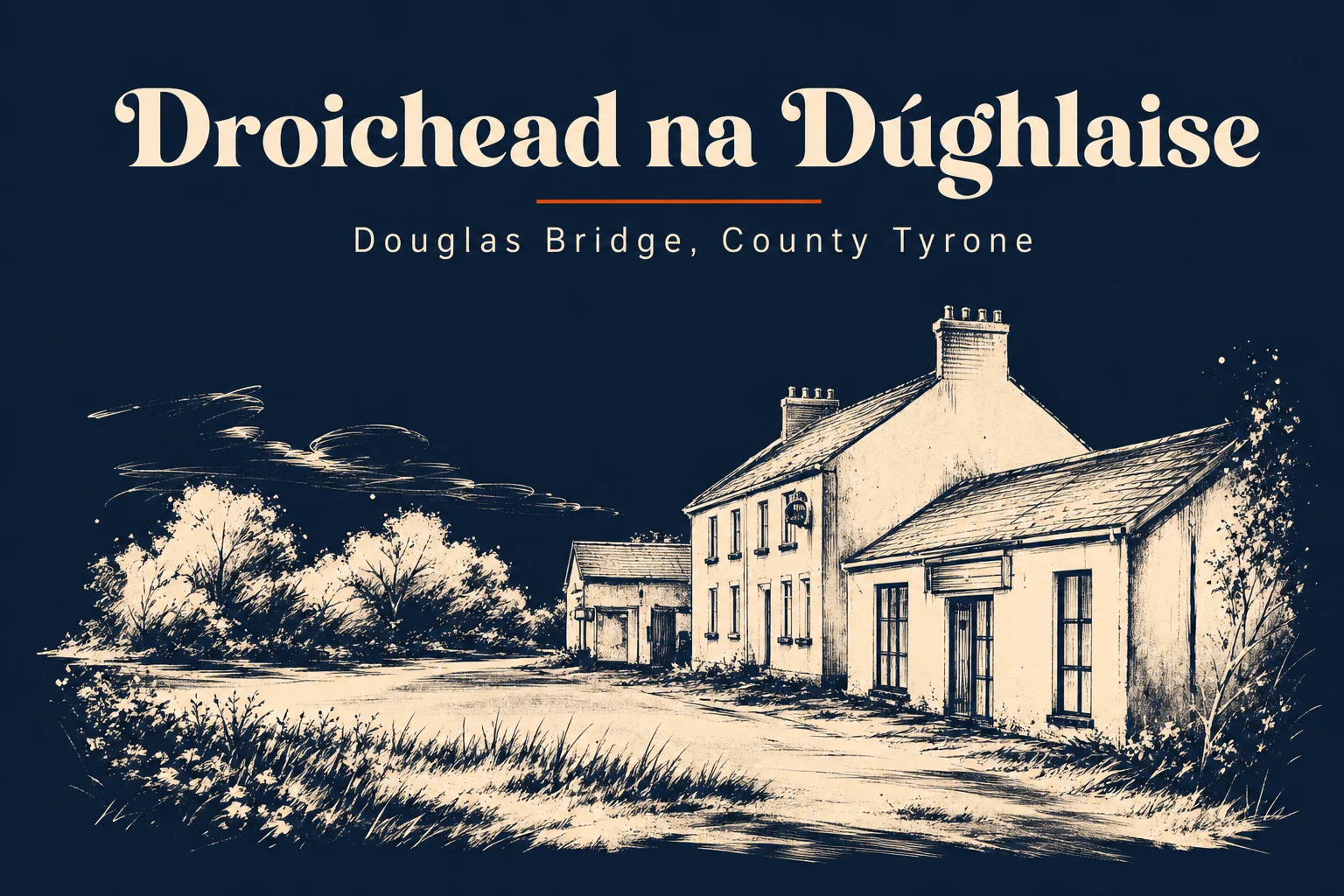
Douglas Bridge is a hamlet, not a village in any working sense. One hundred and forty-one people in 2021, scattered across the townlands of Skinboy, Drumnahoe, and Knockroe in the civil parish of Ardstraw. A crossing on a secondary road where the Douglas Burn runs under the tarmac and continues south toward the Mourne. That is the settlement. That is where the name comes from - dúglas, a black stream, the same root as Dublin, the same darkness in the water.

What it has is a poem. Francis Carlin, born County Tyrone in 1881, set "The Ballad of Douglas Bridge" here - a ghostly encounter with a man who once rode with Count Redmond O'Hanlon, the great Armagh rapparee of the 1670s. The poem made the Anthology of Irish Verse in 1922. The bridge made nothing in particular of this. It is still a bridge. The burn still runs black.

Population
141
Founded
c. 19th century
Coords
54.7567° N, 7.4203° W
01 / 04

At a glance.

Three things every local will eventually mention. Read these and you've already understood more than most day-trippers do.

02 / 04

Stories & lore.

The reason to come back. The things every local will eventually tell you about, usually after the second pint.

Francis Carlin, 1922

"Ballad of Douglas Bridge"

Francis Carlin - born James Francis Carlin MacDonnell in County Tyrone, 1881 - wrote a ballad set on this bridge in which the narrator encounters the ghost of a man who rode with Count Redmond O'Hanlon, the most famous rapparee of 17th-century Ulster. O'Hanlon was an Armagh man, dispossessed by the Cromwellian settlement, who led the Rapparees of Ulster through the 1670s before his death in 1681. The poem appeared in Padraic Colum's Anthology of Irish Verse in 1922 and is the only thing that put Douglas Bridge's name into print with any regularity.

Etymology and place

A black stream and a name

The village takes its name from the Douglas Burn, a tributary that crosses the road here on its way south. Dúglas in Irish means 'black stream' - the same root that gave Dublin (Dubh Linn, 'black pool') its name, and that runs through dozens of Scottish and Irish placenames. The bridge itself is a simple crossing point on a secondary road connecting the Strabane direction to Newtownstewart. The townlands it sits across - Skinboy, Drumnahoe, Knockroe - are working agricultural land, as they have been for several centuries.

03 / 04

What to skip.

Honestly? Don't bother.

If a local was sitting beside you, this is the bit where they'd lean in.

×
Making a dedicated trip

Douglas Bridge is a hamlet of 141 people with no pub, no café, and no visitor infrastructure. It repays a glance from the road if you are passing between Strabane and Newtownstewart, and nothing further. The poem is worth reading at home before you go.

×
Expecting a fishing experience here

The Douglas Burn is a small stream. The salmon and trout fishing the wider area is known for runs on the Mourne/Strule system to the southeast and - more significantly - on the River Finn across the Donegal border. Neither is accessible directly from this hamlet.

+

Getting there.

By car

Douglas Bridge sits on the B72 between Strabane (12km north) and Newtownstewart (12km south). No public car park. The road is the stop.

By bus

No scheduled service stops in the hamlet itself. Strabane is the nearest hub with Ulsterbus connections to Derry, Omagh, and Belfast.

By train

No railway. Derry is the nearest mainline station, 30km north.

By air

City of Derry Airport (LDY) is approximately 40km north. Belfast International is 100km east.