Three brothers, a mill, and a community built from scratch
The Herdmans and the model village
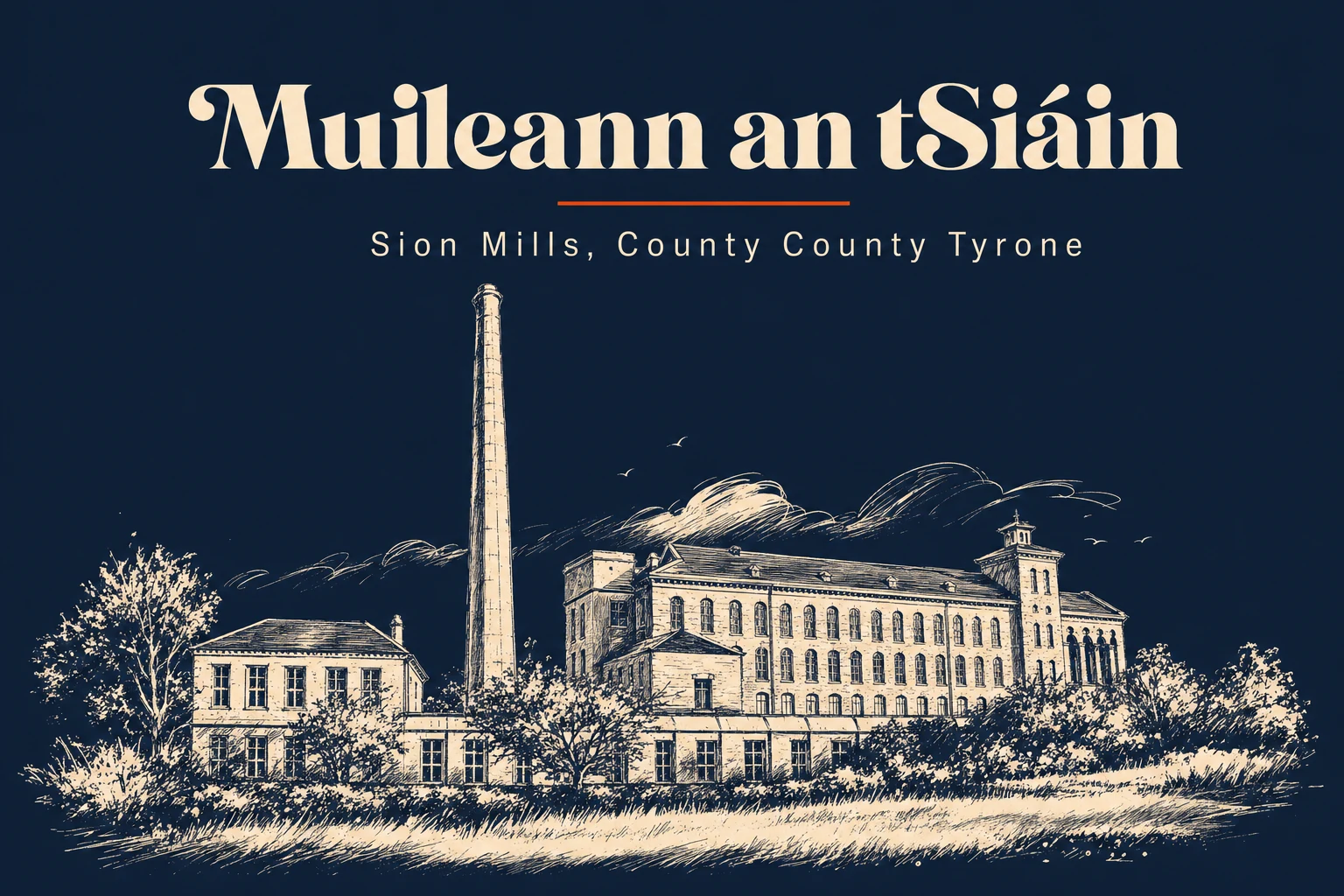
James, John, and George Herdman came to Sion Mills in 1835, converted an existing flour mill on the River Mourne into a flax-spinning operation, and then did something most industrial mill owners did not: they built the village their workers would need. Housing, a school, a cricket ground, a football pitch, recreational amenities - the development of Sion Mills was shaped by the same ideas of industrial paternalism that Robert Owen had demonstrated at New Lanark in Scotland. The mill itself grew over the decades, a second and larger building going up in the 1850s, and by the 20th century Herdmans Ltd was one of the significant linen employers in Ulster. The visual coherence of the village today - the half-timbered facades, the Tudor-revival church, the stable block - came from the family's decision in the 1880s to commission English architect William Frederick Unsworth to redesign the entire settlement. Unsworth worked here across three decades, transforming the Herdman family residence into a half-timbered mansion in 1884 and completing the Church of the Good Shepherd in 1907-1909. His last work in Sion Mills was the church; he died in 1912. The family's name still runs through the village - Herdmans Ltd, the cricket club's origins, the mill buildings on the Mourne.
The morning the West Indies made 25
Ireland v West Indies, 2 July 1969
The West Indian touring side of 1969 was travelling between Test matches in England. Ireland was, by any conventional measure, an amateur team playing at a level far below international Test cricket. What happened on the Holm Field at Sion Mills on a July morning should not have happened. Ireland's Doug Goodwin, captaining the side, took five wickets for six runs. Alec O'Riordan took four for eighteen. The West Indies - a side that included players of genuine Test quality - were dismissed for 25 runs in 25.5 overs. It remains the lowest total the West Indies have ever made. Ireland declared at 125 for 8 and won by nine wickets. The reaction was disproportionate and entirely justified: the London Times ran a front-page column, the Daily Mirror ran a colour photograph of Goodwin and O'Riordan, a cartoon appeared in the Express, and BBC Northern Ireland broadcast the play live with the footage going out on national sports programmes. The match is commemorated at the Holm Field, which Sion Mills Cricket Club - founded in 1864 - continues to play on. Cricket Ireland marked the 50th anniversary in 2019.
A 169-year run, then silence
The mill closes
Herdmans Ltd ran from 1835 to 2004 - one hundred and sixty-nine years of continuous linen production on the same site. The closure was not sudden. By the late 1990s, the European linen industry was under serious pressure from cheaper production in China and elsewhere in Asia. In 2004, Herdmans closed all production at Sion Mills, ending 600 jobs in a village of under 2,000 people. The mill buildings remain: grey ashlar stone quarried at Douglas Bridge near Strabane, the 19th-century weir across the Mourne still intact, the main mill structures visible from the riverwalk. No plans for the mill buildings have been confirmed publicly as of 2025, though they are listed structures. The Sion Stables heritage centre, the walking trail, and the heritage trail app are the current framework for accessing the village's industrial history. The mill itself can be seen from outside but is not open to the public.