County Waterford Ireland · Co. Waterford · Ardmore Save · Share
POSTED FROM
ARDMORE
CO. WATERFORD · IE

Ardmore
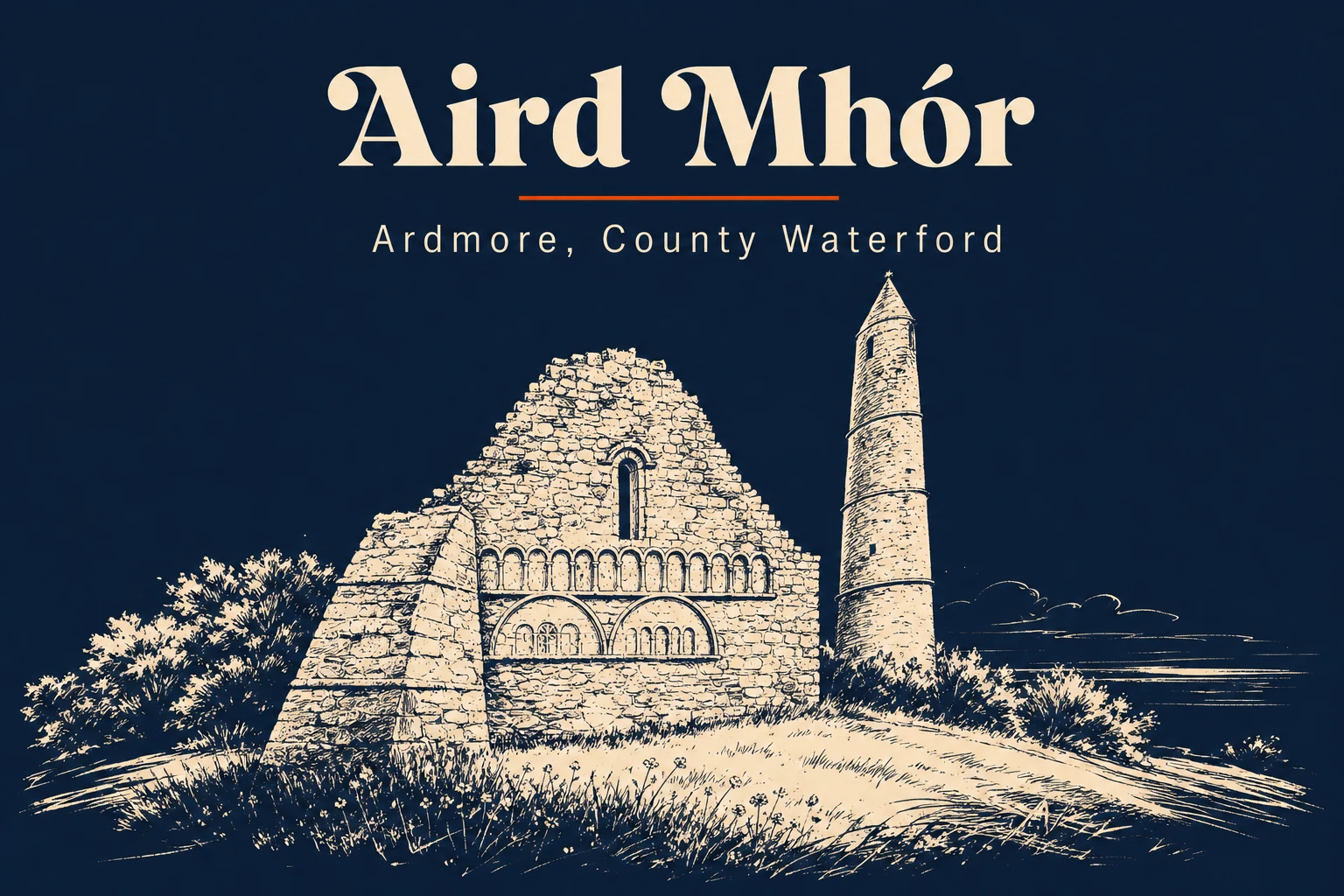
Aird Mhór

The Wild Atlantic Way
STOP 09 / 09
Aird Mhór · Co. Waterford

Where Declan beat Patrick to it. Round Tower, cliff walk, a Michelin star above the sea.

Ardmore is a half-moon of beach and a one-street village stitched into a green headland in west Waterford, five kilometres south of the N25 — far enough off the main road that you have to mean to come here. The Irish name is Aird Mhór, the great height, and the height is the point: the village sits low against the bay, and the headland behind it lifts the Round Tower thirty metres above everything else, visible from miles up the coast. People have been navigating by it for nine hundred years.

The story here is St Declan, and the story is older than most. He was a Déisi prince who went to Rome, came back a bishop, and was preaching Christianity on this hill a clear generation before Patrick is meant to have arrived. The monastery he founded ran in some form until the thirteenth century, when Lismore swallowed up the diocese. What survives is a remarkable tight cluster — the Round Tower (twelfth-century, thirty metres, one of the best preserved on the island), the Cathedral with its Romanesque arcade and weather-eaten biblical carvings, the tiny Oratory said to be Declan's grave, and two ogham stones standing inside the Cathedral wall. Twenty minutes around the lot. Free.

The Cliff Walk is the headline now, and rightly. Four kilometres, an hour at a stroll, looping out from the Cliff House Hotel through gorse and sea-pink, past the old coastguard station, past a Lookout Post from the Emergency, down to the wreck of the Samson — a Victorian crane barge that broke its tow off the headland in 1987 and has been rusting on the rocks ever since — and back to the village through Declan's monastery. Most cliff walks in Ireland make you choose between scenery and history; this one delivers both in one loop and asks for nothing in return. The Cliff House Hotel itself is the other reason people come — built into the rock face, owned in private hands, a Relais & Châteaux member, and home to The House Restaurant which has held a Michelin star every year since 2010. You can come for the dinner without staying. You can stay without the dinner. People do both, and people do neither, and walk the cliff and have a pint at Keevers and call it a perfect afternoon.
Population
~468
Pubs
2and counting
Walk score
Whole village in ten minutes, the cliffs in an hour
Founded
Monastic site c. 5th century
Coords
51.9486° N, 7.7256° W
01 / 09

At a glance.

Three things every local will eventually mention. Read these and you've already understood more than most day-trippers do.

02 / 09

The pubs.

None of these are themed Irish pubs, because they don't need to be. A few that earn the trip:

Keevers

Locals, slow, no fuss
Village pub

On Main Street, the kind of small old pub where the clock seems to have stopped some time in 1978 and nobody minds. A pint, a fire if it is cold, a chat if you want one. No music nights to speak of. The right place to end a wet walk.

An Tobar

End of Main Street
Pub

Was Gallagher's, then Paddy Mac's, now An Tobar — the well. Still the pub at the bottom end of Main Street that the American Nora Roberts fans turn up looking for. The locals shrug and pour the pint.

03 / 09

Where to eat.

PlaceTypeLocal note
The House Restaurant Restaurant, one Michelin star €€€ At the Cliff House Hotel. Held its star every year since 2010. Tasting menu and a shorter table d'hôte. The dining room is glass, the cliff is below the glass, and the food is what west Waterford is doing on its best day. Book weeks ahead.
White Horses Restaurant €€ Family-run on Main Street, going on three decades. Morning coffee through to a more ambitious evening menu. Fish and lobster the headline. Sunday lunch is a proper sit-down. Closed in the deep winter — check before you drive.
The Cliff House bar menu Hotel bar food €€ If The House Restaurant is booked out or beyond the budget, the bar at the Cliff House does a shorter menu with the same view. Same kitchen, same producers, half the ceremony.
04 / 09

Where to sleep.

PlaceTypeLocal note
Cliff House Hotel Hotel, Relais & Châteaux Built into the cliff face above the bay. Thirty-nine rooms, all with sea, a pool that looks out at Ram Head, and the Michelin-starred restaurant downstairs. The reason a lot of people come to Ardmore at all. Not cheap. Not pretending to be.
Newtown Farm Country House B&B on a working farm Run by Teresa and Maurice O'Connor on a farm the family have worked for four generations. Six rooms, sea views from the breakfast room, eggs from the yard, brown bread that earns its keep. Two minutes' drive from the village; ten minutes' walk.
A self-catering cottage above the strand Self-catering There are a handful of holiday cottages on the rise behind the beach. Off-season they are very quiet and the prices ease. Bring a coat and a book.
05 / 09

Stories & lore.

The reason to come back. The things every local will eventually tell you about, usually after the second pint.

Before Patrick

St Declan

Declan was a prince of the Déisi who, the chronicles say, went to Rome, was ordained bishop there, and came home to preach Christianity at Ardmore in the early fifth century. That puts him a clear generation before Patrick. The two are said to have met later and reached an accommodation — Declan kept the Déisi, Patrick took everywhere else. He is buried, by tradition, in the small Oratory beside the Round Tower. The Pattern Day, his feast, falls on 24 July; the village still walks the route to the holy well and back.

Twelfth-century, thirty metres

The Round Tower

The Round Tower at Ardmore went up around 1170 and is one of the best-preserved on the island. Thirty metres, four storeys, conical cap intact, the entrance set well above ground for a rope ladder the monks could pull up. It is also one of the latest Round Towers built — the form was already on its way out when Ardmore went up. They cleared it out in the eighteenth century and found human remains inside. Nobody is quite sure why.

Older than the alphabet you are reading

The Ogham stones

Inside the ruined Cathedral two ogham stones lean against the inner wall. Ogham is the early Irish script — notches cut along the edge of a stone, a one-line vertical alphabet, in use from the fourth century. One of the Ardmore stones reads as the name of a man, Lugudechas. They are older than the monastery they sit inside, older than the Round Tower by seven hundred years, older than the language most Irish people now speak.

On the rocks below the cliff walk

The wreck of the Samson

Halfway round the Cliff Walk, look down. The Samson is a Victorian-era crane barge that was being towed past Ardmore in a December storm in 1987 when she broke loose, drifted in, and went up on the rocks under Ram Head. The crew were lifted off by helicopter. The barge was never recovered. She has been rusting in place for nearly forty years and is now, oddly, the most photographed thing in the village after the Round Tower.

06 / 09

Things to do outside.

Wear waterproofs. Bring a sandwich. Tell someone where you're going if it's the mountain.

Ardmore Cliff Walk Starts and ends at the Cliff House Hotel car park. Climbs out past the round tower of the coastguard station, swings around the headland past the wartime Lookout Post, drops you a view of the Samson on the rocks below, and brings you back through the monastic site. Easy underfoot, well-signed, do it clockwise so the sea is on your left going out.
4 km loopdistance
1 hourtime
St Declan's Way (Ardmore section) The full pilgrim route runs from Ardmore to Cashel in Tipperary, following Declan's traditional path. The first stretch out of the village climbs gently inland through farmland and is a different walk entirely from the cliff loop — green, quiet, no sea. Turn around at Ardoginna or push on as far as you fancy.
First 8 km of a 115 km pilgrim pathdistance
2–3 hourstime
The strand and the pier Down through the village, out along Ardmore Beach to the small pier and back. Flat. Suits a coffee in the hand. Watch for the Atlantic — it does a long flat strand on the days it is being kind, and a serious surf on the days it is not.
2 km there and backdistance
30 mintime
07 / 09

When to go.

There is no bad time. There are different times.

Spring
Mar–May

Cliff path is at its best: gorse out, sea-pink coming on, paths quiet. The Cliff House Hotel reopens after its winter close. The light is the light Irish painters keep trying to catch.

◉ Go
Summer
Jun–Aug

Busy in July and August — the village fills, the Cliff House books out months ahead, the strand is full by eleven. Long evenings make it worth it; book everything two months out.

◐ Mind yourself
Autumn
Sep–Oct

The locals' season. Storms rolling in across the bay, the cliffs at their most dramatic, the village quiet enough to feel like itself again. The Pattern at the end of July aside, this is the right time.

◉ Go
Winter
Nov–Feb

Half the village shuts. The Cliff House closes for a winter spell. White Horses tightens its hours. Keevers is the lit window at four in the afternoon. Quiet in a way that suits some people and not others.

◐ Mind yourself
08 / 09

What to skip.

Honestly? Don't bother.

If a local was sitting beside you, this is the bit where they'd lean in.

×
Driving past on the N25 without turning off

Ardmore is five kilometres south of the main road. People miss it because they did not know to turn. Turn.

×
The Round Tower as a quick photo and back to the car

The whole monastic site — Tower, Cathedral, Oratory, ogham stones, holy well — sits in a single graveyard. Twenty minutes will do it. Five minutes will not.

×
Booking the Cliff Walk for an hour at high tide in November

The path is fine in any weather but the wreck-of-the-Samson view and the Lookout Post earn their keep on a clear day. Pick the morning if the forecast is mixed.

×
Asking after Paddy Mac's

The pub at the end of Main Street has been Gallagher's, then Paddy Mac's, and is now An Tobar. Same building, three names in two decades. The locals will gently correct you.

+

Getting there.

By car

From Cork, the N25 east to the Ardmore turn-off (R673), about 50 minutes. From Waterford city it is the N25 west, about 55 minutes. Last five kilometres are a narrow signed lane down to the village.

By bus

No direct bus into Ardmore. The Bus Éireann 40 between Cork and Waterford stops at the N25 junction; from there it is a 5km walk or a local taxi.

By train

No train. Nearest stations are Cork (Kent) and Waterford Plunkett, then onward by bus or car.

By air

Cork Airport (ORK) is 1 hour by car. Waterford Airport is closer at 45 minutes but has very few flights. Dublin is 3 hours.