County Waterford Ireland · Co. Waterford · Carrickbeg Save · Share
POSTED FROM
CARRICKBEG
CO. WATERFORD · IE

Carrickbeg
Carraig Bheag

The Ireland's Ancient East
STOP 04 / 08
Carraig Bheag · Co. Waterford

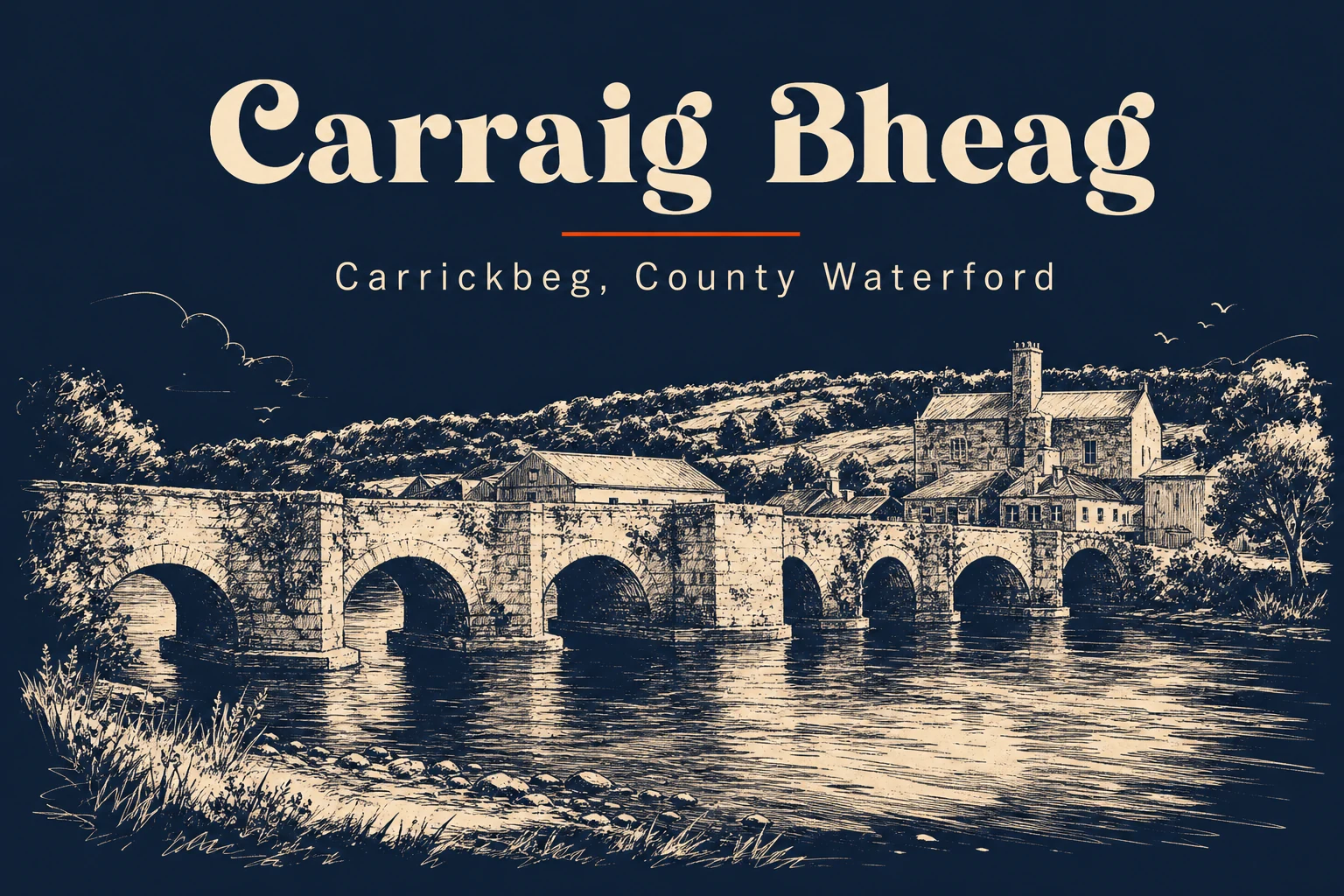
The Waterford half of Carrick-on-Suir, across an eight-arch bridge from 1447.

Carrickbeg — Carraig Bheag, the small rock — is the south bank of Carrick-on-Suir. The river is the county border. The town on the north bank is in Tipperary; this side is Waterford. People who live here know which county their roof is in to the foot, and a great deal of perfectly ordinary life is organised around the difference: which council the bin lorry comes from, which school catchment, which county jersey the children pull on for hurling. The bridge knits the place together. The line under the bridge keeps it apart.

The single building that explains the suburb is the parish church up the slope from the river, because half of it is older than it looks. The square belfry tower and most of the north wall are what is left of the Franciscan friary granted to the order in 1336 by James Butler. The friars were dissolved out of it in 1540, slipped back in 1669 to a thatched house, built St Francis's Church alongside the medieval ruin in 1822, and finally left for good on Easter Saturday, 2006 — six hundred and seventy years on the same patch of ground. The tower is still there. The order is not.

Carrickbeg is not a destination so much as a half of one. You come for Carrick-on-Suir and find yourself walking across the Old Bridge without thinking about which side you started on. Stay an evening. Have a pint in Walls Bar. Walk up to the friary tower. Walk back over the bridge at dusk. The whole thing takes an hour and tells you most of what the town is.
Population
Part of Carrick-on-Suir (urban pop. 5,752, 2022)
Walk score
Bridge to friary tower in five minutes
Founded
Franciscan friary granted 1336
Coords
52.3464° N, 7.4136° W
01 / 07

At a glance.

Three things every local will eventually mention. Read these and you've already understood more than most day-trippers do.

02 / 07

The pubs.

None of these are themed Irish pubs, because they don't need to be. A few that earn the trip:

Walls Bar (Carraigbeg Inn)

Quiet, regulars
Local pub

The Carrickbeg local. Walls is the family name; Carraigbeg Inn is the older signage. Pints, talk, and a view of the bridge from the window seats.

03 / 07

Stories & lore.

The reason to come back. The things every local will eventually tell you about, usually after the second pint.

1336–2006

The Franciscan friary

James Butler, 1st Earl of Ormond, granted the riverside site to the Franciscan Conventuals in 1336. The friary stood here until Henry VIII's dissolution in 1540, when the lands reverted to the Butlers. The friars came back to Carrickbeg in 1669 — first to a thatched house, later to St Francis's Church built alongside the medieval ruin in 1822. The square belfry tower of the original friary, with a fine spiral stair in its wall, was incorporated into the present parish church across the road. The Franciscan presence ended on Easter Saturday, 2006, when the last friars left after six hundred and seventy unbroken years.

1447

The Old Bridge

Edmund MacRichard Butler — known to history as Edmund the Builder — raised the first stone bridge over the Suir at Carrick in 1447. Eight arches, the only crossing between Clonmel and the sea for the next three hundred years. Cromwell's army of 7,500 men marched over it in 1649 on their way to Waterford. In 1799, the worst inland drowning tragedy in Irish history happened beneath these arches, when a market-day crowd was lost to the river — a hundred dead, by the contemporary count. The two western arches were rebuilt around 1925 as a single navigation arch. The rest is the bridge that Edmund built.

Two counties, one town

The line under the bridge

Carrick-on-Suir is one town and two counties. The Suir is the boundary between Tipperary and Waterford, and the bridge is the seam. Carrickbeg has its own post office, its own primary school, its own parish — all of them Waterford. The big town up the hill on the north bank is Tipperary. People shop, drink and worship across the line every day, and then go home to whichever council deals with the potholes. The arrangement is ordinary here and confusing everywhere else.

04 / 07

Things to do outside.

Wear waterproofs. Bring a sandwich. Tell someone where you're going if it's the mountain.

Old Bridge & friary tower loop From the south end of the Old Bridge, up Main Street to the parish church, look up at the medieval belfry tower, back down to the river. Short, but it is the village in miniature.
1.5 kmdistance
30 mintime
Carrick-on-Suir Riverside Walk The towpath along the Suir starts on the Carrickbeg side and runs east toward Tinhalla. Flat, riverbank, a working stretch of water — herons, swans, the odd fisherman. The Carrick-to-Clonmel Greenway plan extends this; the river path is open now.
5 km returndistance
1h 30mtime
05 / 07

When to go.

There is no bad time. There are different times.

Spring
Mar–May

River high, hedges loud with birds, the bridge at its best. Quietest of the four seasons.

◉ Go
Summer
Jun–Aug

Long evenings on the riverbank. Carrick-on-Suir's summer events run on both sides of the bridge.

◉ Go
Autumn
Sep–Oct

Mist on the Suir of a morning. The friary tower looks medieval in the right light because it is medieval.

◉ Go
Winter
Nov–Feb

The Suir floods. The towpath is a mud-bath some weeks. The bridge is fine; the riverside walks may not be.

◐ Mind yourself
06 / 07

What to skip.

Honestly? Don't bother.

If a local was sitting beside you, this is the bit where they'd lean in.

×
Treating Carrickbeg as a separate destination

It is half of Carrick-on-Suir. Plan a Carrick-on-Suir day and walk the bridge as part of it.

×
Looking for the friary itself

The Franciscan friary is gone. What you can see is the belfry tower and north wall of the medieval friary church, embedded in the parish church on the hill. That is the friary now.

×
Driving over the Old Bridge to save time

It is one lane, the priority alternates, and the queue can outlast your patience. Park on either side and walk it. That is the whole point of it anyway.

+

Getting there.

By car

Waterford city to Carrickbeg is 27km on the N24, about 30 minutes. Clonmel is the same distance the other way. The Old Bridge is the obvious crossing; the New Bridge a hundred metres downstream takes the through-traffic.

By bus

Bus Éireann 55 (Waterford–Limerick) and TFI Local Link services stop in Carrick-on-Suir, a two-minute walk over the bridge.

By train

Carrick-on-Suir station is on the Waterford–Limerick Junction line, on the Tipperary side. Limited daily service. Cross the bridge on foot to reach Carrickbeg.

By air

Cork (ORK) is 1h 45m by car. Dublin is 2 hours. Shannon is 2 hours.