County Waterford Ireland · Co. Waterford · Mothel Save · Share
POSTED FROM
MOTHEL
CO. WATERFORD · IE

Mothel
Maothail

The Ireland's Ancient East
STOP 04 / 04
Maothail · Co. Waterford

A ruined Augustinian priory in a graveyard, and a few houses around it.

Mothel is more parish than village. A scatter of houses around a 19th-century church dedicated to Saints Quan and Broghan — the two saints who founded the original monastery thirteen hundred years earlier on the same patch of soft ground. The name is the land: Maothail, the spongy place. You can drive through it in under a minute and not know you were anywhere.

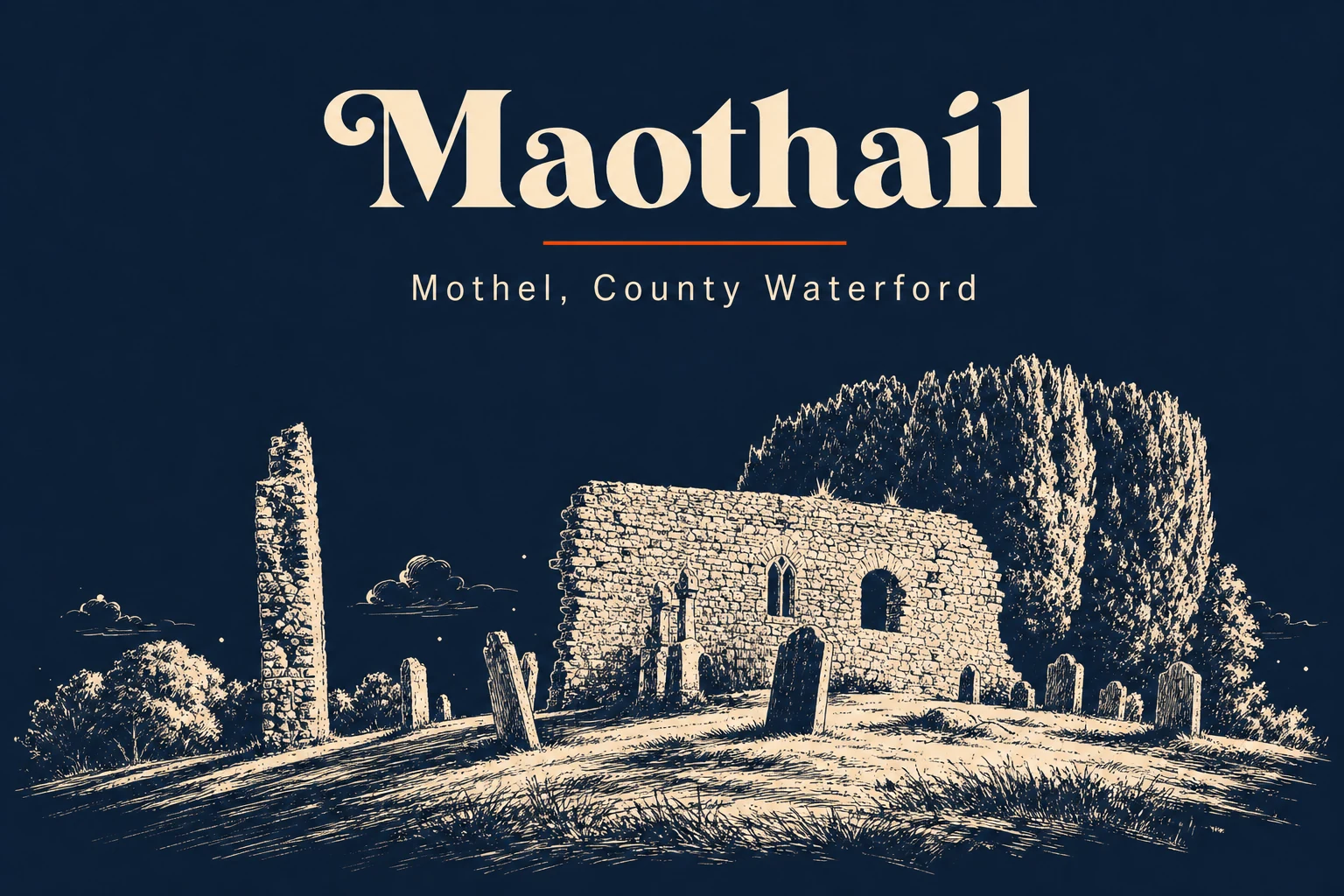
What's here is the abbey ruin in its graveyard, and the long history behind it. The Augustinian canons refounded the site after 1140 under the Powers, the local Hiberno-Norman lords, and ran a substantial monastery through the late middle ages until Edmund Power, the last abbot, handed it over to the crown in 1540. The walls and a carved tomb survived; the rest is grass and headstones. Come for an hour, walk the graveyard, read the stones, and drive on to Portlaw or back into Carrick for a pint.

Population
~150
Founded
Monastic site, 6th century
Coords
52.2867° N, 7.4233° W
01 / 04

At a glance.

Three things every local will eventually mention. Read these and you've already understood more than most day-trippers do.

02 / 04

Stories & lore.

The reason to come back. The things every local will eventually tell you about, usually after the second pint.

Six centuries, then the king

Mothel Abbey

The Augustinian Canons Regular refounded Mothel after 1140 on top of an older monastic site, with the Power family as patrons. They held a large slice of central Waterford from here through the 12th, 13th, 14th and 15th centuries. The last abbot, Edmund Power, surrendered the abbey to Henry VIII's commissioners on the 7th of April 1540. The buildings you can still see are mostly 13th-century. The walls stand to roof height in places. The graveyard is still in use.

The founders

St Cúan and St Brogan

Tradition has two 6th-century saints at Mothel. St Broccán (Brogan), feast day the 8th of July, founded the monastery. St Cúan succeeded him as abbot — the local pattern day is Lá Chuain Airbhre, Cúan of Airbhre. People used to walk through the stream at the holy well seven times on that day, and some still do. The 1817 Church of Ireland building down the road is dedicated to both of them: Sts Quan and Broghan, in the spelling that won the day.

Power family, about 1500

The tomb in the wall

Inside the abbey ruin, near the south wall, sits a tomb with decorated side panels dated to around 1500. Among the slabs in the graveyard is an inscribed one for a Richard Power who died in 1483. The Powers were the patrons here for four hundred years — they founded it, ran it, were buried in it, and the last of them surrendered it. The carvings on the panels have weathered, but you can still read them in low evening light.

03 / 04

Things to do outside.

Wear waterproofs. Bring a sandwich. Tell someone where you're going if it's the mountain.

Mothel Abbey ruin and graveyard Park at the church and walk down to the ruin. The site is open, free, and unstaffed. Read the older slabs along the south wall. The 13th-century walls stand higher than you expect. Take a torch if you want to look at the tomb panels inside.
Short potterdistance
30 minutestime
+

Getting there.

By car

Carrick-on-Suir to Mothel is about 10 minutes on the R676 then a local road south. Portlaw is 15 minutes east. Waterford city is 25 minutes via the N24 and Portlaw.

By bus

No direct service. The nearest is the Waterford–Carrick-on-Suir route through Portlaw; from either end you need a car or a taxi for the last few kilometres.

By train

Nearest station is Carrick-on-Suir on the Waterford–Limerick Junction line. Then drive or taxi.