County Waterford Ireland · Co. Waterford · Ring Save · Share
POSTED FROM
RING
CO. WATERFORD · IE

Ring
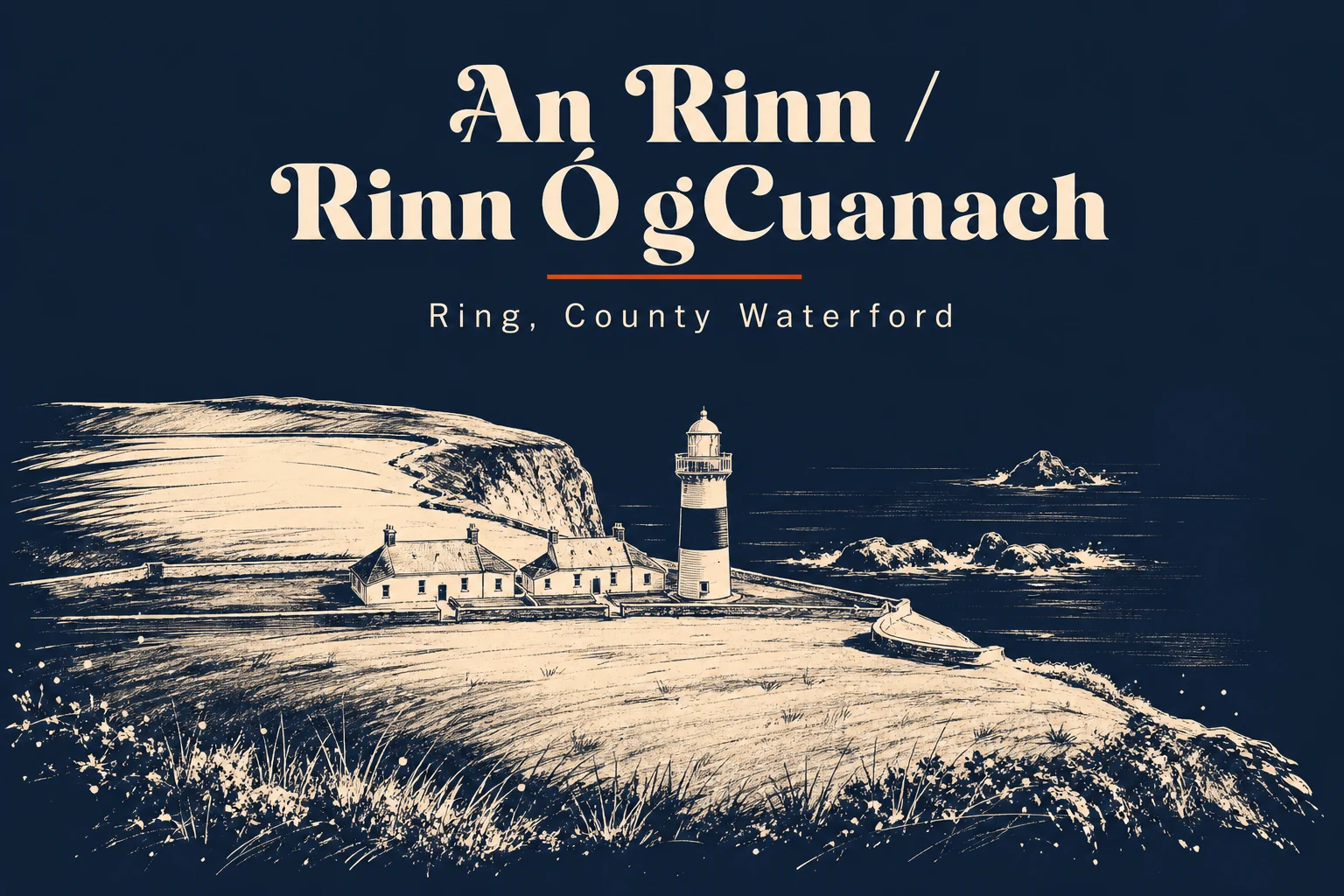
An Rinn / Rinn Ó gCuanach

The Wild Atlantic Way
STOP 03 / 06
An Rinn / Rinn Ó gCuanach · Co. Waterford

The only Gaeltacht east of Kerry, holding on at the end of a peninsula.

Ring is two things at once. It is a parish on a small peninsula ten kilometres south of Dungarvan — fields running down to a fishing pier under the cliff at Helvick Head. And it is a Gaeltacht — the only Irish-speaking parish in Munster east of Kerry, and the only one anywhere in the south-east. Both things are quiet about themselves. You can drive through and miss the point.

The point begins at Coláiste na Rinne. The college was set up in 1905, by the local priest Pádraig Ó Cadhla and the scholar Risteard de Hindeberg, to do what the Gaelic League dreamed of doing nationally — keep the language alive in the place that still spoke it. A century and change later it is still running. Children come for a summer, teenagers come for a school year, and they go home with a working tongue. Half the country has a cousin who did a stint here.

Helvick Head is the other half of the parish. The pier is small, the harbour is shallow, and the fishing has been thinning for decades — the fleet is a fraction of what it was when 3,000 people lived off these waters in 1848. What survives is enough to keep the place a working harbour and not a museum. A few trawlers. A seaweed bath operation. Cliffs above. Dungarvan Bay below, with the Comeraghs blue across it on a good afternoon.

The music is the through-line. Nioclás Tóibín, born here in 1928, won Corn Uí Riada three years running and made the Déise sean-nós style something the rest of the country had to listen to. The sessions in the parish pubs and the ones up the road in Pulla still draw on that tradition. Don't come looking for a stage. Come looking for a corner of a bar, after ten, when somebody starts a song nobody is talking over.
Population
~1,500 (Gaeltacht na nDéise)
Walk score
Spread along the peninsula — drive between the points
Founded
Coláiste na Rinne since 1905
Coords
52.0567° N, 7.5836° W
01 / 09

At a glance.

Three things every local will eventually mention. Read these and you've already understood more than most day-trippers do.

02 / 09

The pubs.

None of these are themed Irish pubs, because they don't need to be. A few that earn the trip:

Tigh an Cheoil

Music house, Gaeltacht local
Trad pub

The name means "the house of music" and the place earns it. Sessions and song nights in Irish and English. Small, plain, and the kind of room where the singer doesn't need a microphone.

Mooney's

Mecca for sean-nós and trad
Tigh tábhairne, sixth-generation

Six generations of the same family up over the bay. The Clancy Brothers, the Dubliners, the Fureys all drank here. Listed for sale in 2025, so check it's still pouring before you make the drive — but if it is, this is the room.

The Marine Bar

Loud Saturday, big crowd
Country pub & sessions

Up the road in Pulla on the N25, eight kilometres from Dungarvan. Christy O'Neill bought it in 1994 and has run a music programme since — Saturday and Monday nights are the reliable ones, plus bank-holiday Sundays. Home cooking, turf fire, and a late session if the night goes that way.

03 / 09

Where to eat.

PlaceTypeLocal note
Mooney's kitchen Pub food €€ If the pub is open, the kitchen does plain feeding — chowder, fish, the standard list done right. The view across the bay does the rest of the work.
The Marine Bar kitchen Country pub food €€ Home cooking in Pulla — soup, stew, fish from the bay. Eat early, sit on for the music.
Sólás na Mara Seaweed baths €€ Not food — but the only sit-down experience at the head itself. Hot seawater and locally cut seaweed in a bath cabin overlooking the harbour. Book ahead. Pair with a pint after.
04 / 09

Stories & lore.

The reason to come back. The things every local will eventually tell you about, usually after the second pint.

An Ghaeltacht is dheise

The last Munster Gaeltacht

Ring is the only Irish-speaking parish in Munster east of Kerry, and the only one anywhere in the south-east of Ireland. Gaeltacht na nDéise — about 1,500 people across the Ring and Old Parish electoral divisions. In the 2022 census, 28% of locals over the age of three reported speaking Irish daily. That is not a tourist statistic. That is a community keeping a language going by using it for school runs, shopping lists, and arguing about football. The signs at the parish boundary are in Irish only. The road signs argued for years and the locals won.

1905, and still running

Coláiste na Rinne

Pádraig Ó Cadhla, a Gaelic League organiser, ran Irish summer classes in Ring from 1903. By 1905 he had a building and a college; the founder Risteard de Hindeberg (Richard Henebry), a Kilmacthomas-born scholar of the language, gave it weight. It was officially recognised in 1907. More than a century later it is still here — children for a fortnight in the summer, teenagers for a full residential school year. Generations of Irish people learned to actually speak the language at this college on this peninsula. There are not many institutions in the country with that record.

The voice of the Déise

Nioclás Tóibín

Born in Ring in 1928, died in 1994. Nioclás Tóibín won the main singing competition at Oireachtas na Gaeilge — the prize now called Corn Uí Riada — three years running, 1961, 1962 and 1963. Both his parents were sean-nós singers before him. His version of "Na Connerys" — three brothers from Waterford transported to New South Wales in the early 1800s — is the one most people know. The annual Tionól Niocláis Tóibín brings singers and musicians back to the parish in his memory.

A working pier, smaller than it was

Helvick and the herring

The Norse called the headland Helvick — one of the few Viking place names surviving in this part of Ireland. Lord Stuart de Decies put up the first Famine-era dock and curing house here in the 1840s; the pier you stand on today is the later structure, designed by Alfred Dover Delap of Dublin around 1900. In 1848 the parish held some 3,000 people, most of them living off the boats. The Quakers and a local clergyman kept the fleet afloat through the worst of the Famine. The fleet went on through the twentieth century and then the late-1980s collapse of the Irish fishing industry hit it hard. A few boats still work the bay. The fishermen built the co-op building on the pier in the eighties to hold the line. Stand on the cliff above and you can see what was here — and what's left.

05 / 09

Music, by day of the week.

Schedules drift. This is roughly right. The real answer is "ask in the first pub you find."

Mon
The Marine Bar — trad session
Sat
The Marine Bar — main session, 9:30pm
Tigh an Cheoil — songs and tunes when the room is right
Sun
The Marine Bar — bank-holiday Sundays only
06 / 09

Things to do outside.

Wear waterproofs. Bring a sandwich. Tell someone where you're going if it's the mountain.

Helvick Head loop Park at the pier. Up the road, onto the cliff path along the head, around the point and back down. Sea on three sides, Comeraghs across the bay. Wind is the only thing here that talks loudly.
4 kmdistance
1h 30mtime
The cliff walk to Mine Head Push west from Helvick along the coast and the cliffs go on for kilometres. Mine Head lighthouse is the obvious target if you have a car shuttle. Mostly trackless — boots, OS map, a forecast that isn't lying.
Variabledistance
Half daytime
Baile na nGall pier The smaller of the two harbours, on the west side of the peninsula. A short walk out and back along the shore. The pier looks across to Dungarvan town.
1.5 kmdistance
30 mintime
07 / 09

When to go.

There is no bad time. There are different times.

Spring
Mar–May

Cliffs at their best, lambs in the fields, the language schools picking up again. Long light evenings on the pier.

◉ Go
Summer
Jun–Aug

The Coláiste fills with teenagers; Irish is everywhere on the road. The sessions move up a gear. Book accommodation in Dungarvan early.

◉ Go
Autumn
Sep–Oct

The locals' season. Tionól Niocláis Tóibín lands in October most years and the parish hosts singers from across the country.

◉ Go
Winter
Nov–Feb

Many places shut or pull back to weekends. The Marine Bar still runs. The cliff walk in a storm is something else entirely — keep back from the edge.

◐ Mind yourself
08 / 09

What to skip.

Honestly? Don't bother.

If a local was sitting beside you, this is the bit where they'd lean in.

×
Driving through and ticking it off in twenty minutes

Ring is not a viewpoint. Without a pint, a session, or a conversation in Irish you have heard, you have seen the road and not the place.

×
Speaking loudly in English at the bar and waiting for someone to switch

They will. They are polite. That isn't the point. A "go raibh maith agat" goes a long way and costs nothing.

×
Expecting a Dingle-sized session circuit

There are two or three pubs running music here, not twenty. Plan a night around one venue, not a pub crawl.

×
The Cliffs of Moher detour from a Waterford base

You are on a Wild Atlantic Way headland with cliffs of its own. The walk from Helvick is yours for nothing. Save the four-hour drive for another trip.

+

Getting there.

By car

Dungarvan to Ring is 10–15 minutes on the R674. From Waterford city, allow 50 minutes via the N25. From Cork, 1h 15m.

By bus

Local bus links from Dungarvan run several times daily. Bus Éireann's Cork–Waterford services drop at Dungarvan; from there it's a taxi or local connection.

By train

No rail. Nearest station is Waterford Plunkett, then bus or car (50 min by road).

By air

Cork (ORK) is the obvious airport — 1h 15m by car. Dublin is 2h 30m. Shannon is 2h 30m.