County Waterford Ireland · Co. Waterford · Abbeyside Save · Share
POSTED FROM
ABBEYSIDE
CO. WATERFORD · IE

Abbeyside
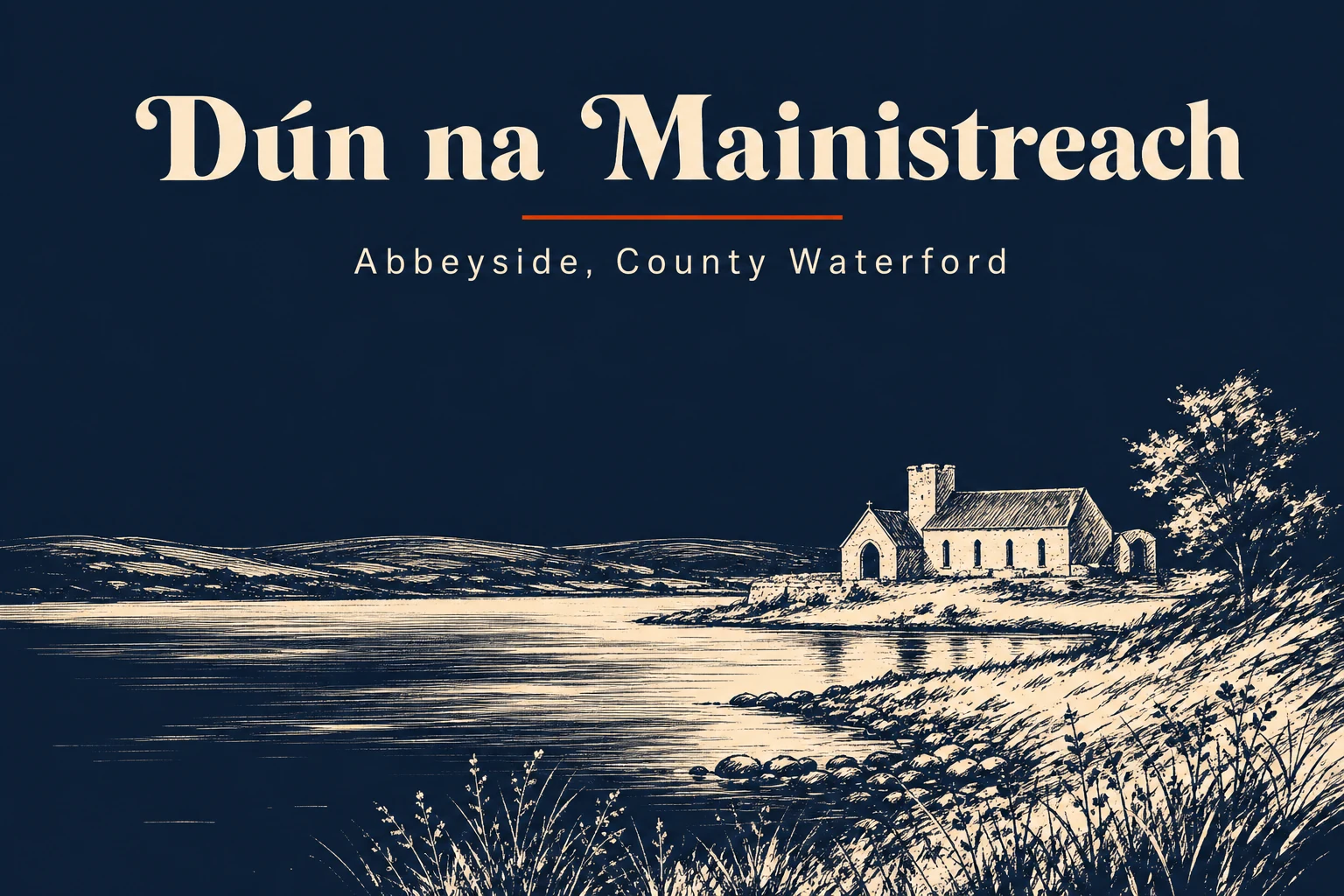
Dún na Mainistreach

The Wild Atlantic Way
STOP 04 / 06
Dún na Mainistreach · Co. Waterford

The east bank of Dungarvan, with the older bones and the Nobel laureate.

Abbeyside is the east-bank half of Dungarvan, across the causeway from the square. It is older than the planned town opposite — the Augustinians were here from 1290, two centuries before the Devonshire Dukes laid out Dungarvan as we know it. The town grew west, and Abbeyside became the suburb. The old name, Dún na Mainistreach, means the fort of the monastery, and the monastery is still here, in pieces, behind the Catholic church.

There is no separate centre to walk to. The single street of Causeway road runs in from the bridge, the GAA pitch and the housing estates spread inland behind it, and Walton Park sits down by the bay where the Greenway pulls in. Most days the only reason a visitor crosses the bridge is to start the cycle east, or to look at the friary ruins, or to sit on the promenade and watch Dungarvan watch you back.

Treat it as part of Dungarvan and you will not go wrong. Stay there, eat there, drink there, and walk over here for an hour to see the abbey, the tower, the McGrath tomb under the east window, and the small park where Ireland's only science Nobel got his name on a bench. Then walk back across the causeway for a pint.
Population
Counted within Dungarvan (~10,080, 2022 census)
Walk score
Across the causeway and you are in Dungarvan in five minutes
Founded
Augustinian friary, 1290
Coords
52.0900° N, 7.6189° W
01 / 06

At a glance.

Three things every local will eventually mention. Read these and you've already understood more than most day-trippers do.

02 / 06

Stories & lore.

The reason to come back. The things every local will eventually tell you about, usually after the second pint.

Founded 1290

The Augustinian friary

Friars from Clare Priory in Suffolk crossed the sea in 1290 and founded the friary here, on land patronised by Thomas FitzMaurice FitzGerald. They lived quietly for two and a half centuries until Henry VIII's suppression of the monasteries in the late 1530s and 1540s closed them down. The 13th-century chancel and the 60-foot square tower still stand at the back of the modern St. Augustine's Church — the tower was kept on as the belfry, which is why the nineteenth-century parish builders did not knock it down.

Under the east window

McGrath's tomb

A medieval McGrath tomb sits under the east window of the priory. The McGraths were a Gaelic family with land along this coast and a castle at the harbour mouth; the tomb is the family's main physical remainder in the town now. Bring a torch — the inscription is worn.

Born here, 1903

Ernest Walton

Ernest Thomas Sinton Walton was born in Abbeyside in October 1903, the son of a Methodist minister. He went on to Cambridge, and in 1932, with John Cockcroft, he became one of the first two people to artificially split an atomic nucleus. The 1951 Nobel Prize in Physics followed. He remains the only Irish person to win a Nobel for science. The Greenway's western terminus is named Walton Park in his honour, with a small monument by the path.

How the two halves were stitched

The Devonshire causeway

Until 1816 the only way across the Colligan was a ferry between Roderick's Quay and Abbeyside, or a long detour to a ford miles upstream. The 6th Duke of Devonshire, who owned most of Dungarvan, financed the bridge from 1808 — William Atkinson's original design, with Jesse Hartley brought in after Atkinson's abutments failed — and the work ran 1809–1816 at a cost in the region of £5,000. The single span and the long stone causeway on the Abbeyside side are what made Abbeyside a suburb instead of a separate village.

03 / 06

Things to do outside.

Wear waterproofs. Bring a sandwich. Tell someone where you're going if it's the mountain.

Walton Park & the Greenway terminus The Waterford Greenway pulls in here at Walton Park after 46 km from the city. Walk it for ten minutes for the bay view, or hire a bike in Dungarvan and ride the whole thing back the way it came. Tunnels, viaducts, the Comeraghs on one side, the Atlantic on the other.
Pick your distancedistance
30 min to a full daytime
The Cunnigar The Cunnigar is a 3 km sand spit reaching across Dungarvan Bay from the Ring side. To do the proper walk, drive round to the An Rinn entrance — a low-tide crossing direct from Abbeyside is occasionally done at festival times but it is not a marked walk and the tide is not negotiable.
About 6 km returndistance
2 hourstime
Abbeyside promenade & the friary Out from the causeway along the refurbished boardwalk, look across at the town and the harbour, then loop back inland to St. Augustine's Church to find the abbey ruins, the McGrath tomb and the medieval tower. A short loop, but it tells you most of what Abbeyside has to tell.
About 2 kmdistance
30 mintime
Clonea Strand Five kilometres east of Abbeyside, past Ballinacourty. Long flat strand, Blue Flag in summer, decent for a walk in any weather. The hotel at the end does coffee. The water is colder than it looks.
Beach as long as you want itdistance
However long you havetime
04 / 06

When to go.

There is no bad time. There are different times.

Spring
Mar–May

Quiet bay, long light, the boardwalk to yourself. The Greenway is at its best — bookable bikes, no coach traffic.

◉ Go
Summer
Jun–Aug

Dungarvan fills for the food festival and weekend visitors. Clonea car park is full by 11. Book restaurants on the town side.

◐ Mind yourself
Autumn
Sep–Oct

The Greenway is empty again, the harbour light goes amber, and the pubs across the causeway settle back into themselves.

◉ Go
Winter
Nov–Feb

Wind off the bay, half the tourist trade closed, the boardwalk wet. A bracing morning if you have the layers — but not a base, not in January.

◐ Mind yourself
05 / 06

What to skip.

Honestly? Don't bother.

If a local was sitting beside you, this is the bit where they'd lean in.

×
Looking for the Abbeyside town centre

There isn't one. The shops, the square, the restaurants and most of the pubs are across the causeway in Dungarvan. Treat Abbeyside as a half-hour visit, not a base.

×
Booking accommodation here as a separate destination

Search Dungarvan instead. You will get more options, you will be five minutes closer to dinner, and the postcode is the same place to a taxi driver.

×
Trying to walk the Cunnigar from the Abbeyside side

The marked entrance is on the Ring peninsula, not here. Drive round. The tide does not care about your itinerary.

+

Getting there.

By car

Abbeyside is the east bank of Dungarvan, on the N25 between Cork (1 hour) and Waterford City (45 min). Cross the causeway from the town square — you are in Abbeyside as soon as the bridge ends.

By bus

Bus Éireann routes serving Dungarvan stop on the town side; walk five minutes across the causeway. Expressway services run Cork–Waterford via Dungarvan several times daily.

By train

No train. Nearest station is Waterford Plunkett, then bus or taxi.

By air

Cork (ORK) is about 1 hour by road. Dublin is 3 hours via the M9 / N25.