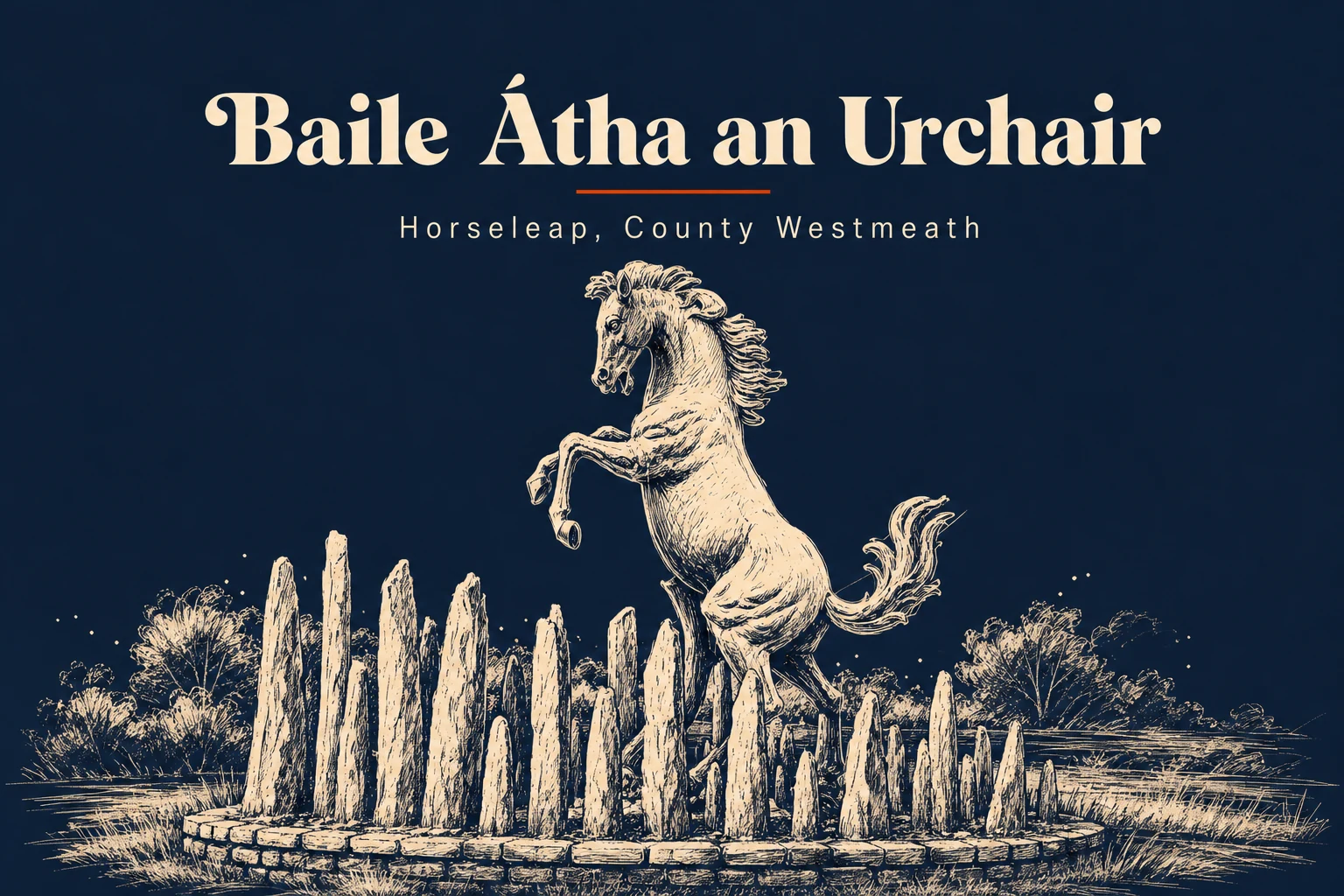
Baile Átha an Urchair · Co. Westmeath
A village named after a horse clearing a drawbridge, split down the middle by a county line, with the one pub in Ireland that sits in two counties at once.
Horseleap is a name first and a village second. You will pass through it in under a minute on the old N6, now the R446, between Moate and Kilbeggan, and if you know the story you will slow down, and if you do not you will not register the place at all. That is fine. The story, and the line on the map, are the reasons to stop.
Sometime in the 1190s the de Lacys, the Norman family who held the lordship of Meath, built a motte-and-bailey here on the edge of their territory, against the Mac Geoghegans whose country began on the next ridge. The motte is dated to 1192 and still sits at the edge of the village, partly slumped but plainly readable. The legend goes that a de Lacy, chased home by the Mac Geoghegans, found the drawbridge raised and put his horse over the moat to save his neck. The English name has stuck for eight centuries. The Irish name, Baile Átha an Urchair, the town of the ford of the cast, predates the Normans entirely. The old fort was called Ardnurcher, and the place was important enough to be a chartered borough by 1235 and to give its name to a battle in 1329 between the Butlers and the Mac Geoghegans.
The other thing worth knowing is on the Main Street. The Offaly-Westmeath county boundary runs straight through the middle of the village, and through the middle of the pub. Paddy Ryan's is widely reckoned to be the only pub in Ireland still sitting across a county line, the bar in one county and a few feet of the lounge in the other. There is a green with a twelve-foot bronze prancing horse on it, the subject of a tall tale about Ferrari and Eddie Irvine that does not survive contact with the facts but is told with a straight face anyway.
Come for five minutes or for one pint. Walk the rise where the motte is, stand with one foot in each county outside the pub, and read the name properly.