County Westmeath Ireland · Co. Westmeath · Moate Save · Share
POSTED FROM
MOATE
CO. WESTMEATH · IE

Moate
An Móta

The Ireland's Hidden Heartlands
STOP 07 / 07
An Móta · Co. Westmeath

A long Main Street, a Norman motte behind it, and three centuries of Quaker thrift in the brickwork.

Moate is a long market town strung along the old Dublin–Galway road, halfway between Athlone and Mullingar. The Normans built the motte in the twelfth century, the Quakers built the wealth in the seventeenth, and the N6 bypassed the lot of it in 2008. The bypass was the best thing that ever happened to Main Street — the trucks went away and the town came back.

What you need to know: the Quakers are the story. Friends from Tipperary settled here in the 1650s, the Clibborn family built a meeting-house in 1692 and made the town a centre for woollens and frieze cloth. The meeting-house is a ruin now, but it's still there, and the burial ground beside it is still legible. A handful of plain-fronted Quaker houses sit on Main Street — once you know what to look for, you can't unsee them.

Don't come for a checklist. Come for an afternoon. Walk the Main Street, find the motte, drive out to Dún na Sí for the folk village and a turn around the lake, then back to town for a pint. If it's the last Sunday in August, the Agricultural Show is on — 182 years of bullocks, baking and bunting. If it's any other day, it's a working town doing what working towns do.
Population
3,013
Walk score
Long Main Street, twenty minutes end to end
Founded
Norman motte, late 12th century
Coords
53.3933° N, 7.7167° W
01 / 07

At a glance.

Three things every local will eventually mention. Read these and you've already understood more than most day-trippers do.

02 / 07

Where to eat.

PlaceTypeLocal note
Savoury Fare Café & restaurant €€ Opened in 2025 in the foyer of Tuar Ard Arts Centre. Fourth outlet for the Athlone-based pair Des Hennelly and Rory Currid. Day-only, Athlone standards in a Moate room.
Par3 Bar & Restaurant Restaurant at the golf club €€ Upstairs at Moate Golf Club, opened September 2020. Open to the public, not just members. Tuesday to Sunday from 10am, hearty breakfasts, view of the back nine from the balcony.
Tuar Ard Coffee Shop Café Inside the arts centre. Soup, sandwich, scone, the standard. Useful before a show.
03 / 07

Where to sleep.

PlaceTypeLocal note
Grand Hotel Moate Hotel Fourteen en-suite rooms on Main Street. Run by the Claffey family for over thirty years. Bar food, A la carte, function room. Not grand in the way the name suggests — grand in the Irish way, meaning it'll do you fine.
04 / 07

Stories & lore.

The reason to come back. The things every local will eventually tell you about, usually after the second pint.

The mound and the princess

Móta Ghráinne Óige

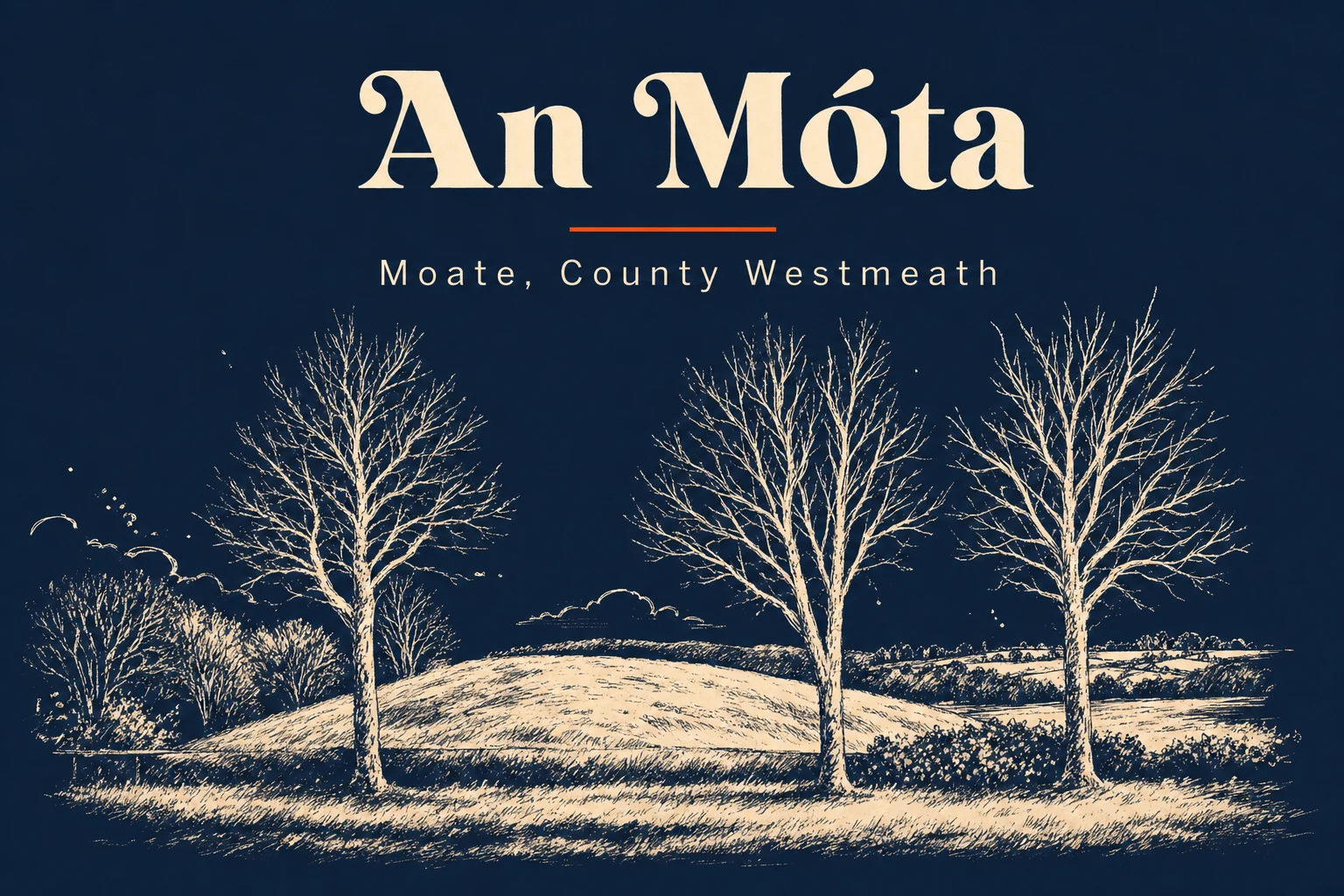
The town's full Irish name is Móta Ghráinne Óige — the mound of young Gráinne. The legend has her as a Munster princess; the archaeology has the mound as a Norman motte-and-bailey, thrown up in the late twelfth century to hold the country between the Shannon and the bogs. Whichever story you prefer, the earthwork is still there behind the Main Street buildings, and the town wears its name on it.

Friends, frieze and a meeting-house

The Quakers

Friends from Tipperary settled in Moate in the 1650s. The Clibborn family — landlords of Moate Castle — converted to Quakerism in the 1680s and built a meeting-house at their own expense in 1692. Quaker industry followed: woollen mills, frieze, felting, a bakery, a brewery. By 1700 Moate was wealthier than the towns around it. The meeting-house was rebuilt in 1768 and largely demolished c.1930, but the surviving walls and the burial ground beside it are still on the Castle grounds. Plain-fronted Quaker houses still line parts of Main Street if you know to look.

The fort of the fairies

Dún na Sí

Dún na Sí — the fort of the fairies, named for fairy bushes that once marked a ringfort on the site — is a 27-acre amenity park on the edge of town. Folk-village style: a recreated forge, hedge school, fisherman's cottage, ringfort, dolmen, stone circle. The Comhaltas Teach Cheoil on the grounds runs classes in trad music, sean-nós dancing, set dancing and singing year round. You can spend a morning here without trying.

182 years of bullocks and baking

The Moate Show

The Moate Agricultural Show is one of the oldest in Ireland — the 2025 edition was the 182nd hosting. Last Sunday in August, on the showgrounds off the Old Dublin Road. Cattle, sheep, horses, dogs, baking, jam, vegetables, vintage cars. The kind of country show where the entries take longer to judge than the day takes to run, and the rosettes mean something to the people who get them.

05 / 07

When to go.

There is no bad time. There are different times.

Spring
Mar–May

Quiet. Dún na Sí is at its best — the woodland and turlough waking up. Tuar Ard runs a steady programme through to summer.

◉ Go
Summer
Jun–Aug

The Moate Show is the last Sunday in August and is the day to be in town. Long evenings, country lanes worth a cycle.

◉ Go
Autumn
Sep–Oct

The town's own season. Markets pick up, the arts centre programme heats up, the bypass keeps the trucks off Main Street.

◉ Go
Winter
Nov–Feb

Quiet. Tuar Ard runs a Christmas season and the Grand keeps a fire going. Otherwise it's a working town in its working clothes.

◐ Mind yourself
06 / 07

What to skip.

Honestly? Don't bother.

If a local was sitting beside you, this is the bit where they'd lean in.

×
Treating Moate as a stop on the way to somewhere else

It's a working town, not a service station. If you only have twenty minutes, you'll see twenty minutes of Main Street. Give it half a day or skip it entirely.

×
The N6 dual-carriageway view of the place

The motorway misses the town by design. Pull off at Junction 5 and drive the R446 — the original road through — to see what the bypass replaced.

×
Hunting for an intact Quaker meeting-house

The 1692 meeting-house was largely demolished c.1930. What remains is a ruin in the Castle grounds with the burial ground beside it. Read it for what it is, not what you wished was still standing.

×
Assuming the motte is Iron Age

It's Norman — late twelfth century, motte-and-bailey, built to hold the line. The Iron Age claim is folklore. The folklore is still worth hearing.

+

Getting there.

By car

Off Junction 5 of the M6, 12km east of Athlone, 30km west of Mullingar. Dublin is 1h 15m, Galway is 1h.

By bus

Bus Éireann services on the Dublin–Galway corridor stop in Moate. Citylink and GoBus pass through on the M6 — you want the local stopper, not the express.

By train

Nearest station is Athlone (12km), on the Dublin–Galway line. Then taxi or the local bus.

By air

Dublin Airport is 1h 30m. Shannon is 1h 30m the other way. Knock is 1h 45m north.