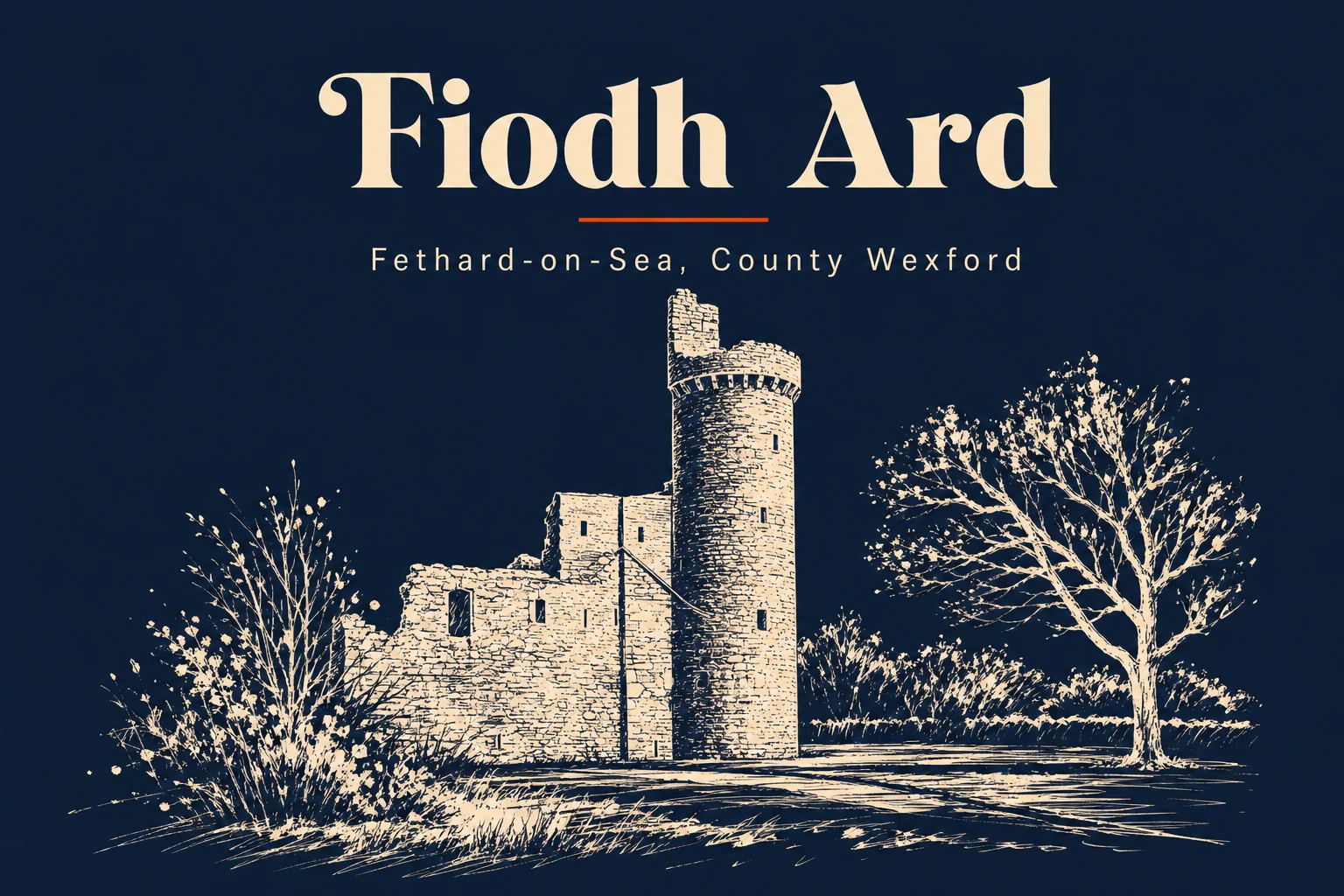
Fiodh Ard · Co. Wexford
A Hook Peninsula village with a Norman lighthouse, a medieval ruin, and one bad summer in 1957 it has not forgotten.
Fethard-on-Sea is the only proper village on the Hook Peninsula - a long thumb of farmland, cliff and Norman ruin sticking out into the Celtic Sea between the Suir and the Slaney. Three hundred-odd people, one main street, a square, a couple of pubs, a handful of B&Bs. Do not confuse it with the other Fethard, the one in Tipperary that has the Coolmore stallions. This Fethard has the lighthouse.
And the lighthouse is the thing. Hook Head, five kilometres south of the village, has been guiding ships into Waterford Harbour since the early thirteenth century. William Marshal - knight, regent, the most powerful man in early Norman Ireland - had the tower built between roughly 1210 and 1230 to bring trade up the estuary to his new town at New Ross. The walls are four metres thick at the base. The light keeps turning. You can walk in, climb 115 steps, and come out on the parapet with a view that has not changed since the lifecycle of the building includes monks, Cromwell, Marconi and a fairly recent automation.
The other big stop is Tintern Abbey, four kilometres north, sitting in its own woodland on Bannow Bay. Cistercian, founded around 1200 by the same William Marshal - this time on the back of a storm-vow at sea - and run since the 1960s by the Office of Public Works. Down the road from that, Fethard Castle in the village itself: a ruined fifteenth-century tower house once used as a summer residence by the Bishops of Ferns, later swallowed by the Loftus family who built a much bigger and stranger house further south. That house - Loftus Hall, Ireland's most-told ghost story - sits closed in 2026, awaiting the next owner's plans for a hotel. Treat the ghost-tour signs you may still see on the road as historical.
There is one harder thing to say about this village, and it is worth saying clearly. In the summer of 1957, after a Catholic farmer's Protestant wife refused to send their children to the Catholic school and took them away, the local Catholic clergy organised a boycott of Protestant businesses in Fethard. It lasted four months. A music teacher lost eleven of her twelve pupils. Two shops lost their custom. De Valera condemned it from the Dáil. The Bishop of Ferns apologised in 1998. It is a quiet village now, and the row is sixty-eight years gone, but the episode is part of the historical record and worth knowing about before you arrive.